
Winter Christmas trees drift from spare minimalist silhouettes with fifteen ornaments total to dense wonderland drifts needing twenty per foot, and the deciding factor is how long you intend to keep the tree standing. A flocked tree photographed for January stays, a red-and-white scheme comes down. The fifteen-to-twenty count is not approximate; on a six-foot pencil tree, it is the wall between statement and clutter.
1. Winter Wonderland Tree
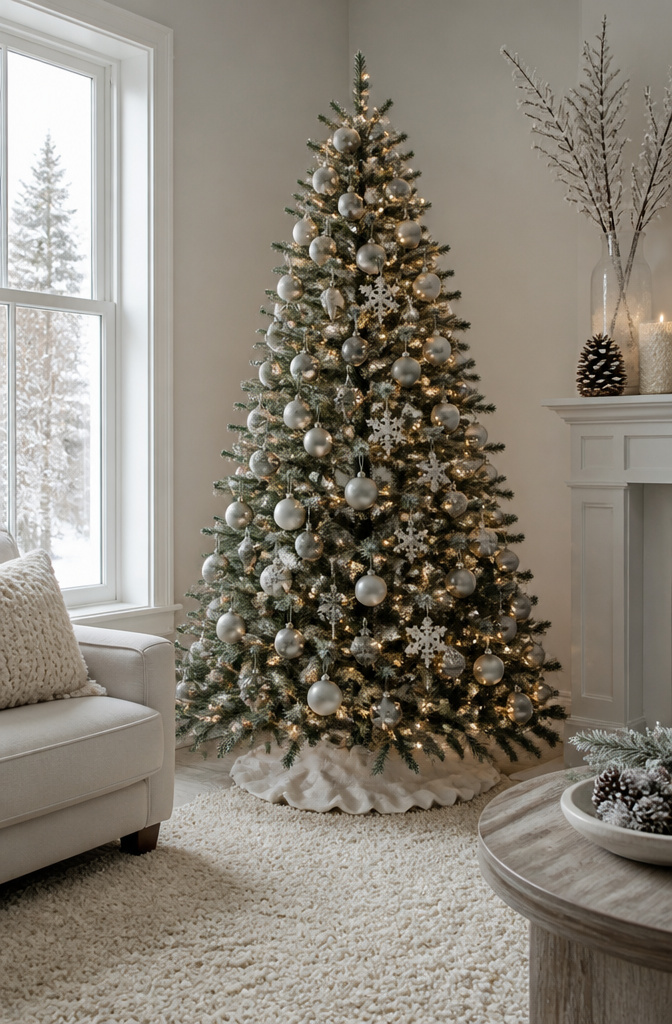
White and silver ornaments catch light the way fresh snow catches morning sun, and that mimicry is the whole point of a winter wonderland tree. The palette reads cold and quiet, which feels right for January evenings when the holidays are past but the tree still stands.
I learned the density rule the hard way after a sparse year that looked half-finished in photos. Fifteen to twenty ornaments per foot of tree gives the weightless, drifted look this scheme needs; much less and the branches show through like bare ground, much more and the silver starts to read as clutter. The count is a guideline, not a mandate. A slim pencil tree at six feet wants the low end, a full Fraser Fir at nine feet can carry the top of the range or slightly past it. What matters is checking the tree from the room’s entry point, where you’ll actually stand to look at it, rather than circling with your nose in the branches.
2. Rustic Christmas Tree
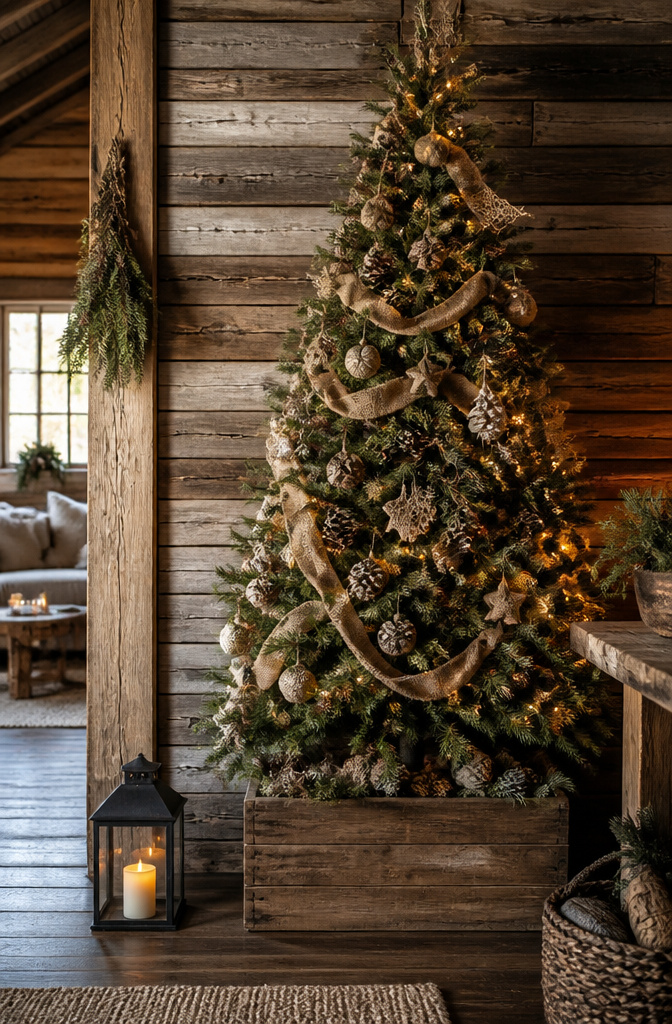
Pine cones, burlap ribbon, and twine give a tree the kind of texture that reads as winter rather than holiday party. I keep a paper bag in the mudroom from November on and add cones on dog walks, the ones that are still closed tight and haven’t been sitting in wet grass long enough to mold. A quick rinse and a low oven dry, and they’re ready to use raw or hit with a light coat of white or metallic paint. The raw ones read more authentic; the painted ones catch light from strands after dark.
Burlap ribbon, not sheet burlap, is what you want for a tree. The ribbon has finished edges that don’t shed fibers onto the carpet every time someone brushes against a branch. Sheet burlap is cheaper by the yard but frays itself into a mess by New Year’s. Twine works for hanging the lighter cones or for wrapping the trunk where the stand still shows, and it costs about what you’d spend on a single ornament at a big-box store.
The woodland trend that’s been building means craft stores are full of fake acorns and berries now. The real thing from your own yard looks less staged and costs nothing but the walk.
3. Snowy Christmas Tree
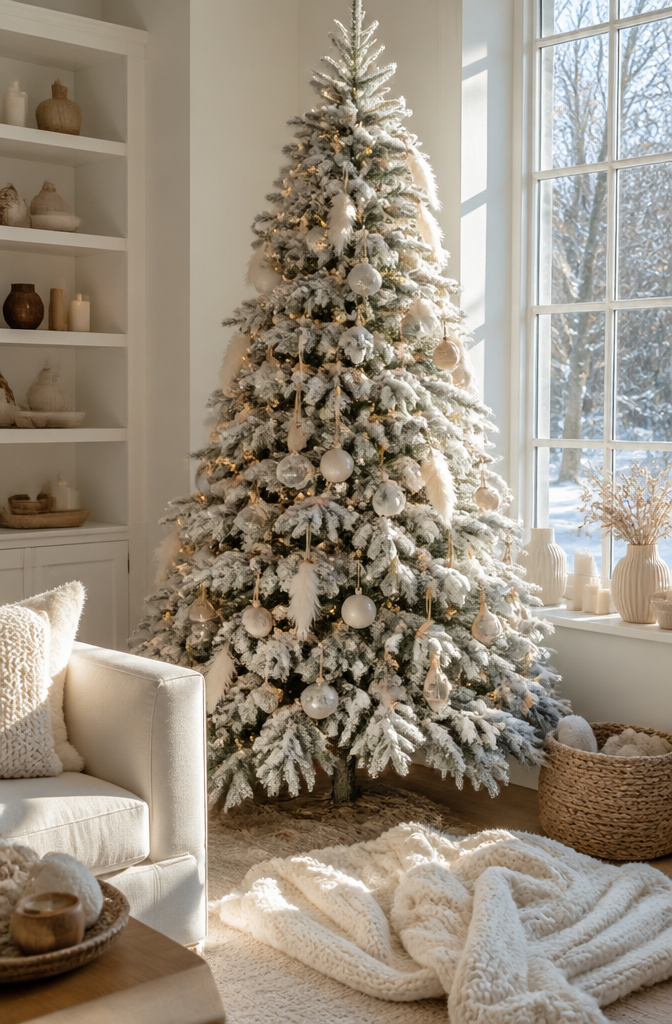
A can of faux snow spray covers a six-foot tree in about fifteen minutes, but the overspray drifts onto floors and window sills and stays tacky for hours. Flocking powder, the kind you mix with adhesive and blow through a mesh sieve, gives a heavier, more dimensional coating that looks closer to real snow caught on branches. The tradeoff is cleanup: spray washes off with warm water, while flocking bonds to needles and sheds white dust for two or three seasons after.
White ornaments and cream-colored accents read as winter without fighting the snow effect. Feathered picks and raw wood shapes tucked into the branches keep the palette from going flat, since an all-white tree in artificial light can look like a single glowing blob. The flocked tree I keep coming back to in my own browsing uses exactly that mix: snowy branches, cream bulbs, a few bleached pinecones, nothing that competes with the texture.
If you rent or swap themes year to year, spray wins for reversibility. Flocking commits you; the residue clings even after you box the tree, and landlords notice. For a tree you own and plan to store as-is, the powder application lasts longer and photographs better in daylight, which matters if you are posting the result anywhere the Pinterest side of this search will find it.
4. Vintage Christmas Tree
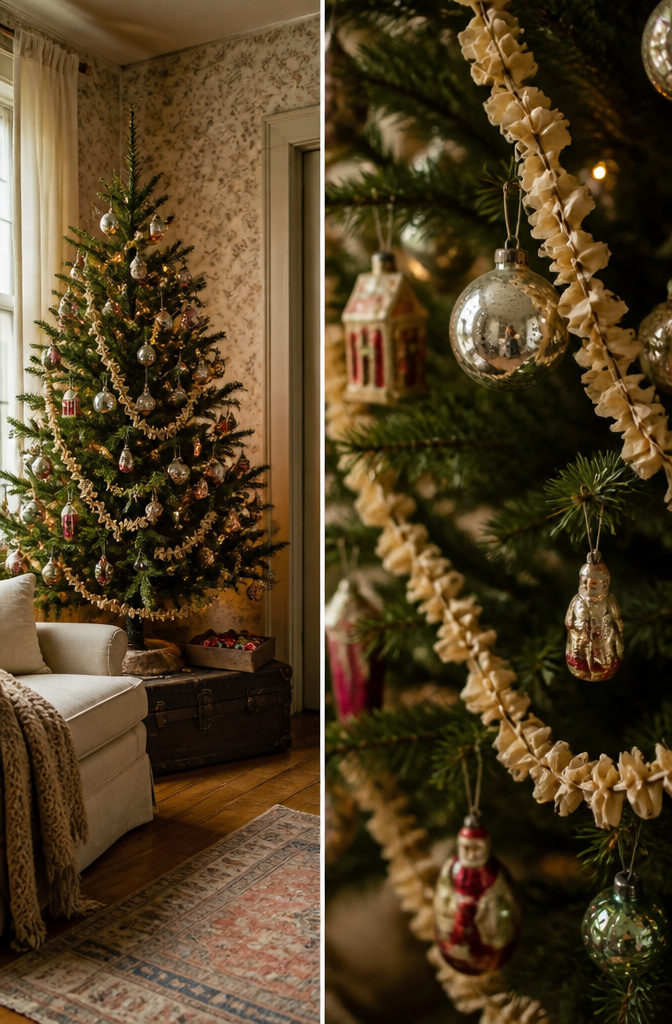
Mercury glass catches light the way old department-store windows used to, and that is the first thing that reads as vintage on a tree. Real mercury glass ornaments, the kind with silvering worn thin at the edges, turn up at estate sales and flea markets for a few dollars each if you arrive early. The personal attachment builds itself: the chip on one bauble from someone’s attic in Ohio, the paper label still clinging to another. I have seen sellers price them higher at antique malls, but the hunt at weekend markets is half the point and the price is usually half too.
Paper garlands are easier to make look old than to find old. Coffee-stained strips of sheet music or book pages, cut with pinking shears and run through a sewing machine, drape soft and already yellowed. Actual vintage paper garlands crumble; the new ones survive packing. Spend the money on real mercury glass, fake the paper is the balance that works for a tree you will unpack ten more times.
Wooden figures, especially the flat German-style silhouettes, bridge the two approaches. Flea market finds carry the grain and paint wear no reproduction matches, but unfinished cutouts from craft stores take stain and a light sanding to pass at middle distance. The inherited ornament, the one your grandmother’s neighbor pressed into your hand, does not need to match anything. It sits near the top where the light finds it, and the story is the decoration.
5. Blue Frosted Christmas Tree
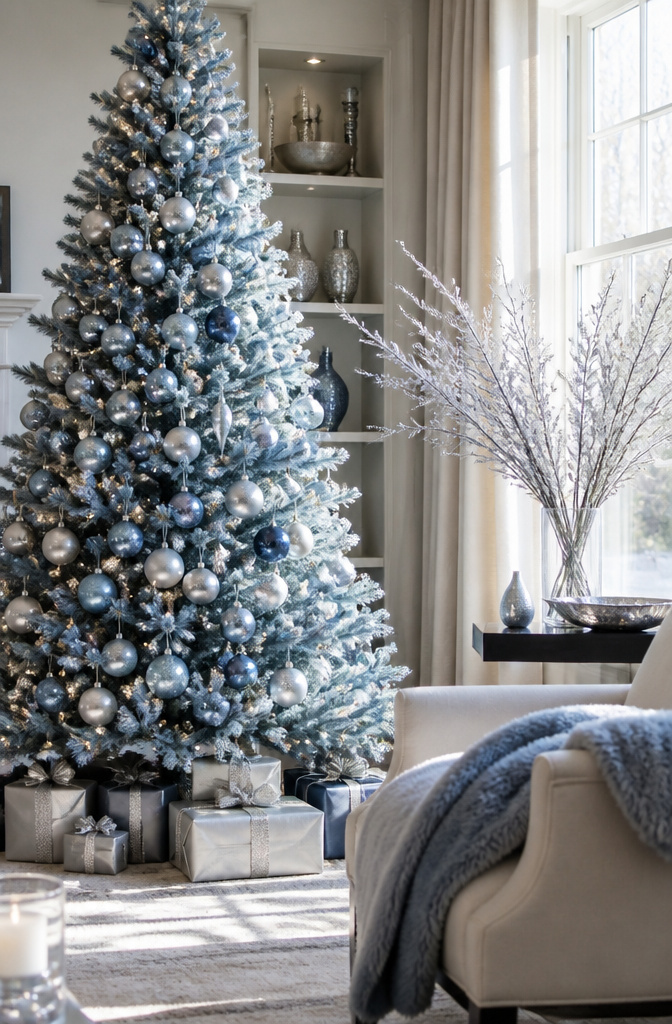
A blue frosted tree lives or dies on the ratio, and 60/40 blue to silver is the split that reads winter instead of something else. I learned this the hard way the year I went heavier on silver and the whole thing looked like a New Year’s Eve party leftover. Too much blue, especially past 70 percent, and the tree turns into a coastal bedroom; too little and the frost effect disappears.
The blue itself matters as much as the proportion. Navy goes dark fast under warm indoor lights and starts reading almost black in corners. Ice blue, the pale almost-white shade, carries the frost idea without fighting the silver for attention. Teal sits in a tricky middle space: in daylight it reads winter, but at night with tree lights it can shift toward tropical, which is not the mood you are building.
Silver goes on the reflective pieces, the balls and icicles that catch light, while blue covers the matte shapes and the larger forms that give the tree its volume. That distribution keeps the eye moving between depth and sparkle without either one taking over. If you have a strand of cool-white lights already, the ice blue plus silver combination turns almost luminous; warm lights push everything toward turquoise, which is where that coastal slip happens.
6. Whimsical Christmas Tree

A whimsical tree earns its name by breaking the rule that every other style on this list enforces: the color lock. Where winter wonderland demands white and silver or rainbow insists on spectrum order, this one lets a felted wool narwhal hang two branches from a blown-glass pickle if both make you grin. The permission is the point. What separates charming from chaos is spacing. Oddball ornaments read as deliberate when the eye has room to land on each one, so cluster no more than three busy pieces within arm’s reach; let plain matte balls or bare branch gaps do the resting. Heavier pieces, the ceramic dinosaurs and cast-resin mushrooms, need more than a standard hook. Floral wire twisted through the hanger and looped around the branch twice, or a short length of pipe cleaner cinched tight, keeps them from nose-diving into the carpet. I have seen a tree collapse an entire limb under a single pound of brass because the owner trusted the factory hook. The work-around takes forty seconds and costs nothing from the junk drawer. That freedom to mix is what makes this style survive a real budget: the narwhal came from a niece, the pickle from a gas station, and neither required a $14 coordinating accent piece to earn their spot.
7. Minimalist Christmas Tree
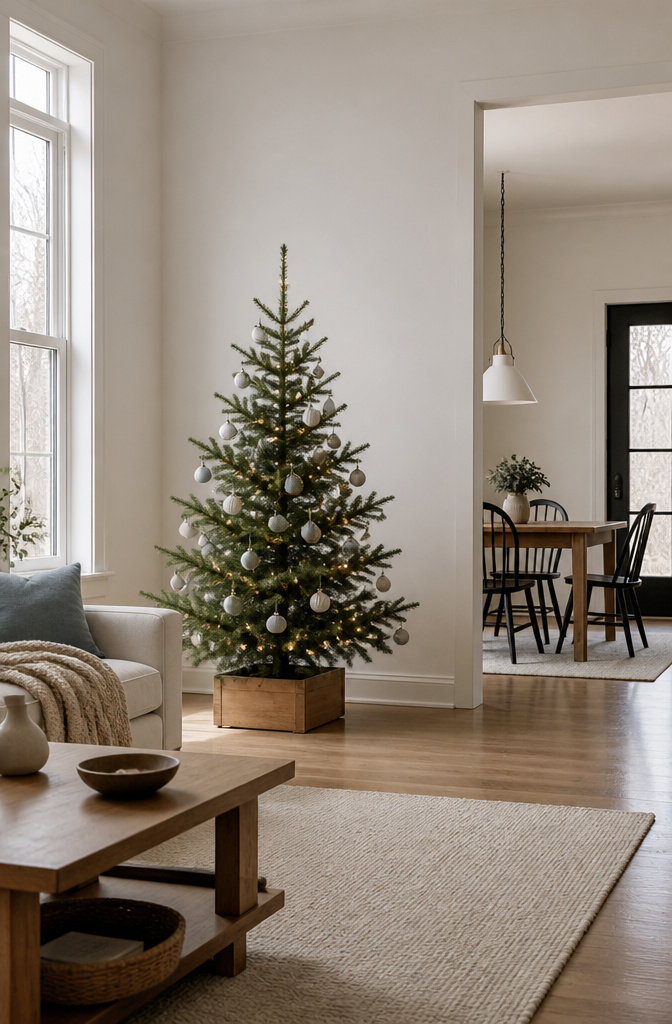
A minimalist winter Christmas tree lives or dies by what you leave off. The discipline is stopping at 15 to 20 ornaments total, no matter how full the branches look. Empty space becomes part of the design; the gaps between ornaments let the tree’s shape read as intentional rather than unfinished.
Single-color or dual-color restriction is the usual route. Two main colors and one accent pulls everything together without the visual noise of a mixed bag. A white tree with pale blue and a single silver accent reads winter without shouting it. The same logic works on green: deep blue ornaments with a warm wood tone, nothing else.
The mistake most people make is adding "just one more" ornament to fill a gap. That gap was doing work. Once you pass twenty, the eye stops resting anywhere and the tree becomes a collection instead of a statement. Count as you hang, and when you hit fifteen, step back. If the silhouette still feels right, you are done.
8. Rainbow Christmas Tree

A rainbow tree reads as winter cheer rather than summer carnival because of the shape itself: the triangular silhouette and the warm glow of string lights ground all that color in December tradition. Two approaches split the difference between orderly and playful. A true ROYGBIV gradient, read top to bottom or spiraled outward, takes patience but gives a stained-glass effect when the room lights dim. Color-blocked clusters, four to six ornaments of one hue grouped like fruit, read bolder from across the room and forgive a thinner collection since each band needs fewer pieces to register.
Sourcing enough colors without a shopping trip means raiding what you already own first. Most households accumulate ornaments in waves: a few red years, a blue phase, the metallic set from a sale. Lay them out on a neutral sheet to see what you actually have before deciding which gaps matter. Filler balls in missing hues run cheap at drugstores and craft chains after Black Friday, or a can of spray paint in a well-ventilated garage turns last year’s rejects into the orange or violet you need. The paint flakes eventually on plastic, but one season is all a rainbow tree promises anyway.
9. Botanical Christmas Tree
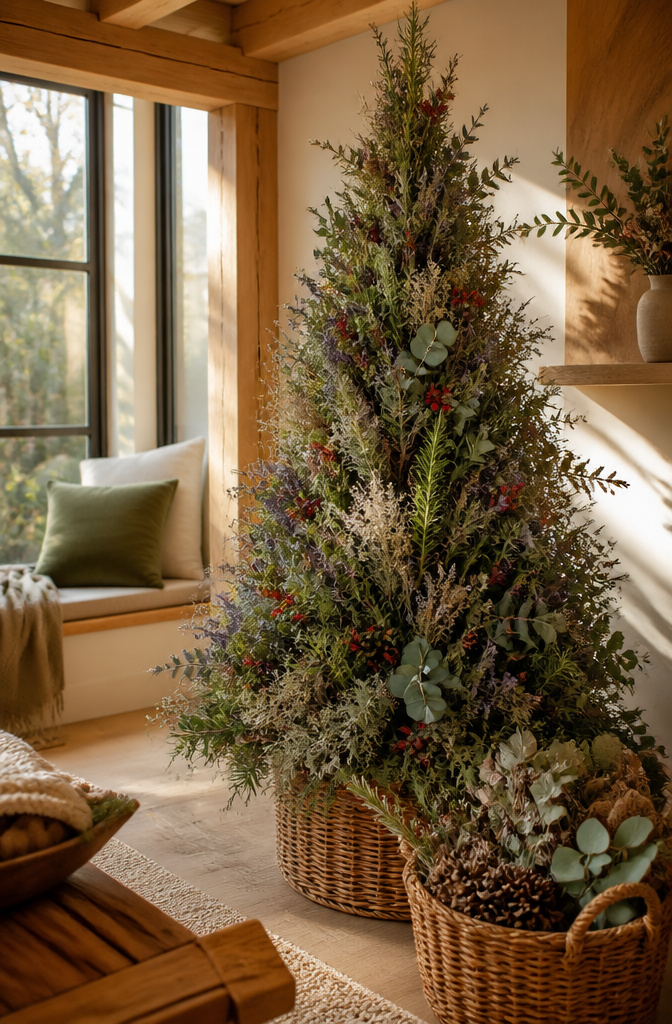
A botanical Christmas tree built from real plants is the least common winter approach, which also makes it the most memorable. Dried lavender, eucalyptus, and rosemary will hold their shape and scent through a week without water, and dried seed pods from lotus or banksia add structure that reads almost like ornamentation. Fresh boxwood or holly looks lush for a day, then sags where the stems dry out, so build the base with the sturdy stuff and use fresh greenery only as filler you replace.
Weight becomes a problem fast. A branch of fresh cedar weighs several times what a glass ball does, and it loads the outer tips where the tree is weakest. Wire heavier pieces to the trunk or a strong interior branch, not to the needle tips that bend under the load.
Fire safety matters more here than with any other winter tree idea. Dried eucalyptus and lavender contain oils that burn readily, and the open heat from old incandescent mini-lights can push them past the flash point. LED strings run cool enough to touch, which is the only kind to use with botanical material. Keep a spray bottle handy, mist the greens every other day, and never leave the tree lit unattended.
10. Candy Cane Themed Tree
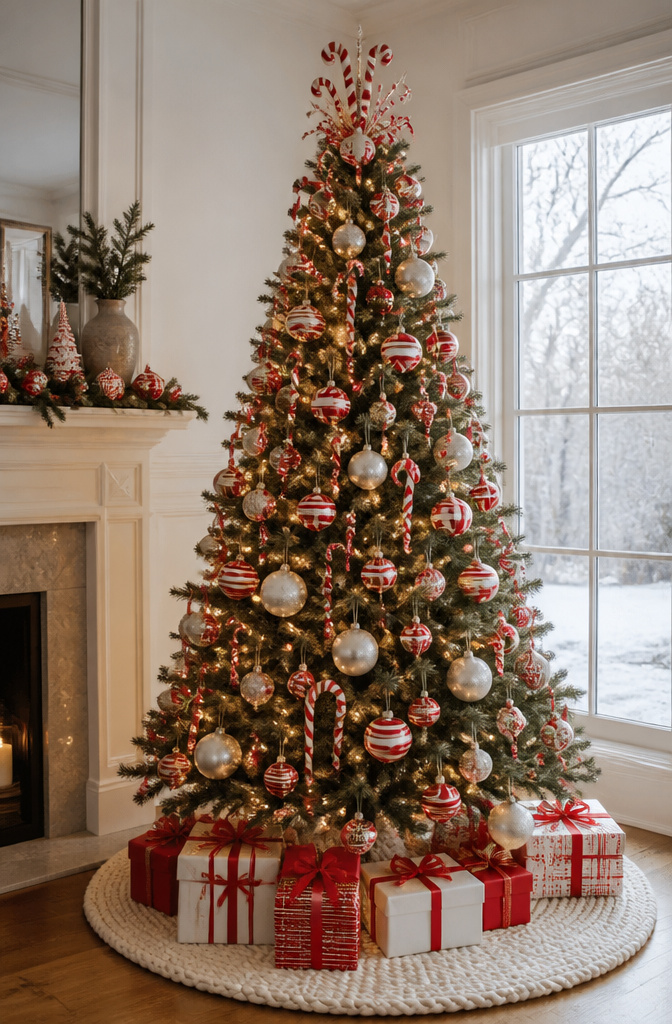
Red and white stripes read as generic Christmas faster than almost any palette, so the winter tilt matters from the first ornament. Silver is the easiest shift: matte ball ornaments in brushed metal, or thin garlands that catch low afternoon light the way ice does. Bare wood works too, especially birch disks or unfinished bead strands, because their pale tone and rough surface suggest a tree stripped by cold rather than wrapped for presents.
Actual candy canes on a tree look charming for about forty-eight hours. The humidity near a living tree softens the hook, the dye bleeds if anything touches it damp, and in warm rooms you will eventually find ants. Faux candy canes solve all of this. The plastic or resin ones sold in craft stores keep their stripe crisp, weigh almost nothing on branches, and hang straight without the sag of real sugar. I have seen paper-wrapped wire shapes that bend to hook over twigs, though they read more handmade and less glossy.
If you already own a load of red ornaments, clustering them with white lights and silver rather than gold keeps the scheme from sliding into standard holiday territory. The test is whether the tree still looks right in January; silver and wood pass, gold does not.
Color Schemes That Read as Winter
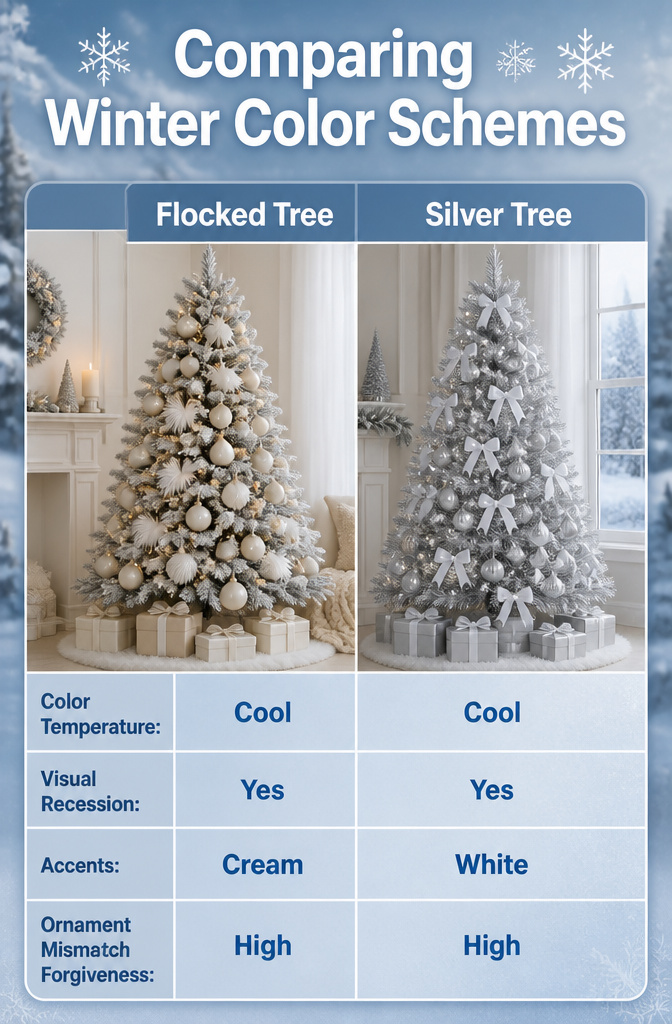
White, blue, and silver dominate winter tree palettes for a reason that has little to do with snow itself. Cool colors recede visually; they push back against the eye the way a January sky pushes against the horizon. Warm colors do the opposite. Red and green advance, which is why a traditional Christmas tree reads as immediate, almost aggressive, holiday. They do not suggest winter; they announce Christmas alone.
The flocked tree dressed in cream ornaments and feathered accents, or the silver tree hung with white bows, both work because they borrow that receding quality. They let the room breathe. A blue and green tree, or one loaded with gold and bronze, still registers as festive, but the temperature shifts. Blue keeps the winter note where green drifts back toward evergreen and gold tilts into candlelight warmth.
For a renter or first-home owner working a weekend timeline, this choice matters practically. A cool palette forgives mismatched ornaments, distance between branches, lights that are not perfectly dense. The eye travels less, expects less, settles faster. Warm palettes demand precision; every red ornament competes with its neighbor. Start with white or silver as the base, add one cool accent, and the tree looks intentional without the hours of fussing that intention usually costs.
Materials and What They Cost

Faux snow spray runs about $8–$12 a can at Michaels and covers roughly a six-foot tree if you are sparing with it. Pine cones in mesh bags sit near the floral aisle for $6–$10, though the same bags often drop to half price after Thanksgiving. Burlap ribbon by the roll and jute twine spools live in the craft section at Target, usually $4–$7 each, and one roll of either will wrap a tree twice over. Traditional glass ball sets in red, green, or gold start around $15 for 50 pieces at Target or Amazon, with shatterproof plastic climbing to $25–$35 for comparable counts.
What convinced me, reading through a dozen of these winter tree write-ups, is that the whole look lands under $80 if you pick two textures and repeat them rather than buying one of everything. The trap is the filler aisle: snowflake picks and glitter branches at $3–$5 each add up fast, and three of them cost more than your entire burlap-and-cone base. My limit for a weekend tree refresh is $120, which leaves room for one splurge, usually a wired garland that actually holds its shape.
DIY Decorations From What You Have
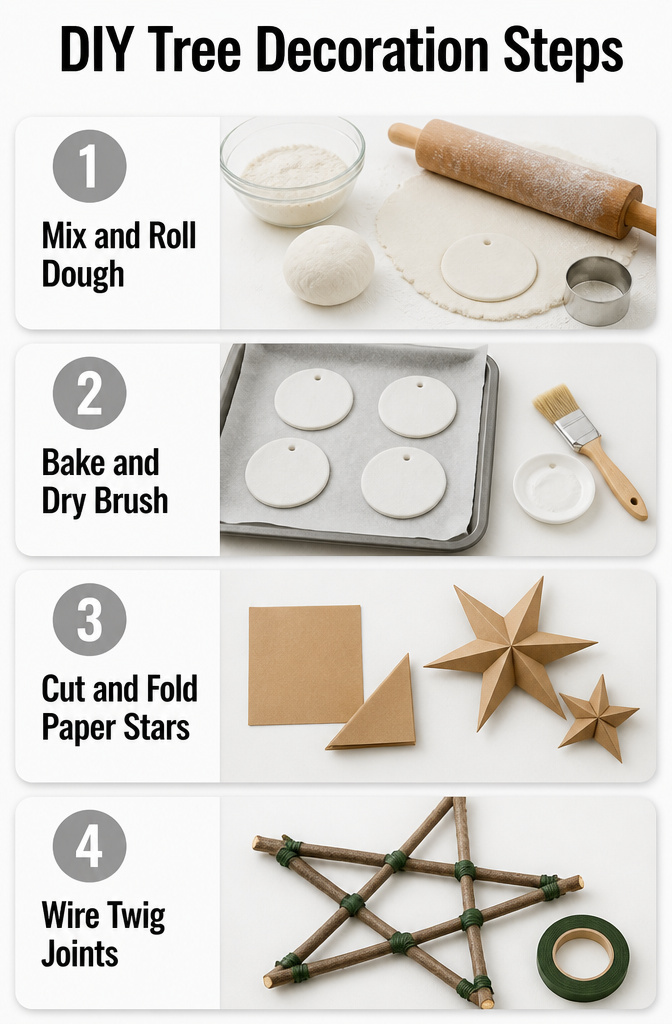
Most holiday craft roundups call for DIY decorations without telling you how long they actually take or where they fall apart. I’ve made three that work on a real weekend, and I’ve broken enough salt dough to know the limits.
Salt dough ornaments painted matte white take about two hours total: one to mix and roll, another to bake and dry-brush with acrylic. The dough cracks if you roll it under a quarter inch, and the fourth batch I made proved it. Thicker disks dry slower but survive the oven and the storage box.
Paper stars from brown grocery bags need twenty minutes once you have the creases down. The paper holds a crisp fold better than construction paper, and the color reads as birch bark against white lights. I make them in two sizes and cluster the smaller ones inside the larger.
Twig stars from pruned branches are the slowest at roughly an hour each, mostly spent wiring joints with floral tape. Any straight hardwood twig works; I use maple trimmings from the yard. They shed a little bark the first week, so I shake them outside before hanging.
All three cost nothing but time, and all three look deliberate rather than desperate. That matters when the tree is the only decoration in a small rental living room.
Sustainability Notes
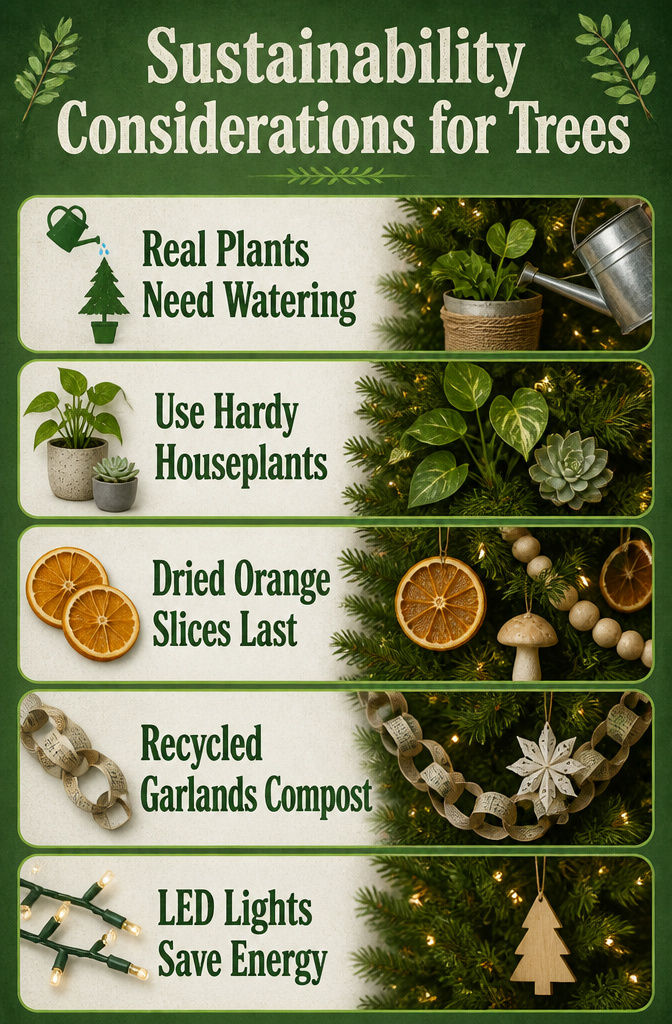
Real plants on a Christmas tree sounds romantic until you count the waterings. The sources that pull it off use hardy houseplants tucked into the branches, not delicate blooms: think pothos cuttings or small succulents that tolerate dry air for a week. Bradley Odom’s greenhouse tree went further with dried orange slices, faux mushrooms, and simple wood garlands. Those dried slices and found-wood ornaments last multiple seasons if you store them in a paper bag, not a sealed bin where moisture warps them.
Recycled paper garlands are the opposite: they compost after one season, which is the point. Twist strips of newsprint or last year’s wrapping paper into chains, run them for January, then shred them into the pile. LED lights pair with either approach and draw a fraction of the wattage of incandescent strands, though the sources don’t quote the savings and neither will I.
The Earth Day tree concept, flowers and blue ornaments and all, translates straight to winter if you swap the palette: white paper, bare wood, and the green of living plants against the dark of early evenings. What fails is trying to keep real flowers crisp past New Year’s. The photophile houseplants in one source, the ones that love bright light, need that light to stay presentable. A tree in a dim corner kills them faster than the holidays pass.
Frequently Asked Questions
What are some unique winter Christmas tree ideas?
Ten distinct styles work well: Winter Wonderland with white and silver, Rustic with pine cones and burlap, Snowy with faux snow or flocking, Vintage with mercury glass, Blue Frosted at a 60/40 blue-to-silver ratio, Whimsical with mismatched oddball ornaments, Minimalist with just 15 to 20 pieces total, Rainbow with color-blocked clusters, Botanical with dried plants and herbs, and Candy Cane with red, white, and silver accents. Each reads as winter rather than generic holiday depending on palette and materials.
How do I decorate a winter-themed Christmas tree?
Start with a cool palette of white, blue, or silver as your base, since those colors recede visually and read as winter. Add natural elements like pine cones, burlap ribbon, or dried eucalyptus for texture, and use LED lights for safety with any botanical materials. For a full look, hang 15 to 20 ornaments per foot of tree, checking from the room’s entry point rather than up close.
What color scheme is best for a winter Christmas tree?
White, blue, and silver dominate because cool colors recede the way a January sky does, letting the room breathe. Blue keeps the winter note intact; green drifts toward evergreen and gold tilts into candlelight warmth. A 60/40 blue-to-silver split reads as frost, while all-white or cream with wood accents avoids the flatness that comes from a single tone without variation.