
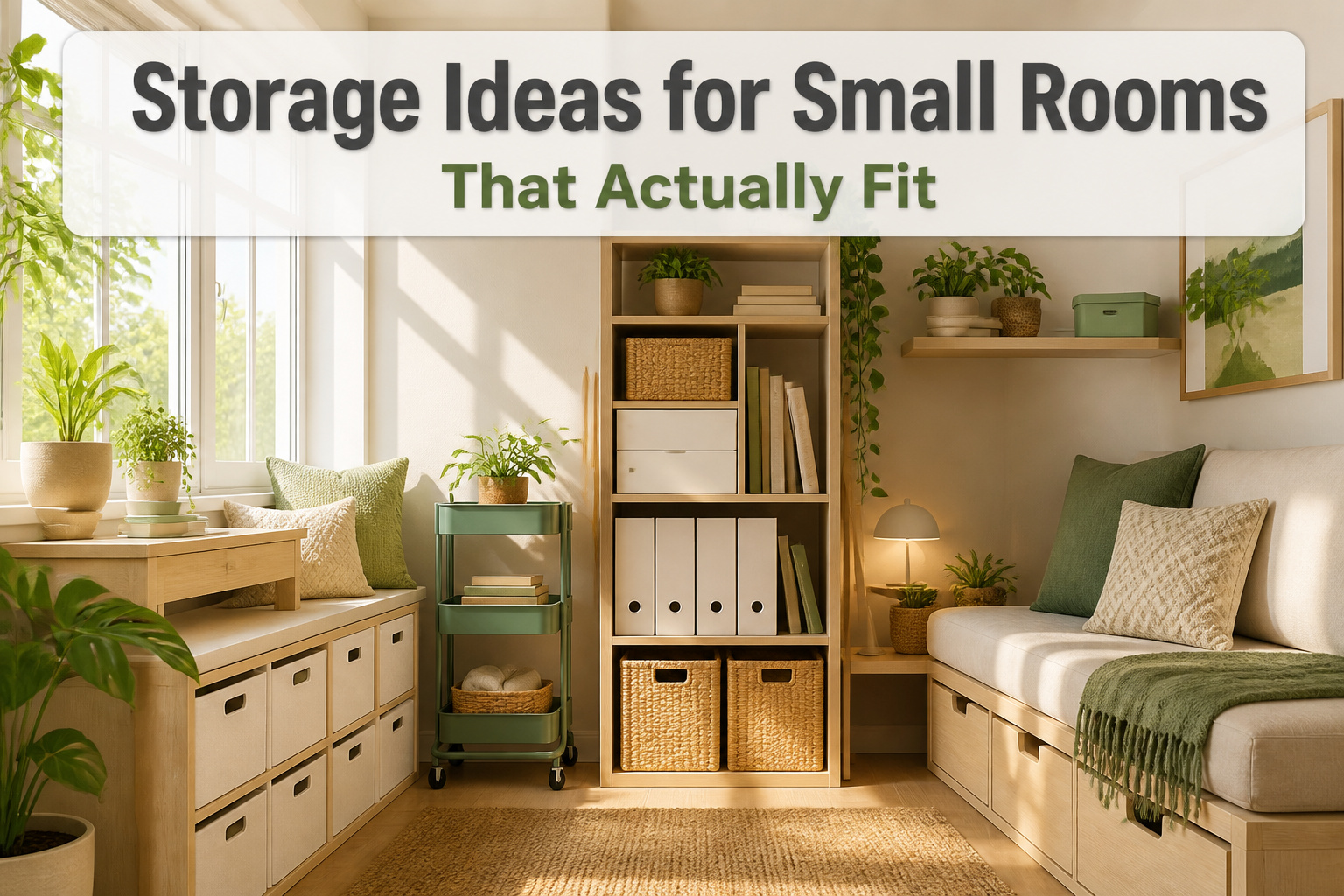
The right storage idea for a small room depends on what you are willing to mount, roll out, or build around. A floating shelf at 12 inches deep holds everyday clutter without stealing walkway, but that same shelf becomes furniture in a room under 10 feet wide. The difference is the measurement, and most people skip it.
1. Vertical Space
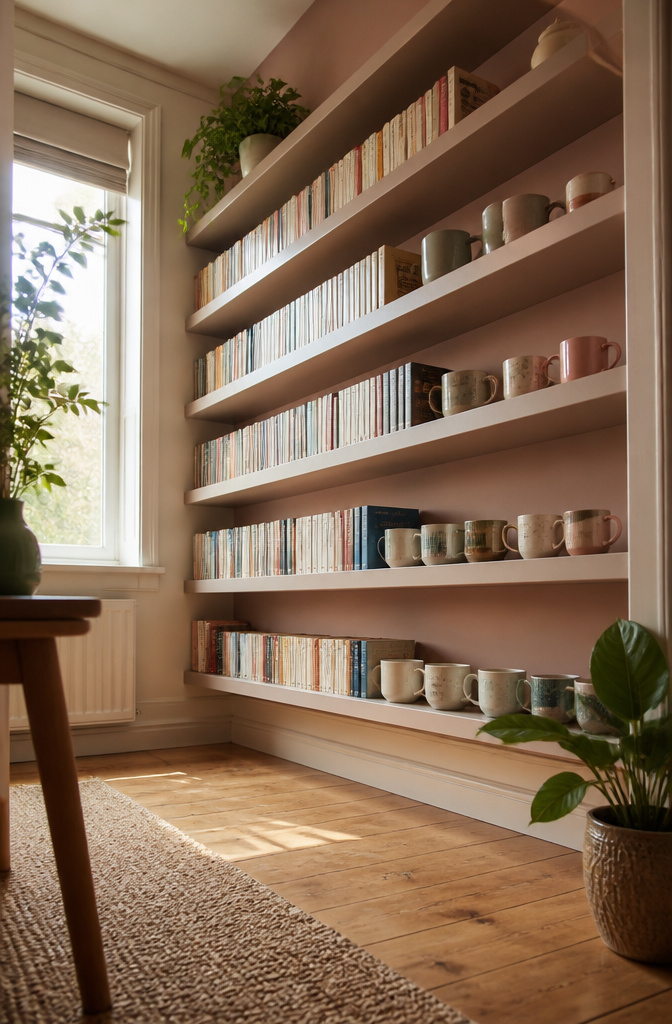
Walls in a small room are empty real estate until you treat them like floor space that happens to stand upright. Floating shelves at 12–16 inches deep hold most books and everyday objects without the bulk of a cabinet jutting into the room. I have watched a 12-inch shelf swallow paperbacks and coffee mugs while leaving walking space intact; 16 inches starts to feel like furniture in a room under 10 feet wide.
Tall bookcases do the same work vertically. A unit that kisses the ceiling draws the eye up and gives the impression of higher walls, but the bottom half does the heavy lifting. I would put the stuff you reach for daily at eye level and treat the top shelf as seasonal storage or display.
Pegboards belong in this conversation more than people expect. The Wall Control Metal Pegboard, rated to hold 200 pounds when properly installed, turns a blank wall into adjustable storage for tools, craft supplies, or kitchen gear. Hooks, small shelves, and bins move around as needs change, which matters when a room serves more than one purpose.
A customizable pegboard is a great place to start… when it’s properly installed, it can hold up to 200 pounds of cookware, utensils, and tools.
That weight rating means you can trust it with real hardware, not just lightweight office supplies. For a renter, the board mounts with a few screws and leaves smaller holes than a shelving unit’s bracket grid.
2. Furniture That Doubles as Storage

A storage ottoman or bench hides blankets, games, and whatever else in plain sight while giving you somewhere to sit. Tuck one by the coffee table, wedge it into a corner, or use it as an end table. A basic storage ottoman starts around $60 at Target, and the IKEA Perjohan bench runs under $100 if you need something narrow (it is less than a foot deep) with a cut-out handle for moving around.
Beds with built-in drawers turn the whole footprint into a closet you do not have to build. The IKEA Malm bed frame with storage runs about $349 for a queen, which is less than most standalone dressers and saves you the floor space one would eat. For a step up, hydraulic lift mechanisms like the Sundays Cloud bed let you reach the entire cavity under the slats without wrestling the mattress.
Coffee tables with lift-tops or shelves underneath pull the same trick in the living room. The lift-top becomes a work surface during the day, then drops down to conceal laptops and chargers at night. A shelf underneath keeps baskets or books within reach but off the rug.
3. Over-the-Door Storage
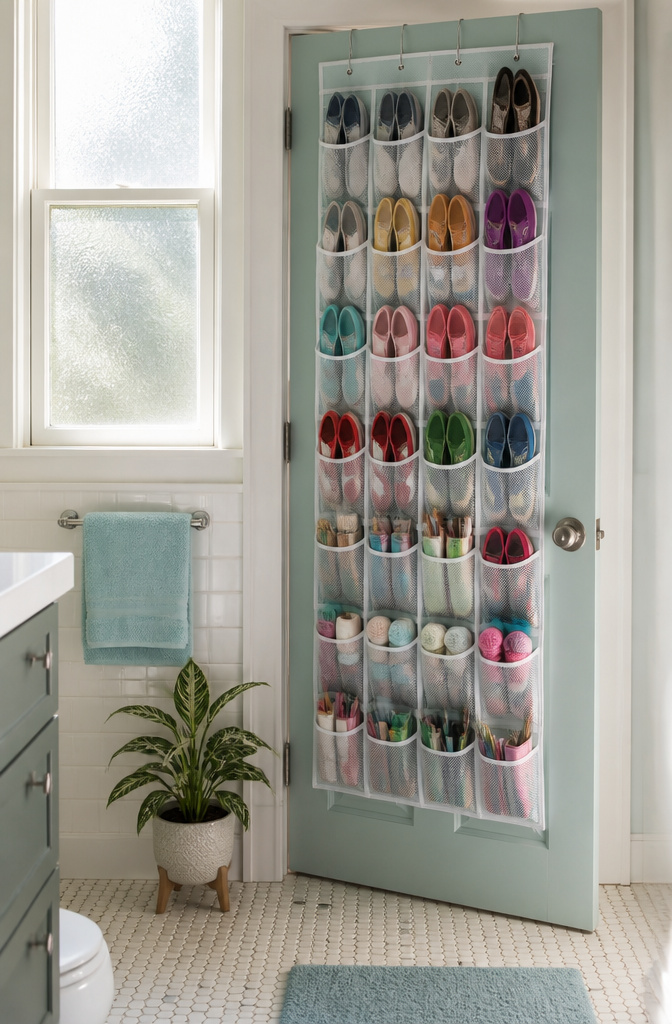
The back of a door is dead space until it isn’t. Standard interior doors run 80 inches tall and 24 to 36 inches wide, which sounds generous until you hang something that fights the doorframe every time you close it. Measure your door before you buy anything, including the clearance behind it; a shoe organizer that bumps the wall is a shoe organizer that lives half-open and looks like clutter.
The Target Brightroom Over the Door 26 Shelf Mesh Shoe Organizer fits most standard swinging doors and holds 26 or more pairs up to a women’s size 11. The cubbies are mesh, so they keep their shape instead of drooping, and the clear pockets let you see contents without opening anything. At $26, it costs less than most single storage bins and does more than shoes: rolled tees, socks, crafting supplies, whatever fits. For accessories that need hanging rather than cubbying, the same line makes a tiered towel rack with wood bars that warms up a room visually while corralling scarves, throws, or belts.
4. Under-Bed Storage
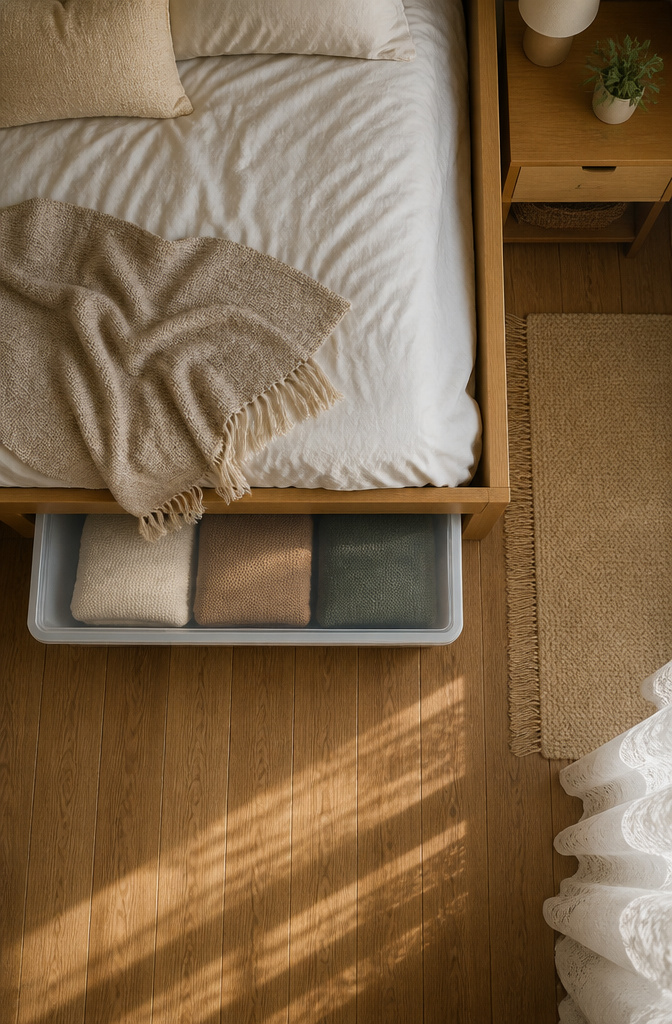
Most beds leave somewhere between 7 and 14 inches of clearance underneath, which sounds like nothing until you measure it. A 6-inch-tall bin on wheels slides under almost any frame and still leaves room to roll. IKEA’s SKUBB series runs shallow and lidded, which matters more than the label: shallow keeps you from overfilling until the bin jams, and the lid keeps dust from coating whatever you stored six months ago and forgot.
The real space gain comes from pairing those bins with vacuum bags for seasonal clothing. Bulky coats and spare comforters shrink to a fraction of their volume once the air is sucked out, and the compressed stack fits flat into a bin that would otherwise hold a fraction of the same items. I would not bother with vacuum bags for anything you reach for monthly; the sealing and re-sealing costs more time than it saves. For the sweater you will not touch until October, though, the compression turns under-bed space from a narrow slot into actual storage.
5. Closet Where None Exists

A blank wall in a small bedroom can become a full wardrobe with a modular system built from hanging rods, drawers, and open shelving. The components adapt as needs change, which matters when a rental lease turns over or a partner moves in. Garment racks start around $25 and handle the same function with less commitment, though they leave everything exposed to dust. Freestanding wardrobes run $150–400 and close it all behind doors, but they eat more floor space than most small rooms spare.
For the tightest spots, the IKEA Ställ shoe cabinet measures just 11 inches deep and tucks into a narrow slice of wall that would otherwise stay empty. It holds up to twelve pairs and keeps them out of sight, though it needs anchoring to the wall with drywall anchors so it does not tip forward when the compartments open. Wall-mounted clothing rods skip the cabinet entirely and hang shirts or pants where a closet rod would go, if only a closet existed. Two ways to play this: mount a single rod high and layer a shelf above it for folded items, or run two rods at staggered heights and double the linear hanging feet in the same wall width. The staggered setup wins for anyone with more shirts than shelf space; the single rod works better if sweaters and jeans need a home too.
6. Modular Systems
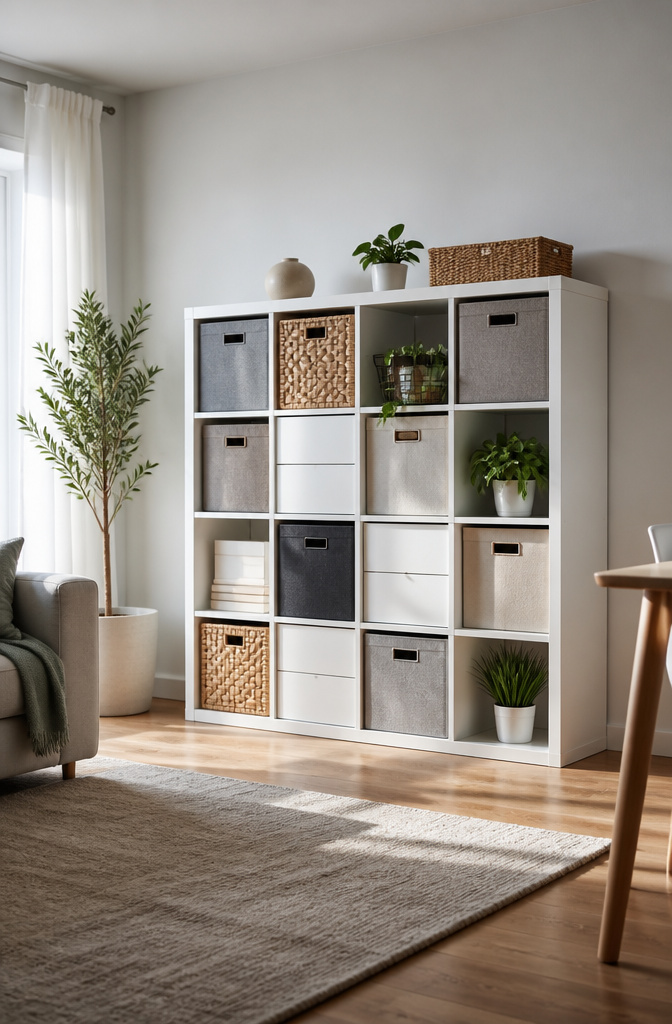
IKEA’s KALLAX shelf unit has become the default first purchase for a reason: the 13-by-13 inch cube slots fit bins from nearly every manufacturer, and those inserts run $5 to $15 each depending on whether you want fabric, wire, or a lidded box. The frame itself stays put while the guts change with your stuff. Stackable bins work the same way without the furniture commitment; buy two to test a closet corner, add four more when the hobby expands. Adjustable shelving carries the logic up the wall, brackets sliding into new holes as the shoe collection shrinks and the file boxes grow. What separates modular from built-in is the move: a renter can haul KALLAX to the next apartment and reassemble it as a room divider, a bench base, or horizontal low storage under a sloped ceiling. The catch is the visual gap. Open cubes read busy fast; doors or baskets cost extra and eat the savings that drew you to the system. Two ways to play this: start with one unit and expand only when you know what actually collects in your space, or buy the full wall’s worth upfront and face the clutter until you fill it. The single-unit start wins if you have not lived in the room through a full season yet.
7. Hooks for Hanging Items
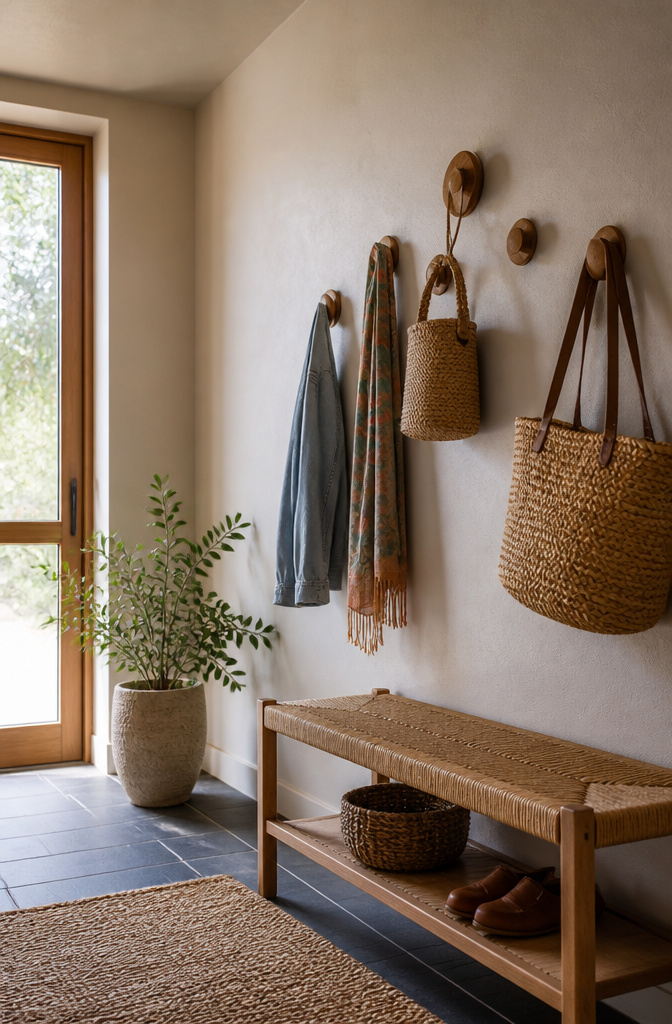
Adhesive strips rated for 5 to 16 pounds depending on size will handle a purse, a light jacket, or a coil of extension cord without leaving holes a landlord would notice. I learned the hard way that the 5-pound version exists for a reason: a cast-iron skillet on a medium strip hits the floor at 3 a.m. For anything heavier, a screw-in hook anchored to a stud or solid wall holds 35 pounds or more, which is where I moved my tool bag and the dog’s leash collection.
Over-door hooks skip both problems entirely, supported by the door itself rather than adhesive or drywall. The Target Brightroom three-tier rack at $40 hangs scarves and ties across horizontal bars, while an 8-hook rack like the Orbit style handles coats, towels, and the clothes that never quite make it to the hamper. I keep one on the garage door for reusable grocery bags, which beats digging through a cabinet with armfuls of produce.
In the kitchen, screw a few hooks under an upper cabinet and mugs hang clear of the counter. S-hooks slipped over a towel bar turn that same bar into a rack for wire baskets, which is how I store onions and garlic within arm’s reach of the cutting board. The basket swings, so I set it where a hip check won’t send shallots rolling.
8. Rolling Carts
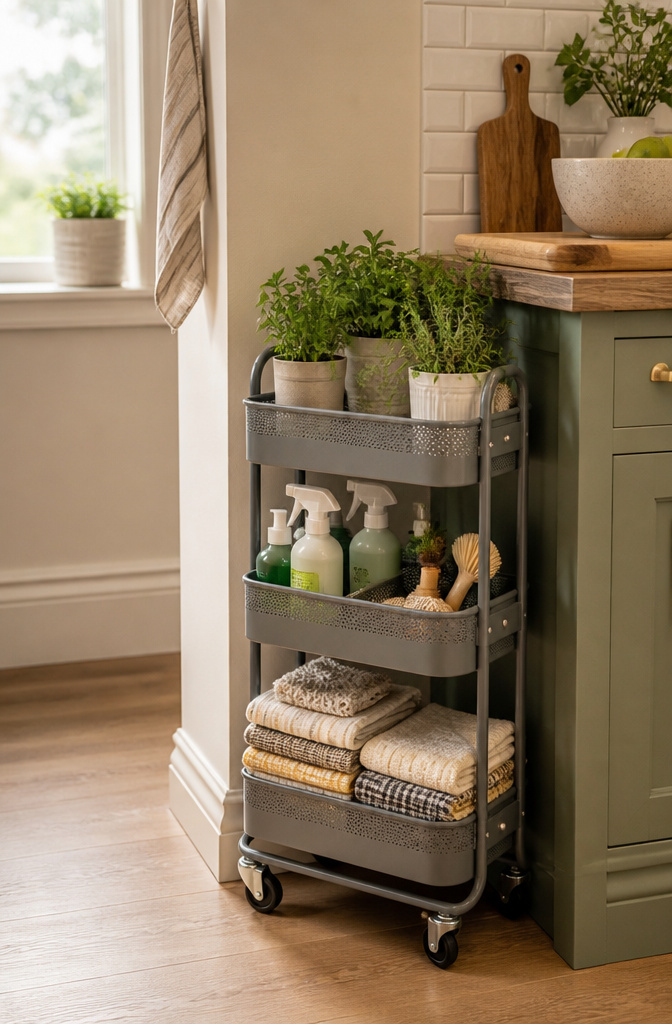
Rolling carts earn their keep in rooms where every inch of wall space is already claimed. Most three-tier metal carts run 15 to 18 inches wide and 30 to 33 inches tall, a footprint that slides into the narrow gap between a vanity and toilet or beside a refrigerator without asking the room to rearrange itself. The Yamazaki Home Tower Rolling Storage Cart takes this further: it fits into gaps as slim as 5 inches, though the tradeoff is a weight limit of 11 pounds. That is enough for toilet paper rolls, cleaning sprays, and a few hand towels, but loading it with heavy craft supplies or bulky kitchen gear will strain the frame. For bathrooms and cramped kitchens, the slim profile wins. For heavier loads in a craft room, a standard 18-inch cart with sturdier shelves is the smarter buy. The Yamazaki runs about $165, which is steep for a cart, but the alternative is often a custom-built shelf that costs more and cannot roll out of the way when you need the floor clear.
9. Multi-Functional Furniture
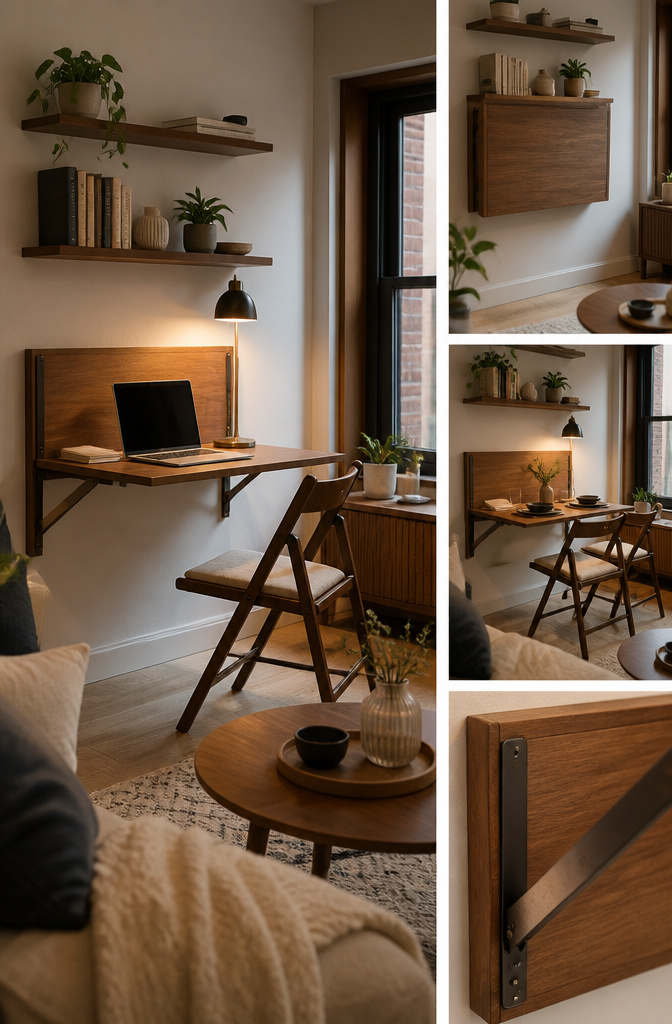
Multi-functional furniture is a different category from pieces that simply hide storage inside a seat or ottoman. These are shapes that physically reconfigure: a daybed that becomes a sofa, a Murphy bed that folds into a wall cabinet, nesting tables that tuck inside one another, or a drop-leaf desk that collapses flat when the workday ends. The distinction matters because the transformation itself is what buys back floor space, not a bin tucked underneath.
A wall-mounted drop-leaf desk runs roughly $80–150 for a basic unit, enough to hold a laptop and a lamp without committing half a room to a workstation. Murphy beds sit at the other end of the price range: a queen kit starts around $300 before you add a mattress, and the install eats a weekend. I have watched friends skip the kit and try to engineer their own pivot hardware; the savings evaporated when the frame tore out of the drywall. The kit exists for a reason.
Nesting tables and drop-leaf pieces ask less of you and of your security deposit. A slim console that extends to seat six, or a coffee table that rises to dining height, lets one room shift modes without a single screw into a stud. For renters, that flexibility usually wins over the wall bed’s dramatic reveal.
10. Decorative Storage

Woven seagrass bins look like something you picked up at a coastal flea market, but they swallow the clutter that would otherwise colonize every flat surface. A 16-inch lidded basket runs $20–40 at most home stores, which is less than you’d spend on a generic plastic tote that screams "storage unit." The lid matters more than you’d think; an open basket still reads as a pile of stuff, but the same bin with a seagrass top becomes texture.
Vintage trunks as coffee tables are the oldest trick in this particular book, and it still works because nothing else stores bulky bed linen or off-season blankets while giving you a place to set down coffee. The weight keeps it from sliding around on a wood floor, and the dents and hardware mean you do not have to be careful with it. If the trunk sits too low for your sofa, a set of small casters underneath solves that without drilling into anything permanent.
Ladder shelves lean against the wall and display what you want seen while the lower rungs hide what you do not. The angle means they take up almost no footprint, which matters when the room is already doing three jobs. Stack two lidded boxes on the bottom tier and suddenly the shelf reads as furniture, not a storage solution wearing a disguise.
Declutter First
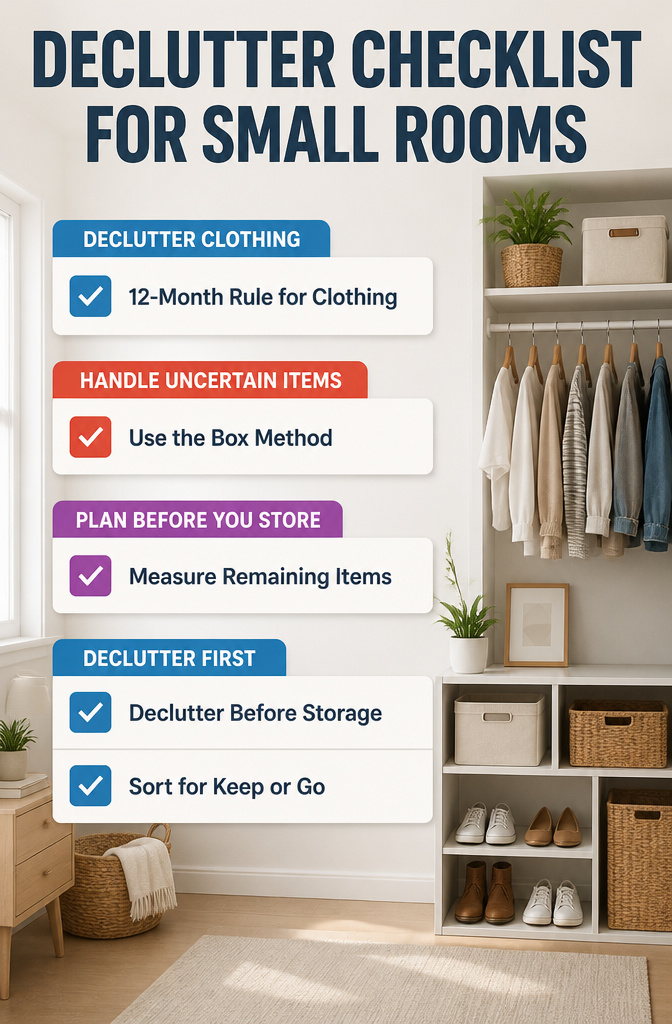
New bins and drawer dividers look like progress, but storage without decluttering just hides problems until they spill back out. The 12-month rule for clothing is the place to start: if it has not been worn in a full year, it goes. That sweater kept for someday is taking the same square footage as the one worn weekly. For the items that stall the decision, the box method works. Everything uncertain goes into a box with a date; if it stays sealed six months, it leaves without reopening. What remains after those two passes is what actually needs a home, and measuring that pile matters before buying a single container. A 12-inch shelf loses its use if the remaining shoes need 14. The numbers from this step are what make the storage ideas that follow fit instead of crowd.
Vintage Repurposing

Vintage medicine cabinets with their beveled mirrors and steel bodies turn up at estate sales and Habitat ReStores for less than the cost of a plastic wall organizer, and they hang at about six inches deep, which is shallow enough that you stop bumping into them. I look for the ones still carrying their original latch hardware; the mirror is usually the first thing to crack, but a local glass shop can cut a replacement for around $20 if the frame is sound. Before mounting, pull the shelves, scrub the interior with a degreasing soap, and check that the door hinge isn’t rusted through at the pin. A stuck hinge will torque the cabinet off the wall inside a month.
Trunks as coffee tables are the oldest trick in this category, but the usable ones are the flat-topped steamers from the 1920s–40s, not the domed hope chests your grandmother might have owned. Domed lids waste the interior volume and your coffee cups slide. Flat steamers open from the top and usually have a tray inside for smaller items; I line the bottom with cedar blocks against the musty smell old canvas and wood hold for years. Check the corners for rot, especially if the trunk lived in a basement. A corner gone soft will collapse under the weight of someone sitting down.
Old crates work best when you treat them as modules rather than shelves in themselves. A single fruit crate is too flimsy for books, but four of them, screwed together at the corners into a two-by-two grid, will carry the load and let you rearrange the grid as the wall space changes. I find crates at flea markets for $5–10, though the ones with intact slats are getting harder to locate. Knock the dirt out, check for splinters along the interior rails where the slats meet the frame, and run a palm sander over the inside faces before you load them. The splinters are what get you, not the rough exterior.
Mirrors and Ceilings
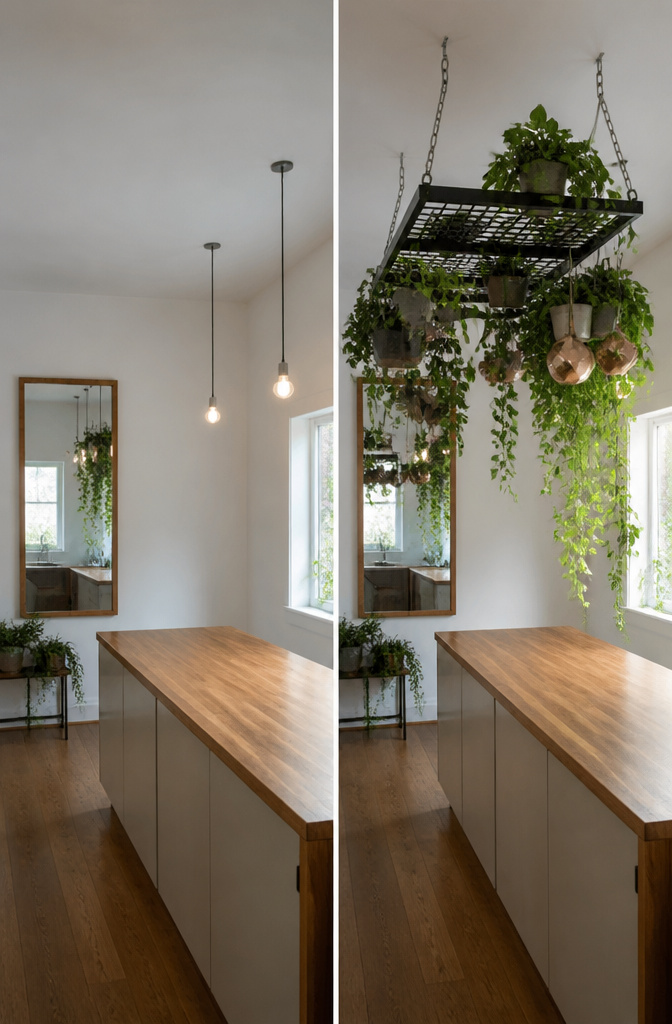
A mirror mounted on a shallow cabinet turns dead wall space into a medicine cabinet or jewelry box without sticking out into the room. The frame hides the seam, and from a few feet back the wall still reads as open. What convinced me, reading through a dozen of these builds, is that the illusion only works if the mirror sits nearly flush; anything deeper than about three inches starts to read as furniture, not architecture.
Ceiling-mounted racks for pots or plants pull the same trick upward. The floor stays clear, the counters stay clear, and the eye travels up so the room feels taller. Ceiling anchors in drywall hold roughly 15–30 pounds each, but a loaded pot rack can push past that fast. Most people find the joist or stud, mark it, then drill slightly off-center because they trusted the stud-finder’s single pass. The fix is tracing the edge: run the finder from both directions, mark each edge, and drill the center of the two marks. A toggle bolt through drywall alone is a backup, not a plan, for anything that swings.
What to Skip

Buying storage before measuring the space is the fastest way to turn a weekend project into a return trip to the store. I have a fabric bin under my bed that holds exactly nothing useful because the frame sits too low; pulling it out requires lifting the mattress corner every time, so it stays empty and collects dust. Deep bins only work where you have real clearance, and most platform beds with drawers built in leave you less height than you think.
Over-the-door racks look like free space until the door won’t latch. My bathroom door needed to close fully for the pocket-style lock to catch, and the hook-backed rack I bought kept the bolt half an inch short. I used it for two weeks before taking it down. Check the door swing and the strike plate before you buy anything that hangs there.
Decorative storage baskets and lidded boxes can cost more per piece than the clutter inside them is worth. I spent $34 on a woven set that looked great on the shelf and held three scarves and a phone charger. A $8 plastic shoebox would have done the same job and stacked better. If the container costs more than what it organizes, the room is not the problem.
Weekend Project Order
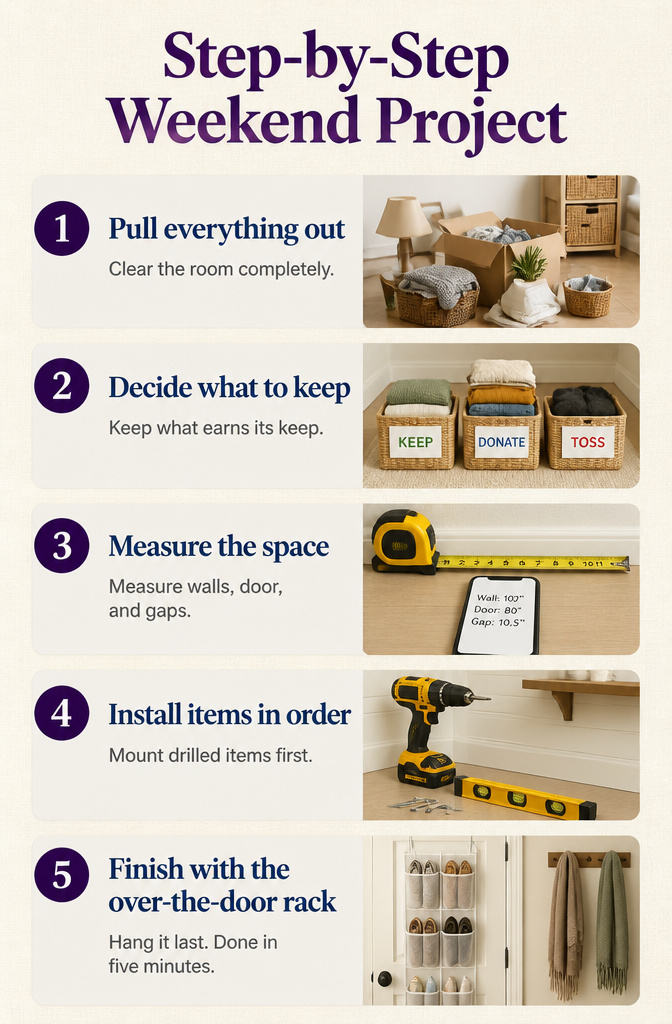
Saturday morning is for pulling everything out and deciding what actually earns its keep in the room. The pile of keepers goes back in loosely; the rest leaves the house before lunch so you cannot second-guess it. By afternoon the floor is clear enough to measure wall space, door height, and that awkward gap beside the bed where a narrow cart might sit. I write the numbers down on my phone, because the store will not forgive a guess.
Sunday is installation day, and the sequence matters. Mount anything that needs a drill first, while energy and noise tolerance are both high. Hang the over-the-door organizer last; it takes five minutes and feels like finishing. The Brightroom Over-the-Door 26 Shelf Mesh Shoe Organizer runs about $26 at Target and swallows shoes, cleaning supplies, or folded accessories in its cubbies. Pair it with the tiered towel rack with wood bars for throws or scarves, and you have two vertical surfaces working without touching the floor.
A full refresh lands between $200 and $500 depending on whether you add one cart or three, whether the closet rod is already there or needs replacing, and whether you already own the drill. The door hardware alone costs under $60. Paint and a single shelving unit eat the rest; spread the spend across both days and the room holds together instead of looking like a storage aisle exploded in it.
Frequently Asked Questions
How can I maximize storage in a small bedroom?
Use vertical space, furniture that doubles as storage, and under-bed bins. Floating shelves at 12–16 inches deep hold books and daily items without jutting into the room, while beds with built-in drawers turn the entire footprint into closet space. Rolling carts and over-the-door organizers add storage without touching the floor.
What are the best furniture options for small spaces?
Choose pieces that serve more than one purpose. Storage ottomans start around $60 and hide blankets in plain sight. The IKEA Malm bed frame with storage runs about $349 for a queen, which costs less than most standalone dressers and saves floor space. Coffee tables with lift-tops become work surfaces by day and conceal laptops at night.
How do I organize a room with no closet?
Build a wardrobe from modular components or wall-mounted rods. Garment racks start around $25, while freestanding wardrobes run $150–400 if you need enclosed storage. The IKEA Ställ shoe cabinet measures just 11 inches deep and holds twelve pairs in a narrow wall slice. Stagger two clothing rods at different heights to double your hanging space in the same width.