
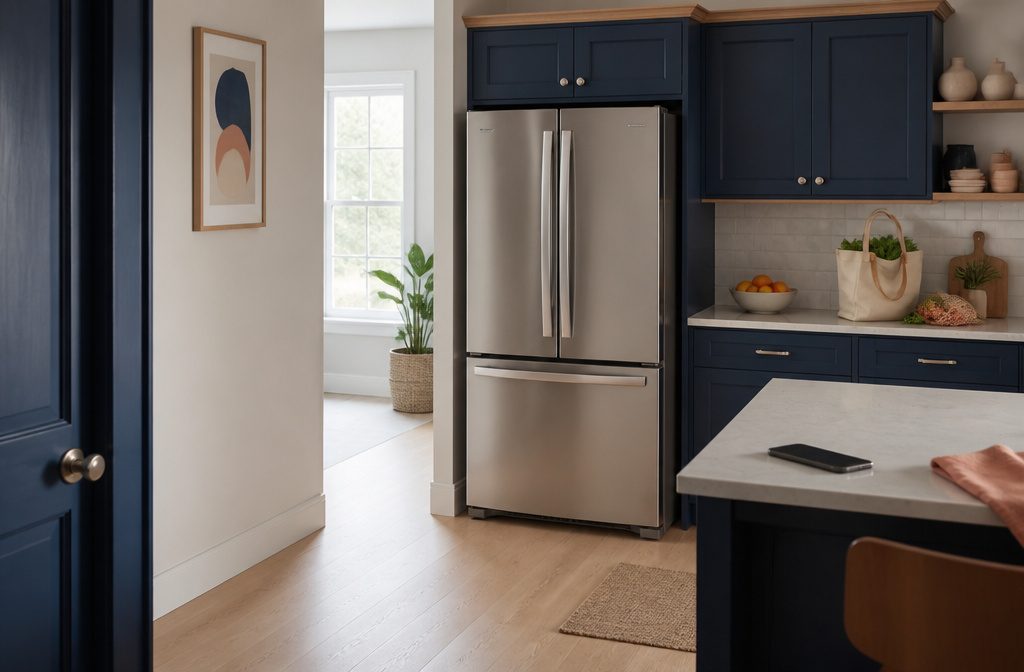
A high tech refrigerator is a full-size fridge with a touchscreen, app control, or specialty drawers added to the cooling.
The extras only pay off if the cabinet fits your opening: the Sharp SJB1255GS is 23.6 in wide, while the LG LF26C8210S is 35.75 in, and that gap decides more than any screen.
My Top Picks
| Product | Award | Best for | Why it won | ||
|---|---|---|---|---|---|
 | Samsung RS27T5561SR Side-by-Side Refrigerator | Best all-round high-tech refrigerator | Shoppers wanting connected features, practical storage | Strongest balance of a Family Hub touchscreen, external dispenser, and practical full-size storage among the o | Check price |
 | LG LF26C8210S 4-Door French Door Refrigerator | Best for shoppers needing flexible food storage | Buyers needing a repurposable food compartment | Its convertible drawer and four-door layout give more flexible storage than the Samsung side-by-side. | Check price |
 | Sharp SJB1255GS 2-Door Counter-Depth Refrigerator | Best for a narrow kitchen opening | Buyers with a narrow kitchen opening | At 24 inches wide and counter-depth, it is the best-documented compact fit, narrower than the LG. | Check price |
 | Samsung Top Freezer with All-Around Cooling | Best value smart refrigerator | Shoppers wanting smart cooling without a screen | Top-freezer design with FlexZone, Twin Cooling Plus, and an ice maker delivers useful features without a scree | Check price |
 | Samsung Side-by-Side | Best for a tight kitchen fit | Kitchens with limited clearance in front | Side-by-side doors are narrow in their swing, so they suit kitchens with tight front clearance. | Check price |
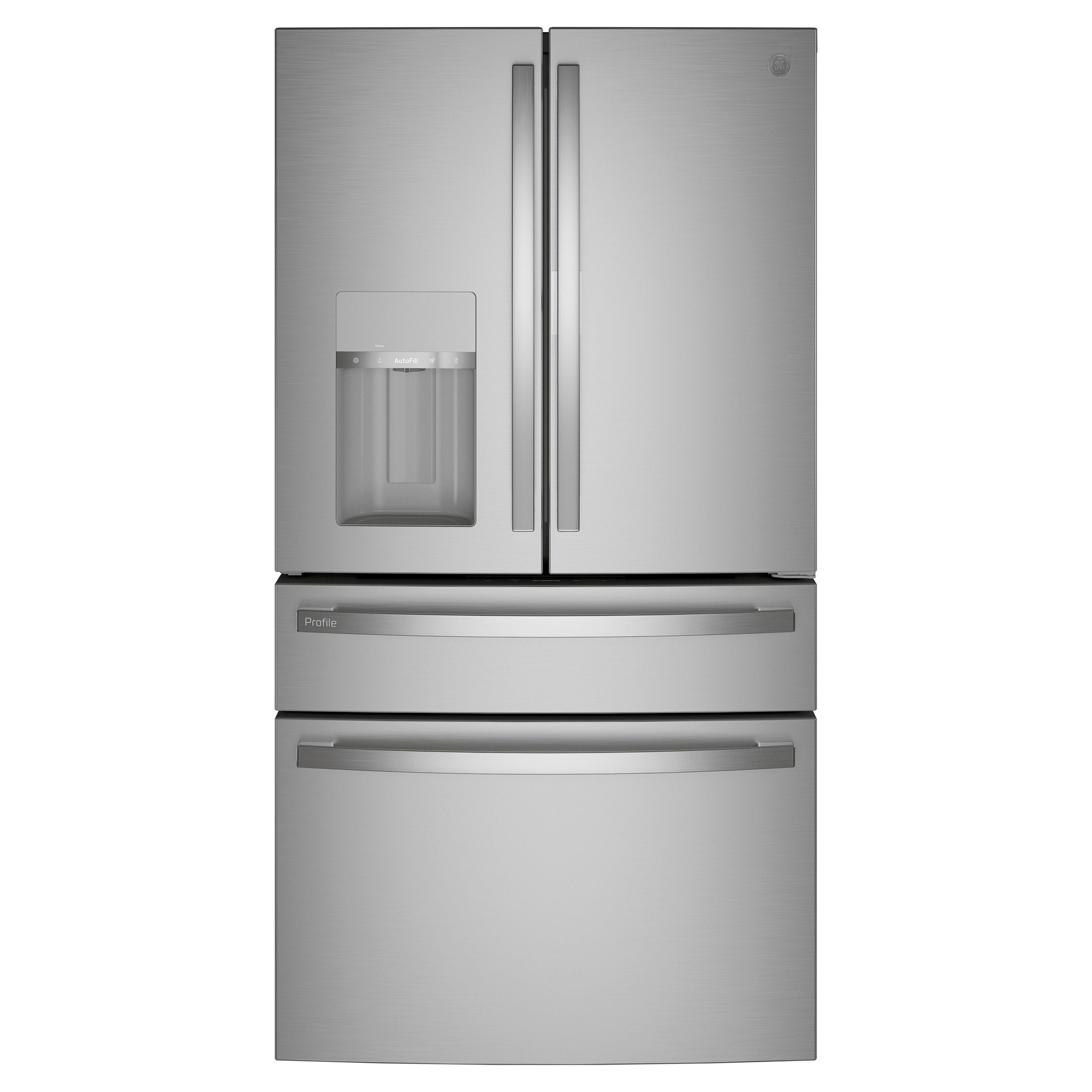 | GE Profile Refrigerator PVD28BYNFS | Best for a screen-centered household | Households wanting a large built-in display | The clearest choice for a big screen, offered in a four-door French-door design. | Check price |
Best all-round high-tech refrigerator: Samsung RS27T5561SR Side-by-Side Refrigerator
LARGE CAPACITY: Completely redesigned interior with 27.4 cu. ft. capacity that fits 10% more groceries than ever. MODERN DESIGN: Flat panel door design with easy-to-open...
Quick Verdict
With 26.7 cu. ft. of space, a Family Hub touchscreen, and an external water-and-ice dispenser, this side-by-side suits buyers who want connected features and practical storage. The screen and layout are the weakness for anyone wanting something simpler.
Key Specifications
- Total Capacity: 26.7 cu. ft.
- Freezer Capacity: 9.5 cu. ft.
- Overall Dimensions: 70.06 inches high; 35.88 inches wide; 33.5 inches deep
- Annual Energy Use: 691 kWh/year
- Electrical Requirements: 115 V; 60 Hz; 5.0 A
What It Does Well
- Abt lists 17.2 cu. ft. of refrigerator space beside the 9.5 cu. ft. freezer, and several owners praise the roomy storage.
- Samsung owners praise the screen and recipes, and the retailer lists built-in Alexa and Google Photos sharing.
- The external dispenser and in-door icemaker deliver water and ice without opening a door.
Where It Falls Short
- It is freestanding, not counter-depth, at 33.5 inches deep.
- One owner calls the tablet sound poor, and I found no independent reliability or pricing evidence.
Who It’s For
A household with room for a 35.88-inch-wide cabinet and a wish for a built-in dispenser fits well. Someone who prefers a plain appliance or French doors will find the screen and side-by-side layout beside the point.
How It Compares
The LG LF26C8210S is a 4-door French-door model with a convertible drawer, per retailer pages. It suits shoppers who want French doors; the Samsung suits those who want the touchscreen and external dispenser.
Where to buy: Amazon · samsung.com · abt.com · hancockappliance.com
Best for shoppers needing flexible food storage: LG LF26C8210S 4-Door French Door Refrigerator
Counter‑Depth MAX Design for Sleek Integration This fridge offers ~26 cu. ft. of storage while maintaining a counter‑depth profile that aligns with surrounding...
Quick Verdict
A drawer that switches between fridge and freezer duty gives this LG its edge for shifting storage needs. Thin smart-feature evidence is the weakness.
Key Specifications
- Depth: 29.75 in
- Freezer Capacity: 7 cu. ft.
- Height: 70.25 in
- Fridge Capacity: 15.7 cu. ft.
- Total Capacity: 25.5 cu. ft.
- Width: 35.75 in
- Door Clearance: 21 in
- Drawer Capacity: 2.8 cu. ft.
- Daily Ice Production: 2.5 lb/day
- Open Depth: 43 in
- Ice Capacity: 3.8 lb
- Side Clearance: 0.13 in
- Storage Layout: 6 shelves
What It Does Well
- The retailer lists five temperature settings on the 2.8 cu. ft. drawer: one bin for produce or frozen overflow.
- Six shelves, four split, plus two freezer drawers, per the retailer, allow custom zones.
- The listing calls it counter-depth, so it protrudes less in tight kitchens.
Where It Falls Short
- Listings give no EnergyGuide figure, so running costs stay unknown.
- The sources include no independent temperature testing; the 1°F hold is the maker’s claim.
Who It’s For
Households that stock up one month and entertain the next suit a drawer that changes roles. Anyone wanting a touchscreen or external dispenser should note that the sources list an internal water dispenser and no screen.
How It Compares
Samsung’s RS27T5561SR is a side-by-side with an external water-and-ice dispenser and Family Hub touchscreen, suiting shoppers who want those features. The LG suits those who want repurposable space.
Where to buy: Amazon · townappliance.com · betterhousekeeping.com
Best for a narrow kitchen opening: Sharp SJB1255GS 2-Door Counter-Depth Refrigerator
The Slim and Spacious 4.2 cu.ft. Freezer Fits All Your Frozen Favorites With Room to Spare Multi Air Flow Evenly Distributes Air Through Multiple Vents in Both Freezer and...
Quick Verdict
A 23.6 in width makes this the clearest documented fit for a tight kitchen opening. Interior space is the cost.
Key Specifications
- Width: 23.6 in
- Height: 72.8 in
- Depth w/ Handles: 27 in
- Depth w/o Door: 23.6 in
- Total Capacity: 11.5 cubic feet
- Fridge Capacity: 7.3 cubic feet
- Freezer Capacity: 4.2 cubic feet
- Annual Energy Use: 397 kWh/year
- Parts Warranty: 1 year
- Labor Warranty: 1 year
What It Does Well
- The seller calls it a 24-inch model, aimed at openings near that size.
- Case depth without the door is 23.6 in, the seller says, keeping the body shallow beside cabinets.
- The seller’s 397 kWh per year gives you a number to compare.
Where It Falls Short
- At 11.5 cubic feet total, a big grocery run may not fit.
- No independent cooling tests or owner reports on temperature consistency turned up in my sources.
- No smart functions are stated; confirm door clearance before buying.
Who It’s For
A renter with a roughly 24-inch gap can check these numbers with a tape measure. Large households, or anyone wanting app control, will meet 7.3 cubic feet of fridge space and no listed smart functions.
How It Compares
The wider LG LF26C8210S is a 4-door French-door model with a convertible drawer, and retailer pages support its capacity and connected features better. It suits roomier kitchens; the Sharp suits openings where width decides.
Where to buy: Amazon · absoluteappliances.com
Best value smart refrigerator: Samsung Top Freezer with All-Around Cooling
Image: merlinstv.com
Quick Verdict
Shoppers who want useful cooling features without a touchscreen or a built-in price tag get a sensible fit here.
The top-freezer layout and a feature list that includes FlexZone, Twin Cooling Plus, and an automatic ice maker carry the case. The weak spot is proof: the sources I read don’t establish its price or any smart connectivity.
What It Does Well
- Top-freezer layout: a familiar, simple configuration that skips the screen-centered approach, so it suits anyone who wants a refrigerator that just cools.
- FlexZone and Twin Cooling Plus: Samsung’s listing names both, which gives you cooling-focused features to compare against other models at a similar tier.
- Automatic ice maker: listed as a feature, which means no refilling and stacking ice trays.
Where It Falls Short
- The evidence I found doesn’t state a price, so I can’t confirm it’s a bargain.
- Smart connectivity isn’t established either, so don’t buy it expecting app control.
- I haven’t tested it, and the material I reviewed is a feature listing rather than owner reports, so long-term reliability is unknown.
Who It’s For
A renter or first-home owner who wants a straightforward top-freezer with a few cooling extras will find the listed features line up with that goal.
Anyone who needs confirmed Wi-Fi features or a firm cost before shopping should hold off, since neither detail is verified.
How It Compares
The Samsung Side-by-Side, model RS27T5200SG, is a full-depth refrigerator with an external filtered water and ice dispenser, a feature this top-freezer’s listing doesn’t mention.
Buyers who want water and ice from the door will lean that way, while those who prefer the top-freezer layout and its listed cooling features can skip the extra bulk.
Where to buy: buyfromsa.com
Best for a tight kitchen fit: Samsung Side-by-Side
Image: ktappliance.com
Quick Verdict
Narrower door swings are what make this side-by-side a sensible fit for kitchens with limited clearance in front of the refrigerator, and the retailer lists 27 cubic feet of total capacity.
The real weakness is depth: at 33.5 inches, it is a full-depth unit and a poor match for a flush fit.
Key Specifications
- Total Capacity: 27 cubic feet
- Annual Energy Use: 728 kWh/year
- Storage & Ice: 4.4 lb ice capacity
What It Does Well
- The retailer lists 17.9 cubic feet of refrigerator capacity and 9.5 cubic feet of freezer capacity, so frozen food gets a sizable share.
- Five door bins, four of them gallon-size per the listing, give milk and juice jugs a home without crowding the four shelves.
- The in-door ice maker stores up to 4.4 lb, and the external dispenser keeps the doors shut for water and ice.
- The listed warranty runs 10 years on digital inverter compressor parts, with 5 years of compressor labor, against 1 year of parts and labor on the refrigerator itself.
Where It Falls Short
- The listing indicates standard depth, not counter-depth, so it will not sit flush with cabinets.
- Wi-Fi and Bixby control are listed, but app functions, network requirements, and platform compatibility are not established in the sources I read.
- The retailer gives 728 kWh/year but no EnergyGuide operating-cost figure, so running cost stays unconfirmed.
Who It’s For
A galley or narrow kitchen where the doors need to open without much room is where a side-by-side layout can make sense, as long as the 35 7/8 inch width fits the opening.
Anyone chasing a built-in look will run into the 33.5 inch depth, which no amount of door styling changes.
How It Compares
The GE Profile PVD28BYNFS is a four-door French-door model listed at 27.9 cubic feet, also standard-depth, so neither one solves a flush-fit problem.
The Samsung suits tight clearance in front of the unit, while the GE suits buyers with more room who want an extra 0.9 cubic feet and a French-door layout.
Where to buy: ktappliance.com · merlinstv.com
Best for a screen-centered household: GE Profile Refrigerator PVD28BYNFS
Image: costco.com
Quick Verdict
A large built-in display in a 4-door French-door body sets this GE apart for a household that lives on connected screens. Capacity is the strength; thin evidence is the weakness, since the sources say little about what the screen does.
What It Does Well
- Large built-in display: puts connected features front and center for screen-minded households.
- 4-door French-door layout: delivers that screen in a familiar format, no side-by-side required.
- Large capacity: suits a family-size household.
Where It Falls Short
- No firsthand performance report turned up in my sources; one Reddit buyer only hopes for steady temperatures and lower energy use.
- The screen’s specific functions are not well established.
- One Reddit commenter argues feature-heavy French-door models run less efficient and reliable, a general view, not about this model.
Who It’s For
A family set on 4 doors and a display will find this a close match. Shoppers who value a proven record have little to go on, since the only owner voice is a buyer still waiting on results.
How It Compares
The Samsung RS27T5561SR is a side-by-side with an external water-and-ice dispenser and a Family Hub touchscreen, and its smart features and fit are better supported by retailer specifications and owner comments.
Choose it for a door dispenser and clearer details; choose the GE for a screen in a French-door format.
Where to buy: lowes.com
How I Chose the Best High Tech Refrigerator
I evaluated 34 models available to U.S. buyers and researched 7 of them in depth, drawing on 18 sources: manufacturer specifications, professional reviews, long-term owner feedback, owner discussions on Reddit, and video reviews on YouTube.
Each product was scored against the factors that matter most for this use case (cooling and temperature consistency, fit and clearance, capacity and storage layout, smart feature usefulness, energy use and running cost), with every score tied to documented evidence.
What to Look for When Buying High Tech Refrigerator
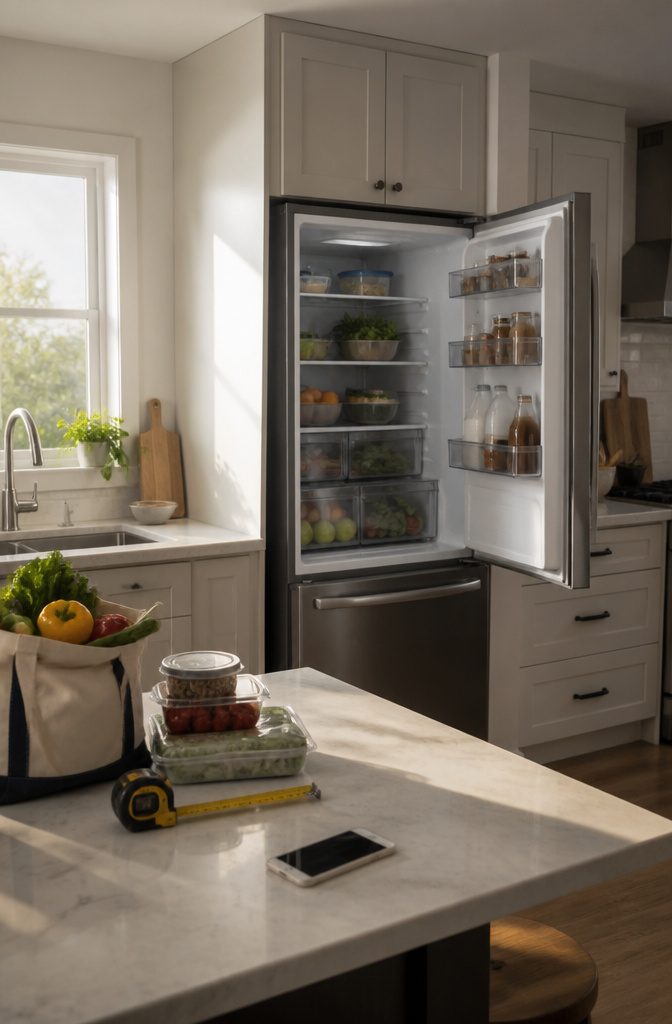
Temperature recovery after a door opens can reveal cooling consistency that a tablet-size screen cannot.
Cooling consistency and food preservation
A refrigerator can have a tablet-size screen and still let the top shelf run warm. Independent reviews and owner reports are where this shows up.
Look for notes on how quickly the temperature recovers after the door opens, whether door shelves match the middle shelves, and whether the produce drawers keep greens crisp for a week.
When I compare sources, the most useful ones describe cooling over months rather than the first few days.
Buyers who cook from fresh groceries, shop in bulk, or open the door all day should weigh this first.
If you mostly store drinks and a day or two of leftovers, small temperature swings matter less. Even then, weak cooling makes every added feature a poor trade.
Kitchen fit and door clearance
Measure before you read a single feature list. Published width, height, and depth tell you whether the model fits the opening, but door swing is where many buyers get caught.
A refrigerator that slides in can still block a drawer, bump an island, or keep a door from opening past 90 degrees, which stops the bins from pulling out.
Check the hinge side, the wall or cabinet next to it, and the clearance the manufacturer lists for the doors. Counter-depth models usually line up with base cabinets, though handles still stick out.
Renters in tight galley kitchens and owners with a cabinet surround should care most. If your fridge sits in open space with room on both sides, this factor mostly takes care of itself.
Usable capacity and storage layout
Total cubic feet is a blunt number. What counts is how the space divides between fresh food and freezer, and whether the shelves, bins, and drawers fit what you actually buy.
A family that stores sheet pans, party trays, and gallon jugs needs adjustable shelves and deep door bins. Someone who meal-preps in stacked containers needs flat, wide shelf space more than a flashy middle drawer.
Convertible compartments and specialty drawers sound useful, and owner comments suggest they are, but only when they match a habit you already have.
Large households and bulk shoppers should study layout diagrams closely. A one- or two-person household can often skip the biggest capacity tier and put the money elsewhere.
Smart functions and app compatibility
Spec sheets list every feature the brand sells across a whole product line, so confirm each one exists on the exact model number.
App temperature controls, door-open alerts, shopping lists, and recipe suggestions are common; food-recognition cameras are less so. Independent testing is the best guide to whether they respond quickly and stay accurate.
Compatibility matters just as much. Check which voice assistants and smart-home platforms the model supports, and whether it needs a 2.4 GHz network, since owners report setup friction there.
Busy households that want door alerts or remote temperature checks get the most from these tools. If you won’t open an app, a plain control panel is fine, and you lose nothing by skipping the rest.
Energy use and operating cost
The yellow EnergyGuide label gives estimated annual electricity use and cost, and it is the fairest way to compare two models.
Bigger units, ice and water dispensers, and extra glass or screens can raise that figure, so a sophisticated interface does not mean a frugal appliance. Energy Star status is a helpful shortcut where it applies.
Because a refrigerator runs around the clock for a decade or more, a small yearly gap adds up.
Buyers on a tight monthly budget, and anyone whose local electricity rates run high, should compare labels side by side. If you are choosing between two models with nearly identical labels, let other factors decide.
Reliability and repair exposure
More electronics mean more things that can fail.
Owner reports for connected refrigerators repeat the same complaints: ice makers that jam, dispensers that leak, screens that go dark, and Wi-Fi modules that stop pairing. Published service information, when it exists, helps separate a one-off from a pattern.
Read the warranty closely.
Note what it covers (sealed system, parts, labor), how long, and whether repair support is available in your area. A long wait for a technician with a fridge full of food is the real cost.
First-home buyers without a repair fund should lean on this factor. If you are comfortable with a simpler model, skipping the ice maker and dispenser removes several common failure points.
Purchase price and feature value
A long feature list and a bold discount can both mislead. Compare the current price for the exact configuration, not a similar one, and ask what the premium over a plainer version actually buys.
If the answer is a camera you won’t check and a screen you’ll rarely touch, the premium is mostly decoration.
Budget, mid-range, and premium tiers tend to separate on cooling hardware, build, and warranty as much as on smart features, so it pays to see which one you are paying for.
Buyers stretching to afford a first fridge should protect cooling and fit before anything else. If a sale price lands a well-reviewed model within reach, treat it as a bonus rather than the reason to buy.
One home tester noted that the controls were so intuitive that even her 10-year-old figured them out quickly.
How the Top Picks Compare
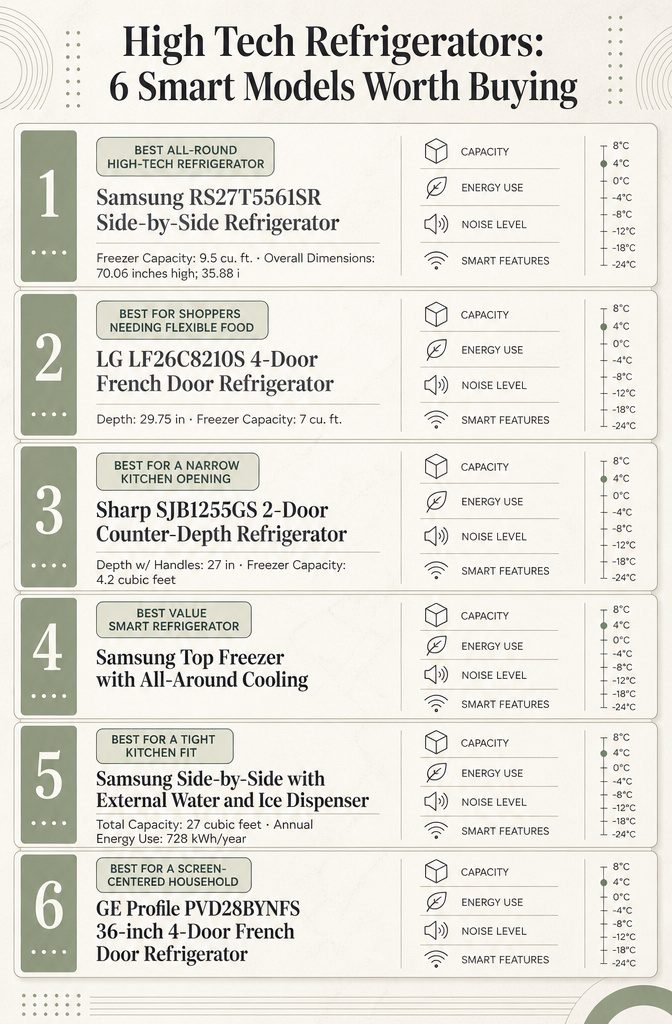
At about 12 inches narrower, the Sharp can fit openings in galley kitchens and older apartments where the LG cannot.
Width decides more than capacity
The Sharp SJB1255GS is 23.6 inches wide, and the LG LF26C8210S is 35.75 inches.
That gap of about 12 inches matters most in a galley kitchen or an older apartment with a narrow opening, because the Sharp fits where the LG never will.
The cost shows up inside. The Sharp holds 11.5 cubic feet total against the LG’s 25.5, and its 4.2-cubic-foot freezer fills quickly if 3 or 4 people share it.
For one or two people who shop a few times a week, that space is plenty. For a family that buys in bulk, the floor space you save gets paid back in a cramped freezer.
Freezer room versus fresh-food flexibility
The two big models split their space differently.
The Samsung RS27T5561SR has a 9.5-cubic-foot freezer, and the LG has 7. That extra 2.5 cubic feet helps anyone who stocks up on meat or batch-cooks and freezes portions.
The LG puts its space on the fresh side instead, with 15.7 cubic feet of fridge spread across 4 doors, so drinks, produce and leftovers can each get their own zone.
Owners of side-by-side models often mention that tall, narrow compartments handle wide platters and pizza boxes poorly. A 4-door layout avoids some of that.
If you cook mostly from fresh food, the LG fits better. If your freezer is always the first thing to fill up, the Samsung does.
The energy gap is small
The Samsung side-by-side with the external water and ice dispenser is rated at 728 kWh per year, against 691 for the RS27T5561SR.
That is about 5% more, with 27 cubic feet of capacity against 26.7. Ice and water features usually add some draw, and the 4.4-pound ice capacity is the thing you’re paying for in electricity.
If you refill pitchers and ice trays daily, the dispenser earns its place. If you rarely touch ice, the gap won’t change your bill much, but it’s still the better reason to skip it than the sticker.
I left the GE Profile and the top-freezer Samsung out of this comparison.
The spec sheets I compared don’t list matching numbers for them, and I’d rather skip a comparison than guess at one. Measure your opening before you commit to any of these.
Using food tracking features
Food tracking is where the brochure and the fridge drift furthest apart.
A camera or recognition system can only identify what it can see, so items behind the milk, leftovers in opaque containers, and anything in a drawer are likely to go unlogged.
I’d treat it as a quick look at your shelves from the grocery store, not a complete inventory.
One manufacturer describes image recognition paired with recipe recommendations, and Good Housekeeping lists food tracking among the smart features it tested. That confirms the feature exists.
It says little about how accurate it is. The owner comments I read praise the recipes and the screen, with one complaint about weak speaker sound, but those are impressions, not controlled testing.
Several of the models in this roundup don’t document food recognition, grocery lists, or recipes at all in the specs I found.
A retailer description of one connected model mentions recipe and grocery-shopping apps, and that is a seller claim, not an independent assessment.
Before you pay extra for tracking, check the exact model number and look for answers to these:
- What does the camera actually identify, and do you have to label items by hand?
- Does the food list sync to your phone, or stay on the door screen?
- Does it send expiration reminders, or only show what is on the shelf?
If the listing can’t answer those, the feature probably won’t change how you shop.
Frequently Asked Questions
Which smart features are actually useful day to day?
Remote temperature control and door-open alerts are the ones that fit what buyers most often say they want, because both help the refrigerator do its basic job. Touchscreen extras like recipes, lists, calendars, and media are harder to judge.
Owner comments praise the recipes and the screen, though one says the tablet sound isn’t very good. No independent source I found measured how responsive any of it is.
Do high tech refrigerators keep food at stable temperatures?
The research doesn’t settle that. Owners describe cooling well and keeping food fresh, and one maker claims it holds temperature within 1°F of the setting, but those are impressions and a manufacturer claim, not controlled tests.
Look for independent temperature testing of the exact model before you pay extra for features.
How much capacity should I expect?
Among the models I compared, total capacity runs from 11.5 to 27 cubic feet, and freezer space runs from 4.2 to 9.5 cubic feet.
One counter-depth model adds a 2.8 cubic foot convertible drawer that works as refrigerator or freezer space. Match the numbers against your real groceries and containers, since shelf and drawer layout matters as much as the total.
What does a smart refrigerator cost to run?
Listed annual energy use runs from 397 kWh for the smallest model to 691 and 728 kWh for the large ones.
The listings I read didn’t give an EnergyGuide operating-cost figure for every model. Check the EnergyGuide label for the exact model, plus its Energy Star status, and compare it with your local electric rate.
Do the connected features need Wi-Fi, an app, or a subscription?
Remote monitoring and temperature control are listed alongside Wi-Fi, so plan on a working home network. The sources don’t establish which phone platforms are supported, what the network requirements are, or whether any feature needs a subscription.
Alexa, Google Photos, and recipe apps appear only as seller claims. Confirm the details with the maker’s support page before you buy.
What warranty should I expect, and how reliable are these models?
Listed coverage is typically 1 year of parts and labor, 5 years on the sealed refrigeration system, and longer compressor coverage. One listing offers 10 years of parts on the inverter compressor with 5 years of labor, and another covers years 6–10 for parts only.
The smallest model I compared lists 1 year of limited parts and labor. I found no independent reliability data or repeated owner pattern about repairs, so that question is still open.
Is a smart model worth more than a simpler refrigerator?
Only if you will use the added functions. One commenter argues that feature-heavy French-door models tend to be less efficient and reliable, but that is a single opinion, not a corroborated pattern.
A fair test is to compare a connected model with a simpler one of the same capacity and fit, then check whether the premium buys anything you would use weekly.
Size also moves energy use, as the 397 to 728 kWh range shows.