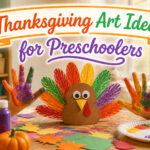
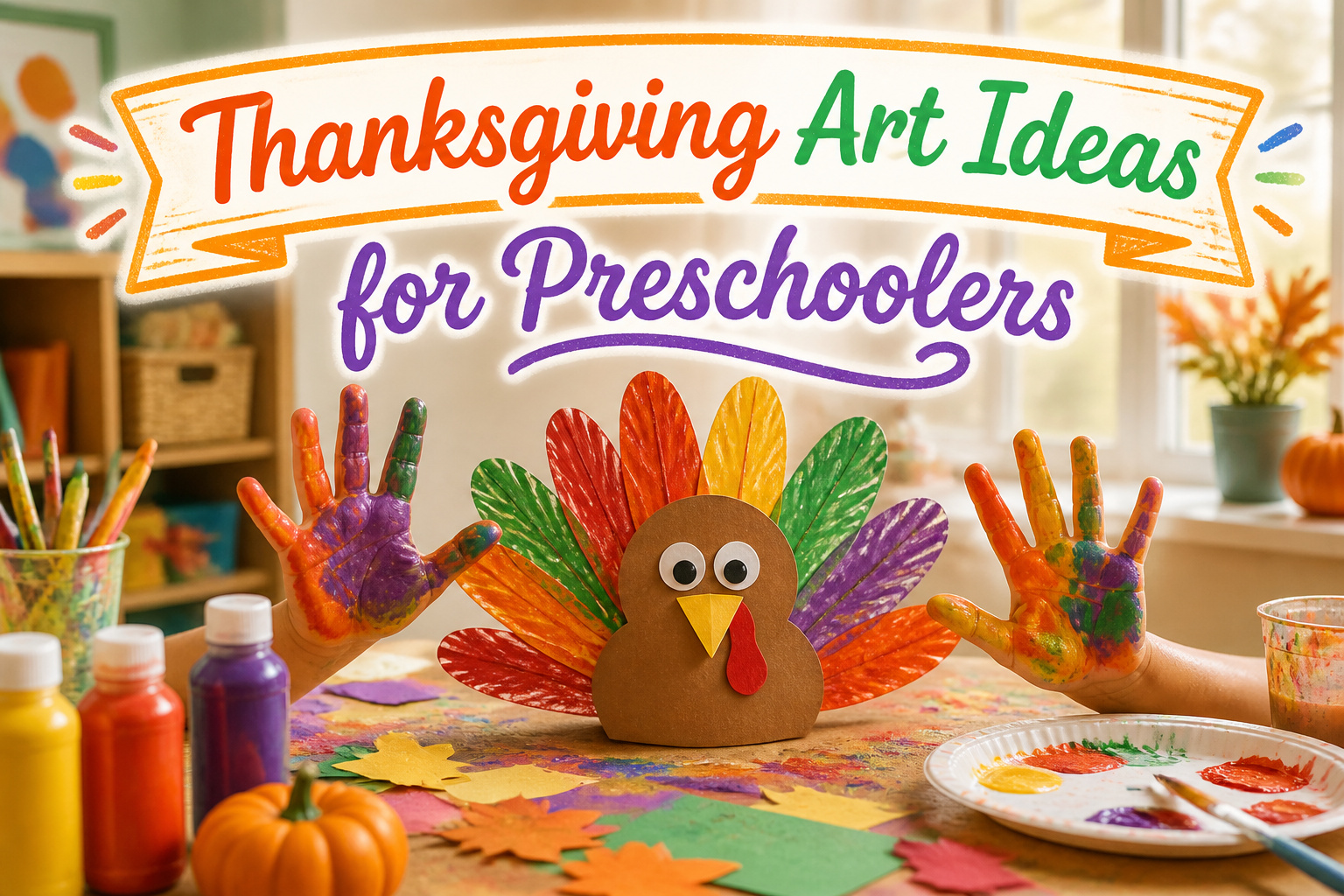
Preschool Thanksgiving crafts run from ten-minute handprint turkeys to weekend-long corn husk dolls, and the deciding factor is rarely skill level; it is how much drying time your afternoon allows. The handprint turkey survives because tracing fingers automatically gives you feathers, but paint flakes off paper plates by day three while construction paper cutouts survive the backpack ride home.
1. Handprint Turkey

The handprint turkey survives because it actually works with three-year-old motor skills, not against them. Tracing a small hand on construction paper gives a shape that reads as feathers without anyone having to draw a recognizable bird. The fingers become the feathers automatically, which matters when a preschooler’s idea of a turkey looks more like a lollipop with sticks.
Scissors are where this project lives or dies. Most preschoolers can close scissors by four, but steering the blade around a thumb outline takes bilateral coordination they are still building. I hold the paper and rotate it as the child snips; they manage the open-close motion without fighting the angle. Some teachers skip the cutting entirely and pre-trace, though the kids lose the fine-motor practice that justifies the craft in a classroom setting.
Paint versus paper for the hand itself is a choice I have stopped treating as optional. Painted handprints on paper plates look vivid in photos and terrible by day three, when the acrylic or tempera cracks and flakes off any surface that bends. Construction paper cutouts keep the hand shape, survive being carried home in a backpack, and let the child pick feather colors without the brown handprint dictating the palette. Googly eyes and a paper wattle finish it in ten minutes, which is about the remaining attention span after the tracing and cutting are done.
2. Paper Plate Turkey

A paper plate gives the turkey its body, but the coffee filter is what makes the feathers worth looking at. The plate is sturdy enough for small hands to hold and glue onto, yet it sits flat and dull. The coffee filter, once you hand a preschooler a marker and let them scribble, turns into something watercolor-soft that no construction paper matches. The colors bleed and feather outward in a way that looks intentional even when it is not.
Layering the two means the plate becomes the frame and the filter becomes the art. You can do this with a full-size dinner plate and a standard basket filter, or scale both down to dessert plates and cupcake liners if you want place cards that actually survive the meal. The smaller version keeps the same proportions without overwhelming a preschooler’s attention span.
What the coffee filter adds that the plate cannot is the bleed. Marker on paper stays where you put it. Marker on a coffee filter travels, and that traveling turns a scribble into something that looks like real plumage. The preschooler did the work; the material did the magic.
3. Toilet Paper Roll Turkey

Empty toilet paper rolls flatten under the weight of feathers and glue unless you seal the ends first. A strip of masking tape across each opening keeps the cylinder round and gives it a base that actually sits flat on the table.
For the feathers, regular school glue on cardboard works fine, but the paper needs something to grip. Construction paper cut into rough ovals and pinched while wet will hold a curve that reads as feather from across a room. Skip that pinch and they dry flat as pancakes, giving you a turkey that looks more like a paddle with eyes.
I have seen these topple straight onto the floor the second a three-year-old lets go. The fix costs nothing: a penny taped inside the bottom opening drops the center of gravity low enough that small bumps do not matter. Without that weight, you are relying on a perfect circle of glue and hope, and preschool glue circles are never perfect.
Paint goes on easier before the feathers, though most kids will add more after anyway. The cardboard drinks it in, so two thin coats beats one thick one that cracks when it dries.
4. Pinecone Turkey

The pinecone turkey works best when the gathering is half the project. A walk to collect fallen cones gives preschoolers something to do before the glue comes out, and the outdoor time usually settles them into the indoor work that follows. Closed cones need a warm oven first; 200 degrees for twenty minutes opens them enough to hold feathers and felt. Once the scales spread, a pinecone becomes an armature: tuck colorful feathers between the rows for the tail, press on googly eyes, and add a felt wattle or bow tie. Some kids want five feathers, some want fifteen, and either look right. Googly eyes with adhesive backs save a step, though white glue holds the heavier craft kind fine if you let it set flat overnight. The finished birds sit on a shelf through November or become place-card holders with a name tag on the front.
5. Yarn Pumpkins

Yarn pumpkins give preschoolers something solid to wrap their hands around while the glue dries. A small balloon works best as the form. You blow it up to roughly the size of a real apple, then help the child wind orange yarn around it in every direction. The trick is a thin glue mixture brushed right onto the yarn as it goes, so the strands stick to each other and not just the balloon. Too much glue puddles and takes forever to set; too little and the whole thing collapses once the balloon comes out.
After a full day of drying, the balloon gets popped and pulled out through a gap in the wrapping. What remains is a light, hollow orb that holds its shape because the yarn has fused into a net. A short brown pipe cleaner twisted around the top finishes the stem. The finished pumpkins fit in a child’s palm, and the uneven wrapping is part of the charm rather than a flaw to correct.
6. Gratitude Leaves Garland

Fall-colored construction paper and a marker are all this garland needs. Cut simple leaf shapes, about the size of your preschooler’s palm, and hand one over. A three-year-old usually needs a prompt they can see, so ask what made them laugh today or which stuffed friend they want to thank. The answer might be "macaroni" or "the dog," and that is the point. A five-year-old can handle the broader question, though they still benefit from a starting place like "What did someone do for you this week?" Write their words legibly, in their own phrasing, so they recognize it later.
String the leaves with a blunt yarn needle and thick thread, spacing them a hand-width apart so each answer has room to breathe. The finished strand works hung low across a kitchen window where small hands can still read it, or above a doorway at eye level for passing guests. Three feet off the floor keeps it visible to the child who made it, which matters more than centering it for adults.
7. Thanksgiving Countdown Chain

A paper chain gives preschoolers something to tear off each morning while they wait for Thanksgiving, and the loop construction is forgiving enough that a four-year-old can manage it without help. Cut strips about an inch wide from orange, brown, and yellow construction paper; preschool fingers grip better when the strips are a little wider than the standard quarter-inch version. Show them to bend a strip into a circle, overlap the ends by about half an inch, and seal it with a glue stick. Thread the next strip through that circle before gluing it closed, and the chain grows.
Start the chain about two weeks out so it hangs with some weight but does not tangle on itself or block a doorway. That gives you fourteen loops, which looks substantial on a dining room chair back or across a window frame without turning into a maintenance problem. The paper itself costs next to nothing, and if a loop gets crushed or the glue fails, the child just builds a replacement that same afternoon.
8. Coffee Filter Turkey

Coffee filters take marker in a way that makes the color worth keeping. For this turkey, markers beat paint because the pigment sits on the surface and bleeds in controlled lines when water hits it, not the muddy pool tempera leaves behind. I watched this happen a few times before I trusted it: the kids scribble across the filter, spray bottle in their own hands, and the colors run together while the white paper still shows through in veins. The water does the blending; they just supply the pressure.
The body is a toilet paper roll cut in half, construction paper folded for the wattle, and googly eyes from the same drawer where the markers live. The feather filter dries fast enough that the whole thing can assemble in one sitting, which matters more than it should with a three-year-old who has already moved on to snack time.
9. Turkey Windsocks

A leftover coffee can or a tin can from dinner makes the cylinder base for this one. Wrap it in brown cardstock, glue on a paper beak and wattle, and the body is finished. The tail is the part preschoolers love: strips of crepe paper or ribbon scraps hanging from the open rim, long enough to flutter when the wind hits them.
The trick is placement. A porch overhang shelters the windsock too much; the streamers hang still and the whole thing looks like a drooping decoration rather than a living craft. An exposed hook on a deck railing or a shepherd’s hook in the yard catches the kind of steady breeze that keeps those strips moving. Ribbon holds up better outdoors than crepe paper if rain is in the forecast, though either works fine for a dry November day. The project takes one sitting, and the materials are already in most craft drawers or recycling bins.
10. Pumpkin Seed Mosaic

Dried pumpkin seeds carry more personality than construction paper ever will. Last year I watched a three-year-old spend twenty solid minutes deciding whether a green seed belonged inside or outside the pumpkin outline. The seeds need real prep first: scoop them from a carved pumpkin, rinse off the pulp in a colander, then spread them on a baking sheet to dry overnight. A low oven speeds this up if patience is thin, but air-drying leaves them lighter and easier for small fingers to lift.
Cardstock holds up against the weight better than plain paper, which warps as glue dries and leaves the whole thing curling by dinnertime. A thin layer of white school glue brushed across the backing works better than squeezing from the bottle, the seeds slide around before they set, so preschoolers can nudge them where they want without the spacing police stepping in. Clumps of three seeds where one would do, a whole orange section abandoned for a sudden interest in purple paint, the abstract patterns hold up better than forcing a recognizable turkey. Fine motor skills get their workout either way, and the finished piece actually looks like someone enjoyed making it.
11. Pilgrim Hat Craft

Black construction paper folds into the simple geometry that preschoolers can actually manage: a circle for the brim, a cylinder or cup shape for the crown, and a rectangle buckle in yellow or white. The pieces are large enough that small scissors can handle them, and the shapes repeat enough that a four-year-old starts recognizing what a cylinder looks like flattened out.
The hat opens up the part of Thanksgiving conversation that gets awkward fast if you lead with it. A child this age understands costume, understands dress-up, understands that people a long time ago wore different clothes for working and for feast days. The hat becomes the entry point, not the lecture. You talk about what the buckle was for, or why black wool mattered when you lived on a boat and then in a cold house, and the conversation stays concrete because the child is holding the thing in their hands.
Paper plates, toilet paper rolls, or painted cups all work, though the cup version sits better on a shelf afterward. The toilet-paper-roll build takes glue and patience; the paper plate version lets them wear it, which matters more to some kids than display value. Either way, skip the glitter unless you want to find it in the carpet until New Year’s. Stickers or crayon details hold up better to actual preschool handling, and the hat survives the car ride home.
12. Corn Husk Dolls

Corn husk dolls open a small window into early American daily life, and the materials cost next to nothing. The husks need soaking first; warm water for about ten minutes softens them enough that small fingers can fold without tearing. A plain bowl of water works better than hot tap, which can weaken the fibers and make the husks split during the twist.
The basic shape starts with six to eight husks layered flat, then folded in half lengthwise and tied about an inch down to form the head. Arms come from rolling a few narrow strips and slipping them through the middle before a second tie creates the waist. Preschoolers will mostly manage the tying and stuffing; the even symmetry is where adult help saves frustration.
Finding husks outside October gets easier than most people assume. Latin grocery stores stock them year-round for tamales, usually in the dried goods aisle or freezer section. Dried husks keep indefinitely in a paper bag, so buying a pack in season works too. The ones from farm stands in autumn tend to be wider and more forgiving for first folds, but the grocery version builds the same doll.
13. Thankful Tree

A Thankful Tree gives preschoolers something to add to every day, and the build matters more than the craft-store finish. I use a limb from the yard, about two feet tall with enough forks to suggest branches. A coffee can filled with sand or dry rice holds it upright; the weight at the base keeps the tree from tipping once paper leaves multiply.
The leaves are simple cutouts from fall-colored construction paper, maybe three inches long, with a hole punched at the stem end. Yarn loops let kids hang their own additions. Each morning or after dinner, my preschooler names one thing, I write it on a leaf in marker, and she finds a branch to hang it from. By Thanksgiving the sparse limb looks full, and the accumulation matters more than any single leaf.
Leave the marker and blank leaves in a bowl beside the tree so the habit sticks without your prompting. The branches will sag if you use regular paper; construction paper holds up through November without curling.
14. 3D Pumpkin Craft

A 3D paper pumpkin pops off the table in a way flat crafts never quite manage. The build is simple: cut orange paper into eight or ten strips, let the preschooler scribble paint or crayon across them, then pin or tape the ends together so the strips bow outward into a round, standing shape. An adult handles the fastening and the spacing, since even strips are what keep the thing from collapsing sideways. The child owns every mark on the surface. One variation that stuck with me: writing a single thankful thing on each strip before assembly turns the finished pumpkin into a small gratitude exercise, which lands neatly with the holiday. A mixed-media route swaps paper sections for seeds, corn kernels, beads, or pom poms glued onto a cardboard pumpkin cutout. That version eats more time and needs more drying, but it teaches the same hand skills and the same patience. Paper wins for a single afternoon; mixed media wins if you have the weekend and do not mind the hunt for materials.
15. Thanksgiving Cards

A folded piece of cardstock becomes a card a preschooler can actually send, and the difference between craft and mail matters more than the decoration. The postal service wants a flat rectangle under one ounce, which means no glued-on buttons or pom-poms thicker than a quarter inch. Stick to crayon, marker, or a thin paper leaf and the card ships for a single stamp.
Preschoolers handle the folding, the scribbling, and the leaf placement if you pre-cut simple shapes. Gratitude enters when they dictate one thing to you to write inside, or when they make their own marks alongside your transcription. The card becomes a record of what they valued at four, not a polished design piece.
I have seen the best results when the adult handles only the address and the child handles everything else. The lopsided turkey, the misspelled "THANKS," the leaf glued slightly off center: those are the details grandparents save.
16. Edible Turkey Treats

Gumdrops stack better than you would expect, and a dab of peanut butter or frosting works as edible glue so the building stays upright long enough for a photo. The trick is setting the candy out in measured portions before the kids start; hand them the whole bag and half the turkeys get eaten before the second layer goes on. Raisins or candy corn make solid tail feathers, while pretzel rods snap too easily for little hands and end up frustrating. Apple slices turned on their side give you a round body that holds together without any adhesive at all, which means less mess and less sneezing on shared frosting bowls. A finished turkey on a paper plate travels to the fridge faster than it walks to the table, and the cold keeps the structure firm until after the pictures. The adults in the room handle the slicing and the portioning; the preschoolers handle the assembly and the proud carrying-over. If dessert doubles as the activity, nobody needs to bake.
17. Leaf Turkey

Dry leaves work best when they are already past the curling stage but not yet brittle enough to crack at a touch. The oak leaves in my neighborhood always seem to hold their shape through November better than the maple ones, which is the kind of thing worth testing on your own walk. Regular white glue will bond dry leaves to paper, though you need to press gently and let it set flat; the veins help the adhesive grab, but too much weight and the leaf splits along its own structure.
Paper feather versions let you layer and overlap without worrying about breakage, and they keep the tail upright on their own. Real leaves give you color variation no marker matches, especially that mottled brown-yellow mix that reads as actual autumn rather than craft-table autumn. The tradeoff is the timeline. One of the tutorials I kept seeing suggested faux leaves if the goal was a keepsake past Thanksgiving weekend, which felt like an honest admission. A leaf turkey using found materials is a two-day project at most: one afternoon gathering, one morning gluing. If your preschooler wants to carry it around or the classroom intends to pin them up through December, paper or artificial leaves win.
18. Thanksgiving Banner

A banner gives preschoolers a defined job within a bigger piece, which solves the problem of a project that swallows the whole afternoon and still looks like nothing. I trace block letters onto felt, one per child, and cut the rough rectangles ahead of time. The tracing and scissor work they do themselves, and that is enough: the letters do not need to be perfect because the string pulls them into a line and the irregularity reads as charm. Sparkly stickers cover a multitude of wobbly edges.
The gratitude angle comes from what goes between the letters. Felt leaves, maybe, or paper feathers the kids color while I string the main line. Their work hangs at the center, mine fills the gaps, and neither piece makes sense without the other. Felt holds up to toddler glue and stores flat for next year if you are the type to save these things. String and stickers run under ten dollars if you need a hard ceiling; the felt is the bulk of it and a yard gets you more letters than you have nieces and nephews.
Two ways to hang it: across a doorway where short arms can reach to point at their own letter, or above the table where the adults sit and the kids watch them read the word. The doorway wins if you want them to keep visiting it.
19. Thanksgiving Bingo

Not every Thanksgiving art slot needs to end with something glued to construction paper. A bingo set built around the holiday’s visual vocabulary fills the same time block and gives preschoolers practice recognizing and naming images they already see on the table and in picture books.
I make the cards by folding cardstock into quarters, then drawing or printing a 4×4 grid on each. The images go in the squares: turkey, pumpkin, pie, leaf, acorn, cornucopia, pilgrim hat, family at table. Preschoolers respond to the turkey and pie fastest; the cornucopia usually needs a prompt the first round, but they lock it in by the second. Draw one image rather than write the word so pre-readers play without help.
Markers can be anything small and plentiful: dried beans, buttons, torn paper scraps. The caller holds up a card or describes the image, and the players hunt their grids. The art practice is in the card-making itself, in the looking and matching, and in the fine motor work of placing markers precisely.
The game runs about fifteen minutes, which is the outer edge of attention for most three- and four-year-olds. I keep a few blank grids ready for kids who want to draw their own versions during the rounds they sit out.
20. Thanksgiving Day Placemats

A preschooler-made placemat needs to earn its spot on a table that sees gravy boats and butter knives. Two paths work: sealed paper that survives one meal, or fabric paint on a real cloth that gets folded away for next year.
An 11-by-17 inch sheet hits the right scale. That leaves room for a dinner plate plus a small hand to steady a cup without drifting into territory where a four-year-old’s reach can’t clear the edge. Anything larger and the turkey drawing ends up under the silverware.
For single-use, thick paper with tempera handprints works if you run it through a cold laminator after the paint dries. The laminate keeps cranberry sauce from soaking through, though a determined fork will still punch holes. For the fabric route, basic cotton and fabric paint let a child stamp leaves or trace a hand-turkey that actually absorbs into the weave instead of flaking off. The painted tablecloth route from that leaf-print project scales down neatly: same outdoor gathering of leaves, same paint, but confined to a placemat-size rectangle so the mess stays manageable.
I skip the activity-page placemats with mazes and word searches. Preschoolers ignore them once the rolls hit the table, and the point here is art they made, not a restaurant simulation.
Frequently Asked Questions
What are some easy Thanksgiving crafts for preschoolers?
Handprint turkeys, paper plate turkeys with coffee filter feathers, toilet paper roll turkeys, and yarn pumpkins all work well with preschool motor skills. Each uses simple materials like construction paper, glue, and markers, and most finish in one sitting. Pinecone turkeys and gratitude leaf garlands also make the list without requiring advanced cutting or writing.
How can Thanksgiving crafts for preschoolers promote gratitude?
Gratitude leaves garlands and Thanksgiving cards give preschoolers a concrete way to name what matters to them. A child might say they are thankful for macaroni or a stuffed animal, and writing those exact words on a leaf or inside a card preserves that moment. Thankful trees work the same way, adding one leaf daily until Thanksgiving fills the branches.
What supplies do I need for Thanksgiving crafts for preschoolers?
Construction paper, white school glue, markers, scissors, and googly eyes cover most projects on the list. Coffee filters, paper plates, toilet paper rolls, and yarn handle the rest. For specific crafts, add balloons for yarn pumpkins, pinecones for nature turkeys, or dried corn husks for dolls. Nothing on the list requires specialty store runs.
Why are Thanksgiving crafts beneficial for preschoolers?
Cutting handprint turkeys builds bilateral coordination, wrapping yarn pumpkins strengthens grip control, and placing pumpkin seeds in a mosaic trains fine motor precision. Crafts also give preschoolers a finished object they carried home themselves, which builds independence. The emotional piece matters too: gratitude crafts let children name their own feelings in their own words.
How can I make Thanksgiving crafts for preschoolers more engaging?
Gathering pinecones on a walk before building the turkey turns one craft into two activities and settles children for indoor work. Letting preschoolers spray their own coffee filters with water gives them control over the color bleed. For edible turkeys, measuring candy portions beforehand keeps the build from becoming a snack free-for-all before the second layer goes on.