

Classic Christmas decoration ideas range from a $39 cedar garland to full room overhauls, and the deciding factor is what your walls already do. Cooler spaces need green as the base with red in smaller touches; navy or cream rooms let the traditional palette sit forward without feeling repainted. The real test is whether your existing furniture fights the color or frames it.
1. Traditional Color Palette
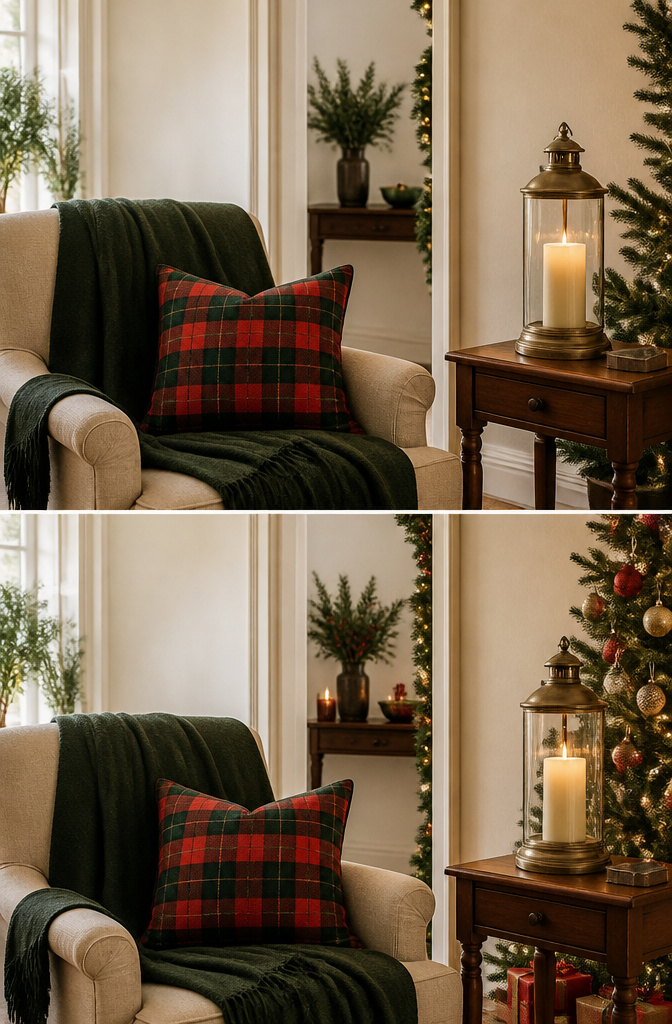
Red and green carry the weight of memory whether you grew up with them or not, and that is why they still anchor most classic Christmas decoration ideas. The pairing works because it already lives in the mind: holly berries against waxy leaves, the stripe on a candy cane, the velvet ribbon on a wreath. Green reads as nature and hope, red as the joy that survives a short winter day, and together they do the emotional lifting without any single object having to try too hard.
Plaid pushes that warmth toward rustic territory. A red-and-green tartan pillow or a frayed velvet ribbon tied around brass candlesticks reads as found rather than staged, and the pattern repeats well across rooms without looking copied. I have seen the same oversized plaid pillow move from a navy armchair to a sofa to a window seat and register as intentional each time because the palette stays consistent.
The real test is whether your walls already fight you. A navy chair takes a red throw without apology; cream or gray walls let the colors sit forward. If your space runs cooler, lean on green as the base and add red in smaller touches so the room does not feel repainted by accident. The plaid itself does the unifying work, not a fresh coat of anything.
2. Classic Christmas Wreaths

A wreath’s lifespan depends almost entirely on where you hang it. Fresh greenery holds up outside for roughly two weeks, maybe three if you spray it with Wilt Stop before the first freeze sets in; dried or preserved wreaths last longer indoors where heat and dry air would crisp a live one in days. Artificial options skip the whole timeline, and swapping the ribbon each year gives them a new look without much spend.
For a standard front door, 24 inches is the diameter that reads right: full enough to feel generous, not so large it bangs the frame every time someone enters. Window wreaths need the opposite logic. Visibility from the street matters more than presence up close, so a slimmer profile and a plaid or contrasting bow tend to read better from the sidewalk than dense greenery pressed against the glass.
Exterior doors in wet or windy climates push you toward artificial or at least preserved boxwood; interior heat makes dried magnolia the safer bet for a foyer. LED lights clipped to a dried wreath add evening warmth without the fire risk of candles or the heat of old incandescents, and a surge protector is non-negotiable if you’re plugging anything in outside. The personalization is in the details: tartan ribbon for a vintage feel, a single oversized ornament wired in for something quieter.
3. Garlands

Greenery draped over a mantel or staircase reads as classic only when the lights are already worked in, not clipped on afterward as an afterthought. The strands need to be tested for length before you hang anything: a 6-foot garland with a 9-foot light string leaves three feet of cord to hide or three feet of garland sitting dark. Extension cords disappear best when they run behind the garland itself, tucked into the curve where the greenery meets the wall, rather than trailing down to an outlet in plain sight.
The $39 Woodland Cedar Garland sets the price ceiling that makes layering affordable. At that point you can add a second strand with berries or pinecones without the total crossing into showroom territory. Two garlands, one plain and one dressed up, give more flexibility than one expensive piece that tries to do everything. The plain cedar works across a doorway where traffic brushes it; the berry layer stays higher on the mantel where it will not shed.
Battery lights solve the cord problem on stair railings where no outlet sits close, but their color temperature rarely matches plug-in strands. Mixing the two on the same run is the mistake that makes the whole thing look assembled from leftovers.
4. Vintage Ornaments
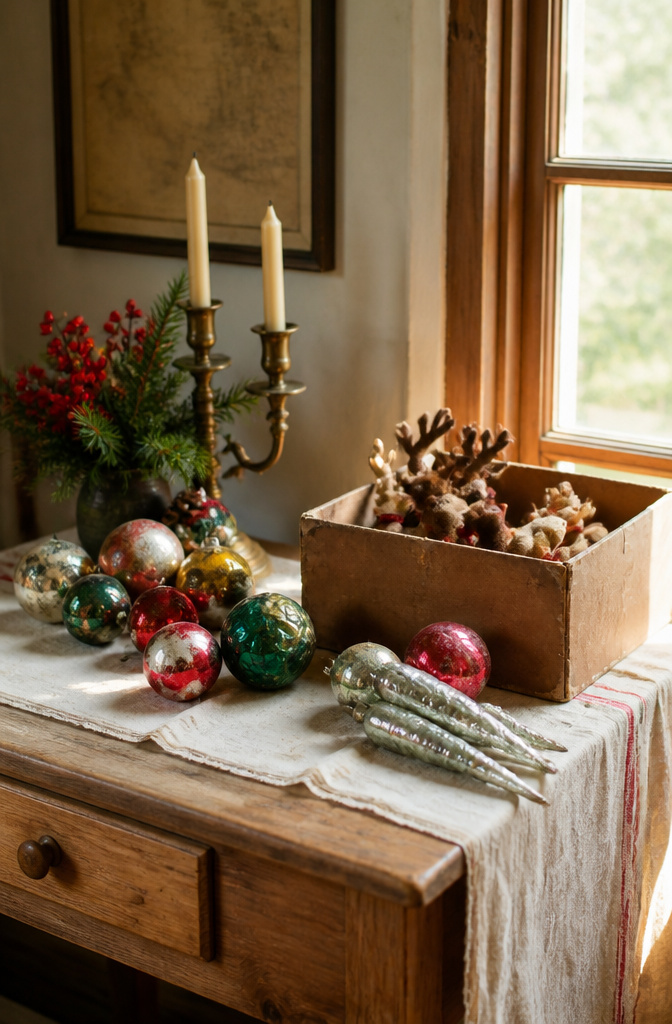
Vintage ornaments carry the weight of the holidays better than anything new off the shelf. Glass globes from the 1950s, tarnished metal icicles, even the slightly lopsided felt reindeer your grandmother hung, each piece carries its own era and the mix is what saves the look from feeling like a museum display. I group by color rather than decade, reds and golds across forty years of manufacture, and the clash of 1960s satin with 1980s glitter reads as intentional rather than accidental.
The hunt matters as much as the hanging. Estate sales in early November, before the serious collectors arrive, still turn up boxes of Shiny Brite and Polish glass for a few dollars. Thrift stores are less predictable but the prices stay low. For reproductions, several makers now cast new glass in mid-century molds; the weight is wrong and the colors are too saturated, but from three feet back the effect holds. Store ornaments in original cardboard dividers or egg cartons, never loose in a bin where surface decoration flakes against hard edges.
What fails is predictable. Thin glass hooks rust through and drop ornaments without warning. Painted details on pre-1970s pieces crack if the attic temperature swings too wide. The repro lines fade faster, two or three seasons before the gold turns brassy. Real vintage glass, handled around the cap instead of the body, outlasts the new stuff by decades.
5. Table Settings

Vintage dishes do not need to match to read as a set. Three plates in cream ironstone, two in faded pink transferware, and a single chipped gravy boat in blue will pull together if the linens repeat one color from each piece. I lay a runner in a muted cranberry across a pine table, then let the plates overlap slightly so the edges create their own pattern. The eye fills in the rest.
A centerpiece for display can sit tall: taper candles, forced paperwhites in a low bowl, a brass deer borrowed from the mantel. For actual dinner, anything above eye level blocks the person across from you, so the same table drops to a runner of seeded eucalyptus and three votives in mismatched jelly jars. The rule I follow is candles below the wine glass stem, greenery below the plate rim.
The 15% off ribbon deal I spotted on white-and-gold velvet, 4 inches by 5 yards, works as the bridge between mismatched elements. A 33.99 yard of 2.5-inch jewel-trim dupion metallic back ribbon, also at 15% off to 42.49, ties napkins or weaves through a centerpiece base with more texture than wire-edged polyester. I cut lengths the night before, not the hour of; velvet creases if you rush it, and the point of classic styling is looking like you did not.
6. DIY Projects

One project that keeps coming back onto my list is a laminated cookies-and-milk placemat kids can color themselves. The first time I tried it, I skipped the test run and the markers bled straight through standard printer paper onto my dining table. Now I use 110 lb cardstock, no exceptions.
- Cut two 12-by-18 inch rectangles from heavy cardstock.
- Draw or print a simple milk glass and cookie outline dead center, leaving a 2-inch border clean.
- Let kids color with washable markers, then wait a full hour, longer than feels necessary.
- Run both sheets through a hot laminator together, sealed edge first, to prevent curling.
- Trim the seal to a quarter inch and round the corners so they don’t spear anyone.
The whole thing takes about twenty minutes of actual work plus drying time. Store it flat in a drawer and it holds up for years, which matters more than it sounds when you are already managing a hundred DIY decorations and need the ones that do not become landfill by New Year’s.
7. Outdoor Decorations

Outdoor decorations live in two climates at once: the one that judges them from the curb and the one that actually wears on them through December. I learned this the hard way with a garland I hung too early; by the third week it had soaked through three freeze-thaw cycles and dropped needles across the porch like it was giving up. Now I wait until after Thanksgiving, even if the neighbors start sooner.
LED lights are the move for anything plugged in outside, and not just for the power bill. They throw less heat, which matters less than you’d think for fire risk and more for what happens to the wiring inside the bulb housing when water gets in. The sources all agree on surge protectors and checking for frayed cords, but the detail that stuck with me is securing with clips instead of nails. Nails let water wick in behind the socket; clips let the strand move with the wind without working the copper loose.
Timers earn their keep out here. A strand running dusk-to-dawn burns maybe six hours longer than one timed to shut off at midnight, and in January that gap matters for how fried the sockets are when you finally take them down. Speaking of which: wreaths and garlands come down first, ideally before the serious freeze-thaw punishment of late January. Anything purely structural, lights clipped to gutters or railings, can wait until February if you’re willing to spot-check for ice damage. The themed displays, the ones you built around a figure or a scene, those are the ones that look sad fastest once the holiday passes, so they go first too.
Unique Tree Alternatives

A full evergreen in a studio apartment eats floor space you do not have, and most leases do not forgive sap on carpet. Two directions solve this without looking like you gave up.
Foraged branches hung against the wall give the silhouette without the footprint. String them in a rough triangle, add lights and ornaments the same way you would on a standing tree. The branches dry out, so the arrangement lasts the season and then goes back to the yard. Weight is the limit: test the hook with the full load before you decorate, not after.
Cardboard builds bigger. Recycled boxes fold into a full-sized tree that stands on its own, carries lights, and folds flat for storage once January hits. No watering, no needle drop, no argument with a landlord. The tradeoff is surface texture; paint or wrap paper around it if the corrugation reads too warehouse.
Both options skip the ritual of circling a trunk with a skirt and fighting the stand. For a few hundred dollars and a Saturday, you get the shape and the lights without the square footage.
Seasonal Textures
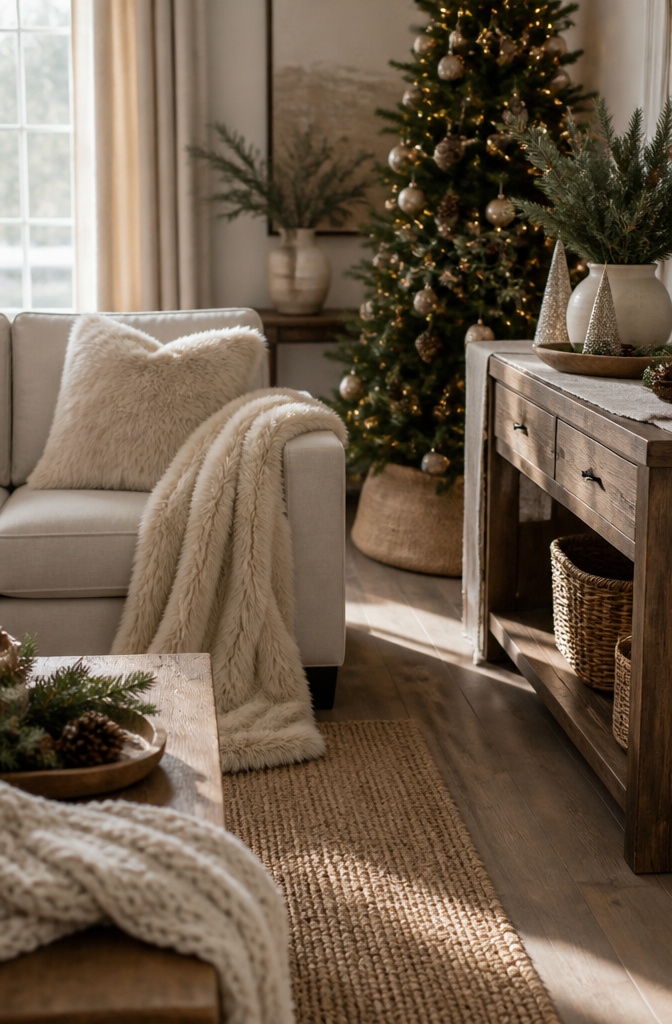
Faux fur throws draped over the sofa read classic when the pile is short and the color stays cream or camel. I learned that the hard way after a shaggy pink blanket I bought in 2019 photographed like a stuffed animal and looked dated by February. Macrame works the same way: thick cotton cord in an off-white or oatmeal tone looks like something your grandmother might have owned, while the thin, dyed stuff in sage or rust screams the year it was made.
The trick to layering these textures without turning the living room into a craft fair is keeping the visual weight low. A wool runner on the console, a burlap tree skirt with a clean hem, one faux fur pillow per seating area. The eye needs flat surfaces to rest on. I spread three textures in my own place last year and the room felt busy; this year I cut back to two and the warmth stayed without the clutter.
What separates classic from trendy is the finish. Burlap reads timeless when it is lined so it does not shed, and wool looks collected rather than purchased when it carries a little fuzz or an uneven weave. Faux fur should feel dense enough to hold its shape, not the thin acrylic that mats where your elbow rests.
Natural Elements

Dried orange slices keep that vintage look for weeks if you dehydrate them fully, but a half-dry slice in a warm room will mold before New Year’s. I run mine until they click when dropped, then thread them with cinnamon sticks and bay leaves through holes drilled near the rind edge. Drill, don’t pierce with a needle; a clean hole keeps the slice from splitting and dropping crumbs across the table.
Pinecones shed scales as they dry further, so a coat of matte sealer on the outside and a dab of hot glue where scales meet base keeps them intact through handling. For scent, dried rosemary and whole cloves last the season without turning; fresh eucalyptus looks lush for ten days then bruises brown and drops oil spots. If you want the greenery note, preserved cedar holds better than fresh boxwood in dry indoor heat.
Shea McGee’s approach to scent as design tool lands precisely here: you do not need themed clutter when a bowl of orange slices and dried sprigs sets the room.
"Scent is such a powerful design tool, especially around the holidays. I like to set a mood that feels familiar and warm through a bowl of orange slices, dried sprigs, or a classic winter candle."
What this means in practice: arrange your natural elements where people pass close enough to catch the fragrance, not packed behind glass where you get the visual and lose the point entirely.
Budget and Timeline

Classic Christmas decoration ideas do not have to drain a December paycheck. The projects that keep coming up are the ones built from what is already cheap or already free. A batch of DIY flocking snow mixes in five minutes and covers tabletop trees, berry centerpieces, wreaths, or garland without a separate trip to the craft store. Terra cotta pots get their holiday moment with printable wraps that turn them into decor or last-minute gifts. For wall space, a favorite carol stretched across an oversized canvas runs about $15 and reads as intentional, not last-resort. The hanging branch tree is where the real savings land: foraged limbs strung overhead, lit, and ornamented like any evergreen, with no floor space sacrificed and no tree lot receipt. Renters especially win here, since the whole thing disappears into a closet January 2. Sale shopping helps, but the bigger move is skipping the category that eats budget whole and building the tree yourself from what the yard dropped.
Cohesion Mistakes
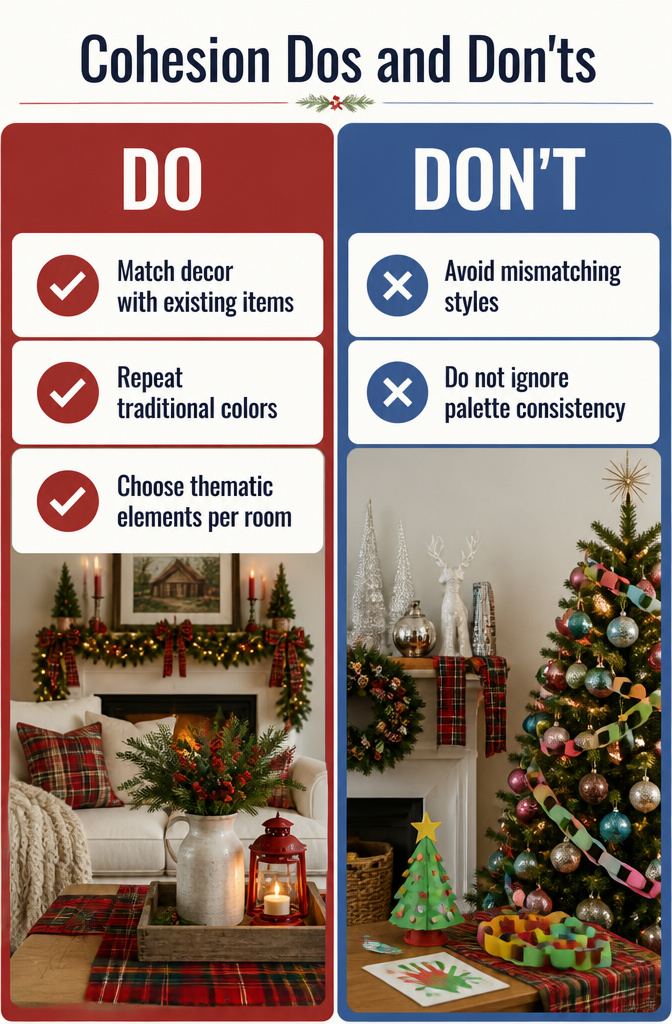
The year I bought mercury glass ornaments because they caught the light beautifully, I hung them on a tree strung with bright retro balls and homemade paper chains from the kids. Each piece was fine on its own. Together they looked like three different holidays collided in my living room.
Matching decorations to what you already own matters more than any single item’s charm. A traditional red-and-green palette only reads as classic when it repeats across enough pieces to feel intentional. That year I had the plaid ribbon on the mantel, the neutral mercury glass on the tree, and the kids’ colorful crafts on a second tree in the playroom. Separating them by room saved the look, but it taught me to decide the palette before I buy anything.
Now I start with the house itself. Cottagecore details like natural greenery and soft plaids sit easier in my slightly rustic space than the glacial modern figurines I once tried on the same shelf. One consistent thread, carried through three or four touches per room, does what a dozen unmatched beauties cannot.
Why Vintage and Plaid Now
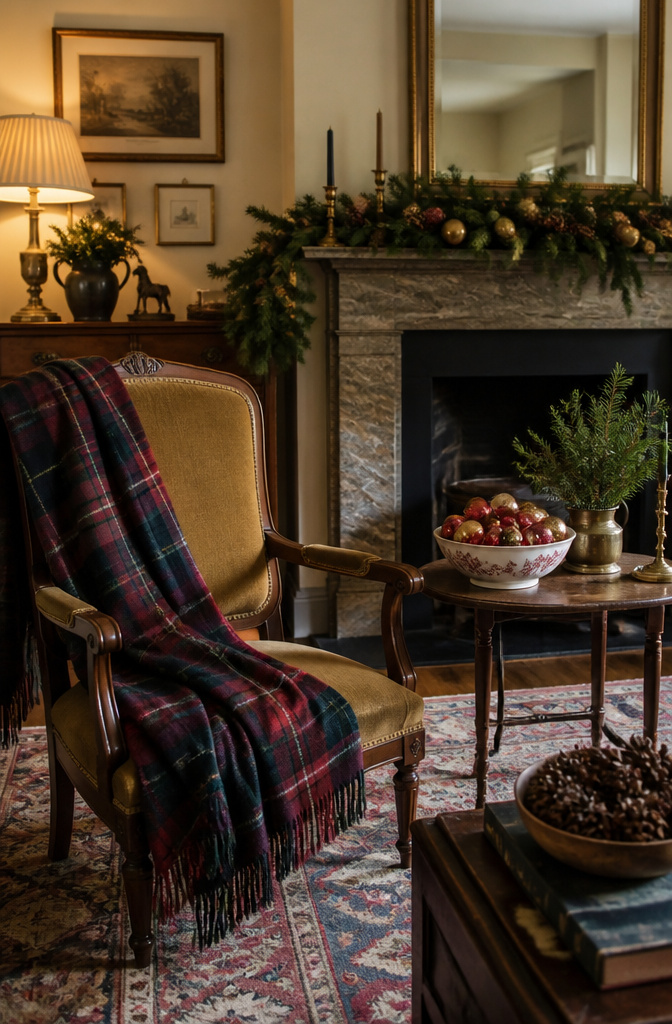
Vintage Christmas décor keeps circling back because it solves a problem the trendy stuff doesn’t: you can reuse the same core pieces year after year without the living room feeling stale. The sources describe this as a "capsule" of decor, swapping only gift wrap and ribbon to shift the color scheme while the heavy lifting stays put. Plaid and tartan patterns anchor that system. They read as festive without fighting the architecture of a rental or a first home, and they hide the wear that comes from actual use better than metallic or monochrome schemes. Natural greenery works the same way, though the sources note the safety reality: LED candles and lights reduce heat, and surge protectors matter when you’re stringing vintage-style bulbs on real garland. What the trend reports call "nostalgia" is really practicality dressed up. A 30-year-old dish set qualifies as vintage now, which means the look is accessible at thrift-store prices rather than antique-mall markup. The wooden lanterns, bell garlands, and bottlebrush tree clip-ons the sources mention all share that quality: they look collected over time, not bought in a single weekend, even when they were.
Frequently Asked Questions
What are some budget-friendly Christmas decorating ideas?
The hanging branch tree costs nothing but time: foraged limbs strung overhead, lit, and ornamented like any evergreen, with no floor space sacrificed. DIY flocking snow mixes in five minutes and covers tabletop trees, wreaths, or garland without a craft store run. A favorite carol stretched across an oversized canvas runs about $15 and reads as intentional wall decor.
How can I make my Christmas decorations look cohesive?
Match decorations to what you already own rather than chasing any single item’s charm. A consistent color palette, repeated across three or four touches per room, does what a dozen unmatched beauties cannot. Separate clashing styles by room if needed; that year I had plaid ribbon on the mantel, mercury glass on the tree, and the kids’ colorful crafts on a second tree in the playroom.
What are popular Christmas decorating trends?
Vintage decor, plaid and tartan patterns, and natural greenery are the standouts. Vintage pieces work because you can reuse the same core items year after year, swapping only gift wrap and ribbon to shift the color scheme. Plaid hides wear better than metallic or monochrome, and natural greenery pairs safely with LED lights and surge protectors.