

A cozy house exterior is the feeling that someone actually lives there, not that a designer just left. The cost is lower than most renovations because the biggest change is restraint: one vintage piece against two plain ones, not a costume drawer of cottage props. A $34 cedar trellis and $12 in ivy starters can soften a corner in two seasons if you leave six inches of air between vine and siding so moisture stays out.
1. Trellising and Trailing Ivy

Hard edges on a facade read as new construction even when they are not. A cedar trellis running the height of the front porch post and a handful of English ivy starters changed that for me in about two seasons. The trellis cost $34, the three plants $12, and the labor was an hour with a drill and a level.
The mistake came from impatience. I planted the starters right against the siding, thinking the ivy would find its grip faster. It did, and within a year the tendrils had slipped behind the clapboard and started holding moisture where paint meets wood. I pulled it all back, cut a foot of clearance, and reset the root balls on a slight lean away from the house. Leave six inches of air between vine and siding; the ivy still climbs, but the wall stays dry.
Now the post looks like something that grew there. The cedar has silvered, the ivy filled in unevenly in the way actual old cottages do, and the whole corner softens without looking maintained to death. The cost is low enough to risk, and the correction is cheap if you start too close.
2. Wood Paneling and Natural Textures

The cedar shake panels above my porch came from a lumber yard about twenty minutes outside town, not the big box store where I usually grab two-by-fours. I wanted the rough-sawn stuff, the kind that still smells like the mill, and the guy behind the counter talked me out of the pre-finished option without me even asking. Saved a few dollars per square foot, but that was not the point. Pre-finished shakes sit too flat, too uniform; the whole point of this kind of texture is that each piece catches light differently through the day.
My existing siding is smooth painted Hardie board, almost flat to the eye, and the contrast is what makes the porch feel like an addition with history rather than a weekend project I finished last fall. The rough grain shadows change from morning to evening, so the wall looks alive in a way painted surfaces do not. Installation took about six hours with a borrowed nail gun and a level I trust. I left the cedar raw, no stain, because graying naturally beats any color I would have picked in a store under fluorescent light.
3. Original Fixtures and Antique Pieces

A 1987 ranch house arrives with almost nothing worth keeping. The builder-grade mailbox was plastic, the porch light a flat brass disc that aged badly. If you want original, you have to import it yourself.
I started at estate sales on Saturday mornings, the ones advertised in neighborhoods built before 1960. The cast iron mailbox cost $45 and still carried someone else’s house number, ground off with a wire wheel in twenty minutes of work that threw sparks across the driveway. The porch light was $18, a 1960s aluminum lantern with cracked gaskets and wiring that crumbled when I touched it. Rewiring took an hour, a YouTube video, and a $7 tube of dielectric grease.
The mistake I almost made was tucking them against the house where new fixtures would sit. These pieces need breathing room. The mailbox went on a post six feet from the walk, where you actually approach it. The light hangs from a short arm off the porch beam, not flush to the wall, so it throws a real shadow. Displaying them as the focal points they are, rather than hiding them as functional afterthoughts, is what changed the exterior from "updated" to something closer to a cottage.
4. Sheer Linens and Low Silhouettes
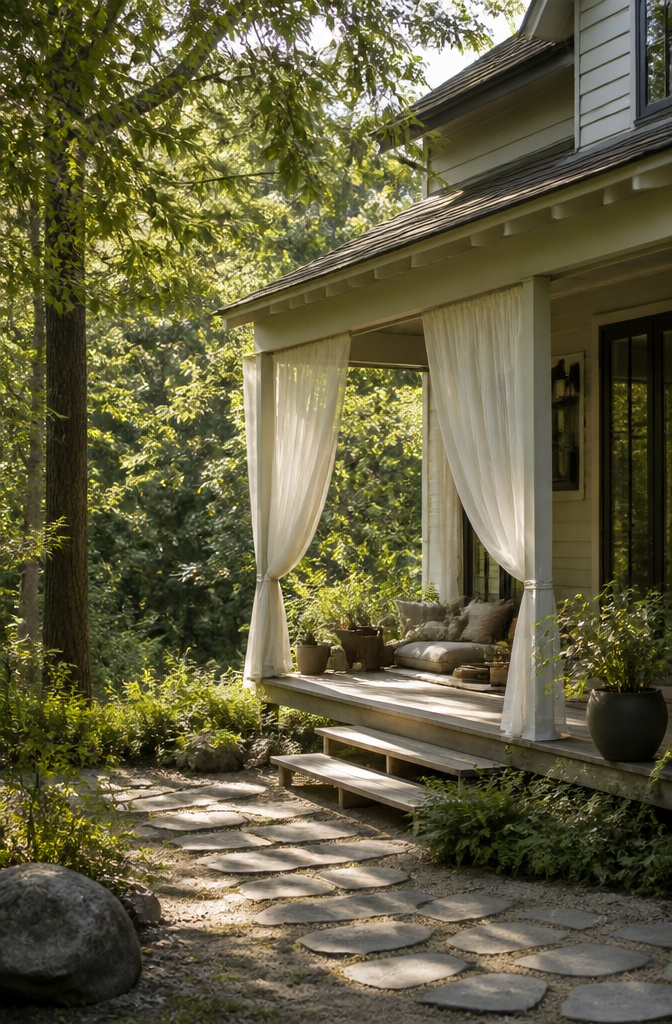
The porch ceiling was already there, so the hard part was finding curtains that would not rot in humidity. Outdoor-rated sheers exist, but most stores stock them only in beige or navy. I found white panels at a discount store for $22 each, hung them on a tension rod, and spent two days watching the center drop an inch and a half before I admitted the span needed a bracket. The fix cost $4.
The seating mattered more than I expected. Standard patio chairs sit 18 inches off the ground, which left everyone staring at my knees above the rail. I cut two old wood-frame chairs down to 14 inches, just enough that the seat cushions skim the porch floor. Low furniture reads as settled, not temporary, and the sheers filter the light without blocking the breeze. The whole setup looks like someone lives here, which is the only definition of cozy that lasts past sunset.
5. Quaint Symmetry and Mixed Patterns

Two mismatched planters flanking a door sounds like the kind of mistake that happens when you grab what’s left at the nursery in October, but the pairing on my porch was deliberate. The blue-and-white glazed pot on the left and the plain terracotta on the right share nothing except their trailing bacopa spilling over the rims. The symmetry of placement lets the patterns clash without chaos because your eye registers the matching heights and equal spacing first; the surface decoration reads as variation, not accident.
I used to buy matching sets. Then I noticed that the pairs looked flat in photographs and somehow flatter in person, like a hotel entrance. The rule I follow now is simpler than I expected: one element matches, one varies. Here, the plant and the scale match. The color and the pattern vary. If both pots had been different colors and different shapes, the effect would tip into junk-sale territory. If both had been identical, the door would look catalog-staged instead of lived-in. The bacopa does the actual unifying work, green threading between the two colors, and the symmetry gives it a frame to hold onto.
6. Every Knickknack
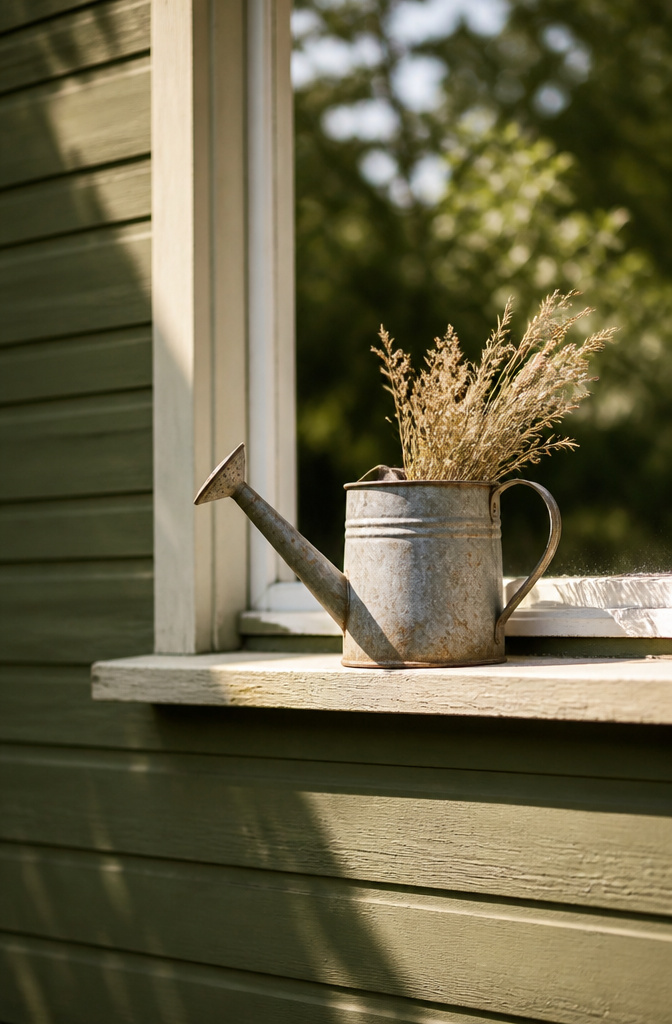
A windowsill of too many small things reads as yard sale, not cottage. I learned this the hard way the summer I set out every ceramic bird, painted sign, and rusted watering can I owned. The result was clutter that swallowed the siding color I had just spent two weekends painting.
Now I keep a single rotation: one piece per season, moved from a closet shelf to the ledge and back. The ceramic robin comes out in spring. A weathered "Welcome" sign, the paint flaked to silver, stays through fall. A galvanized watering can, dented and useless for actual watering, sits winter mornings with dried grass tucked inside. Each change takes about ten minutes, costs nothing, and makes the window read as intentional rather than accumulated.
One item at a time is the rule. The eye needs empty space to call something special. Give it three competing knickknacks and the brain registers noise. Give it one, with a foot of bare sill on either side, and it registers charm. The watering can alone looks like a found object. The watering can plus bird plus sign looks like you could not decide.
7. Bringing Nature Close
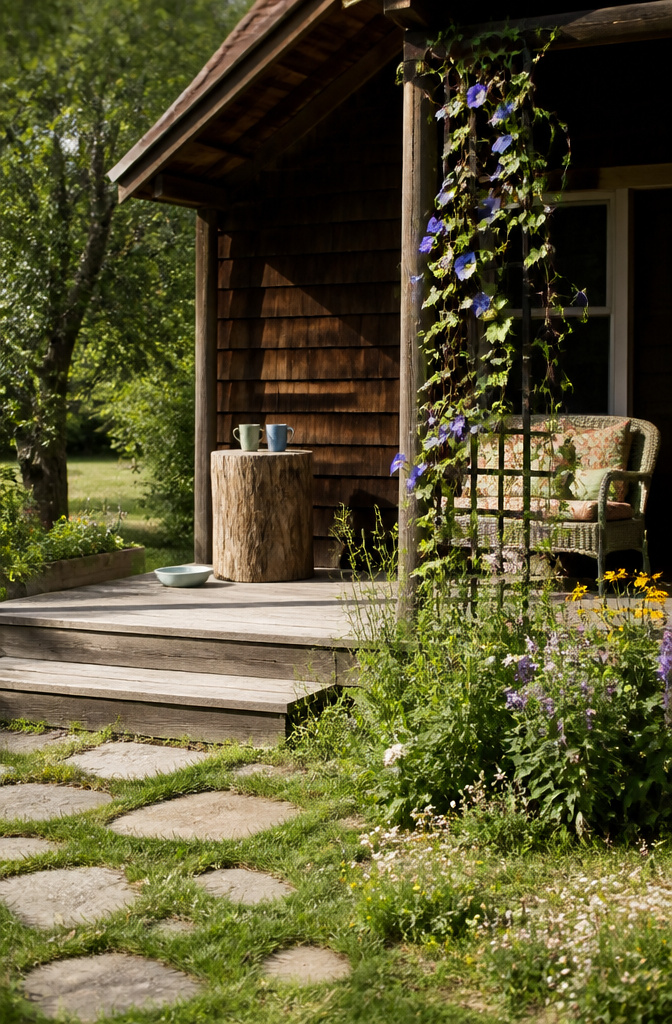
The log pile I kept meaning to haul away became my favorite side table last spring. I leveled the bottom with a hand saw, sealed the cut ends, and now it holds coffee mugs on the porch where the afternoon light hits. Fallen branches from the neighbor’s oak became a trellis for morning glories with nothing but baling wire and patience; by August the wall beside my steps was solid blue until noon.
A bird feeder on the porch rail draws finches that chatter while I eat breakfast. The small water dish below it, nothing fancier than a glazed saucer from a broken pot, brings in bees I now expect and no longer swat at. Letting the yard stay a little messy is what made it feel like part of the house instead of a separate project. The tidy lawn I tried for years never looked cozy. The sticks and seed shells do.
8. Accentuating Small Spaces

A six-foot-deep porch sounds generous until you try to fit anything on it. Mine is twelve feet wide and barely that deep, a strip of concrete most people would treat as a landing pad for the door. I wanted it to feel like a room, not a threshold.
The rug came first, an outdoor flatweave that runs wall to wall and visually erases the concrete. A side table followed, narrow enough that a coffee cup fits but knees don’t bang it. The chair angles toward the street, not the front door; facing outward lets the porch breathe, while an inward-facing chair turns the space into a crowded hallway. Thirty inches of clearance for the door swing is the measurement that matters, a detail I learned the hard way after setting everything too tight and having to drag it all back out the same afternoon. That gap is non-negotiable on a porch this size.
9. Maximizing Outdoor Space

A cozy house exterior lives or dies on whether the space outside your walls feels like rooms you forgot to furnish. My porch was technically square footage, but it read as a concrete slab until I laid down a $65 outdoor rug with a low pile and a faded stripe pattern. That one rectangle turned the concrete into a sitting area my brain recognized as part of the home.
String lights did the rest. I bought two strands of globe bulbs rated for damp locations and strung them from the eave to the fence post, maybe twelve feet total. The trick was the power source. An outdoor-rated extension cord, the kind with a three-prong grounded plug and a weather-resistant jacket, runs from the exterior outlet under the porch rail and out to the post. No electrician, no trenching, no permit. The cord lies flat where the rug covers it, and I bring the plug end inside when the forecast turns.
I stayed out past dark the first night because the lights dropped the ceiling low and the walls far away. That is the whole project: not more space, but space that asks you to stay in it.
What Cottagecore Means for Exteriors

Cottagecore reads as cozy because it builds from comfort first, not period accuracy. The exterior of a 2022 subdivision home can carry the same warmth as a hundred-year-old cottage if you keep that priority straight.
The trap is costume. Three vintage elements in view at once, and the house looks like a stage set. My rule is one vintage piece against two plain ones. A wrought-iron lantern by the door, clean siding, and a simple mailbox. Or a reclaimed window box, standard vinyl windows, and a blank wall. Never the lantern, the box, and a climbing rose all fighting for attention.
Modern materials actually help the vintage element read as chosen rather than inherited. New fiber-cement siding in a quiet color gives an old copper planter somewhere to land. The contrast does the work. Two vintage pieces would cancel each other out; three makes the neighbors wonder if you are running a bed-and-breakfast.
This is why cottagecore works for exteriors that are not cottages at all. It borrows the feeling of gradual accumulation without requiring the decades. One found object, two restrained companions, and the house looks lived-in rather than decorated.
Color That Reads as Cozy

Sage, terracotta, dusty blue, and cream read as settled because they carry gray or brown in the mix. Bright cobalt or lemon reads cheerful; the muted versions read like something that has already aged into the house. I painted my shutters in Farrow & Ball Green Smoke, a sage that leans olive in afternoon light. One quart cost $48 and covered both shutters with a small roller and enough left to touch up the edges where I rushed the second coat. A quart of quality exterior paint does two standard shutters if you roll thin and even. I had considered a brighter seafoam but stood in the hardware store comparing swatches against a brick sample from my foundation. The brighter shade looked like a beach house. The muted one looked like it had always been there. For trim, cream with a drop of ochre warms better than pure white, which can read as glare against softer siding. The mistake I nearly made was matching the shutter color to a potted plant rather than to the mortar between my bricks. Plants change; mortar stays.
Frequently Asked Questions
How can I make my house look cozy?
Add natural elements like trellising with climbing vines, mix rough textures such as cedar shakes against smooth siding, and import one vintage piece like an estate-sale lantern or cast-iron mailbox against two plain companions. The goal is gradual accumulation without clutter: one knickknack per season on a windowsill, low furniture that reads as settled, and muted paint colors like sage or dusty blue that look like they aged into the house. Let the yard stay a little messy with fallen branches and seed shells; tidy lawns never read as cozy.