
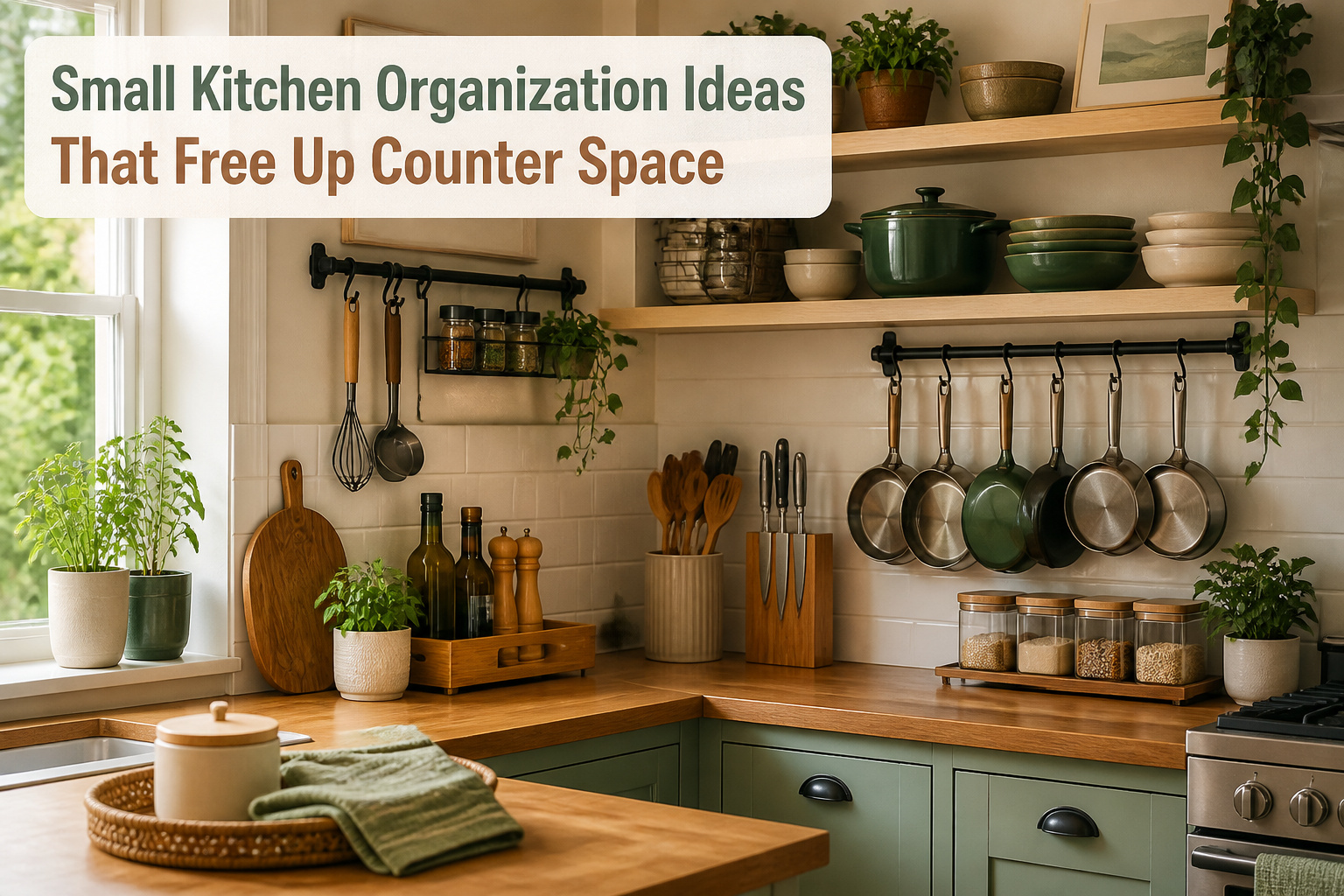
The twelve fixes below range from a $7 pack of hooks to a $68 wall-mounted pot rack, and the one that will work in your kitchen depends on whether you can drill a wall or only stick to surfaces. Most fail at the same point: a cabinet door with a faint grease film that nobody cleaned, or a tension rod bought an inch too long for the plumbing it has to clear. The hook that peeled away slowly, sagging lower each morning until it dropped, held fine once I wiped the door with rubbing alcohol and pressed for the full thirty seconds.
1. Self-Adhesive Hooks
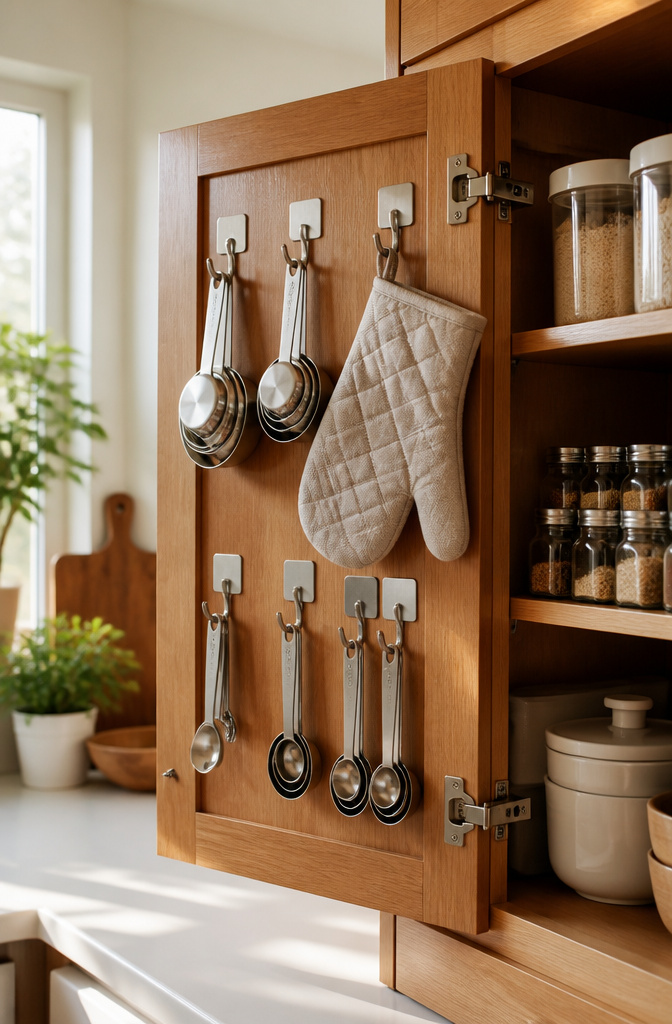
Self-adhesive hooks turn the inside of a cabinet door into real estate you already own but never used. A pack of thirty runs under $7, which works out to roughly what you would spend on a single overpriced coffee. Each hook holds about half a pound of weight, enough for measuring cups, measuring spoons, or a pair of oven mitts, but not your cast-iron skillet or that heavy Dutch oven.
I tried them first on the inside of the upper cabinet nearest the stove, thinking I would hang my most-used spatulas there. The adhesive failed within a week. The surface had a faint grease film I had not bothered to wipe off, and the hook peeled away slowly, sagging lower each morning until it dropped. On the second attempt I cleaned the door with rubbing alcohol, let it dry, and pressed the hook firmly for the full thirty seconds the instructions suggest. That one has held for months now.
The back of a lower cabinet door works better for heavier items like a small sieve, since the door itself carries less momentum when you open it. You will learn to open doors more gently once cups are swinging there, which is a small habit to build for the counter space you get back.
Julia Child once noted that hidden tools go unused, and visible storage keeps cooking within reach. Cup hooks installed below an upper cabinet keep utensils out of the way yet still accessible, and the same principle applies behind a cabinet door: what you can see, you will actually grab.
"The harder the utensils are to see, the less you will use them."
For renters who cannot drill into cabinet faces, the adhesive version trades permanence for portability, and the trade is worth it at this price.
2. Mug Holders
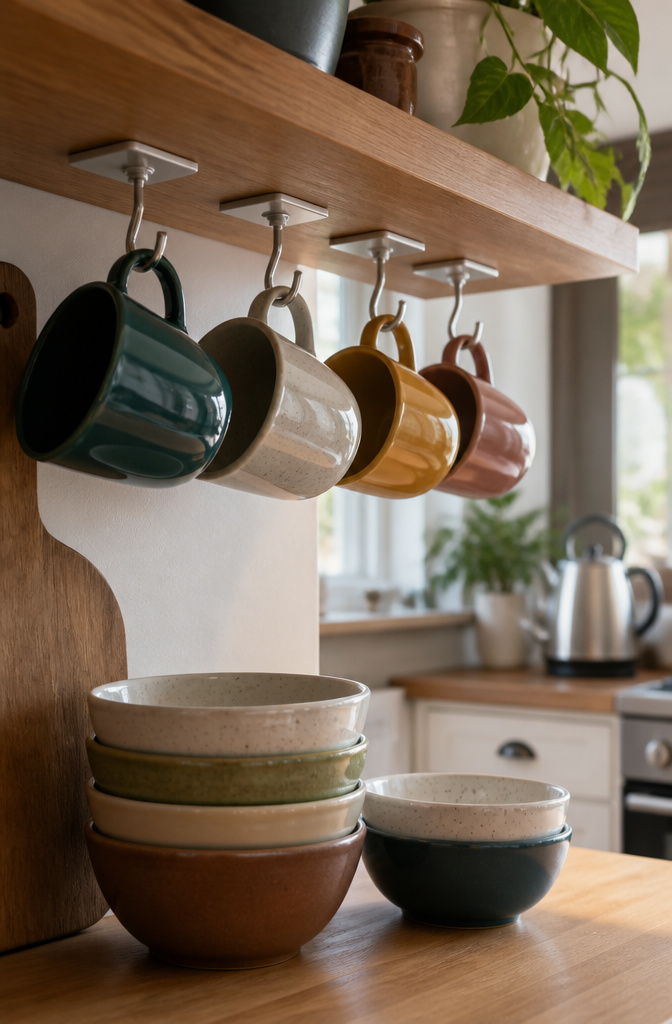
Under-shelf mug hooks turn the dead air beneath a cabinet shelf into usable storage. I installed a set one Saturday morning after realizing my mug shelf had become a game of ceramic Jenga, cups stacked three high and the one I wanted always on the bottom. The first attempt left me drilling pilot holes for screw-in hooks, which held fine but took an hour I did not have and left wood splinters on the counter. The next weekend I switched to self-adhesive under-shelf hooks instead: two minutes to stick them in place, no tools, and the hold has lasted through two years of daily coffee cups. The original mug hooks now hang measuring cups and a pair of kitchen shears, which keeps Julia Child’s point about visible tools being used tools. Three mugs hang where six used to crowd a shelf, and the space underneath still fits a row of cereal bowls.
3. Tiered Shelving
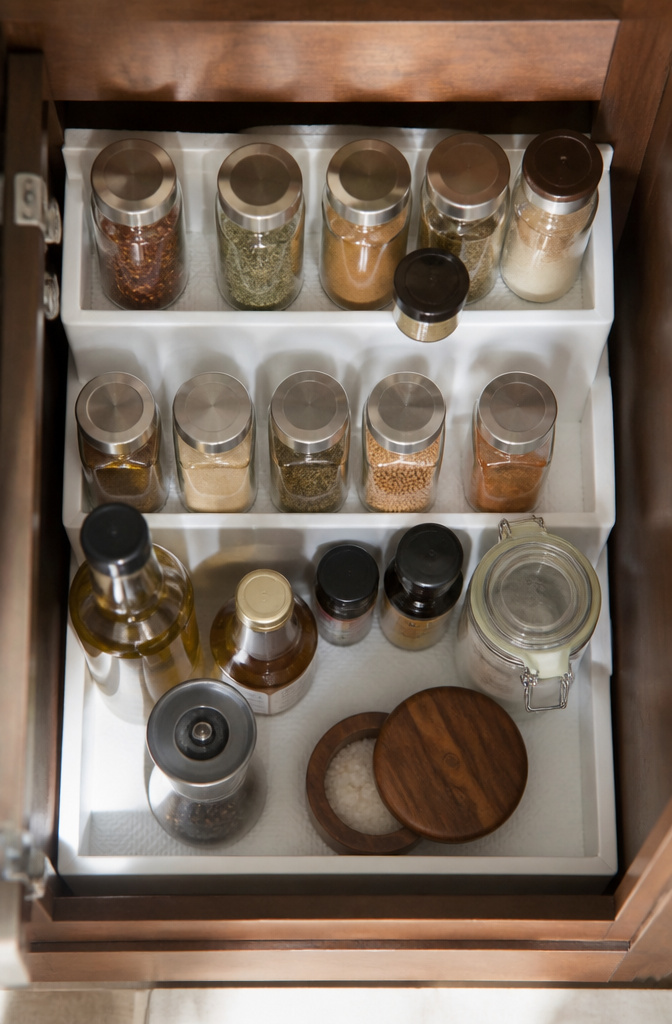
A 38 by 22.5 by 8.5 cm non-slip shelf organizer fits most standard upper cabinets with the door closed, which was the whole point when I bought it for spice jars. The three tiers step back enough that you can read labels without pulling anything out, and the footprint leaves room beside it for a small oil bottle or a salt cellar.
What I actually stored: sixteen spice jars, three small condiment jars, and a narrow jar of pepper flakes. The pepper flakes lived on the top tier because I grab them often, and that was the mistake. The jar was too light for the tier’s lip, and the non-slip surface, which grips glass well enough when the jar sits still, did nothing when the cabinet door swung shut hard. The jar tipped on week two and cracked against the cabinet wall. After that I moved lighter, narrower jars to the middle and bottom tiers where the step-back lip is taller, and the top tier now holds only the wider, heavier stuff.
Six months in, the non-slip coating still grips a wet jar bottom, though it has collected a faint film of oil residue that needs wiping every month or so. The real limit is the depth: 8.5 cm is generous for spices but rules out most standard coffee mugs or tall sauce bottles.
4. Lazy Susans
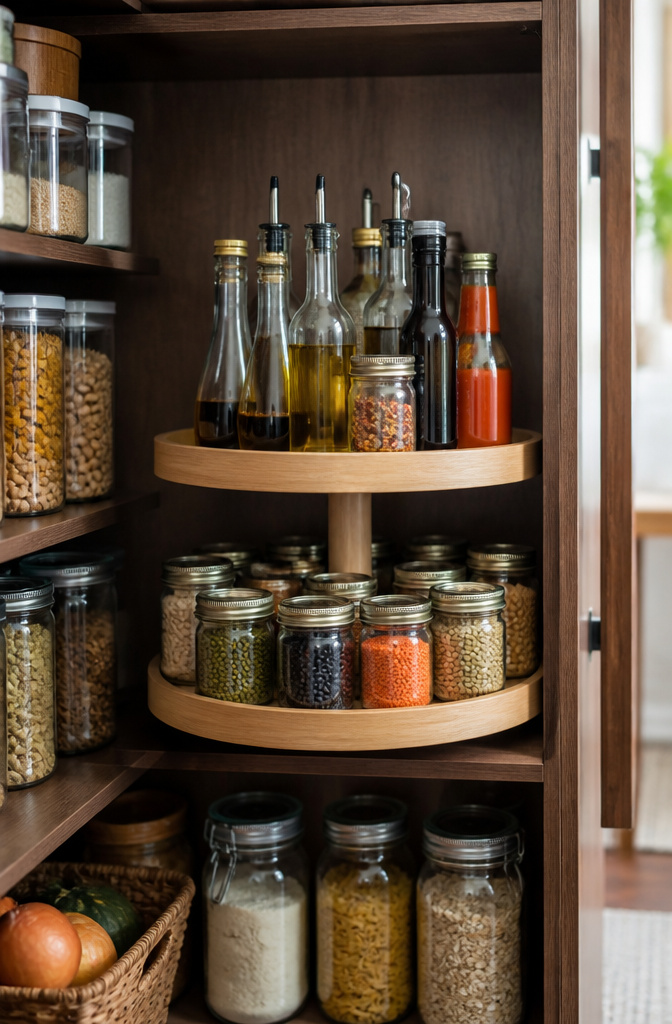
The first double-level turntable I tried went straight into the corner cabinet beneath my sink, the one with the half-moon door that swings out at an awkward angle. Bottles of cleaner and dish soap sat on top, taller spray bottles underneath. Within two weeks the bottom tier had become a graveyard of nearly empty containers I forgot existed. Deep corners swallow vertical storage unless every item on both levels is short enough to clear the shelf above; my mistake was treating the height as infinite.
That same turntable now lives in the upper pantry, rotated forty-five degrees against the wall where the shelf is one fixed board with no door mechanism to fight. Oils and vinegars spin forward without the reach-in contortion that turned my corner cabinet into a black hole. The bottom tier holds shorter jars, gravy and honey, while the top keeps the olive oil and rice wine I grab almost daily.
Hands-down the difference is accessibility. A single-level Susan in a blind corner still leaves the back sixty percent buried; the second tier at least lets you spin the lower ring out into the light. For renters, this is one of the few fixes that travels: no screws, no adhesive, just lift it out when the lease ends.
5. Drawer Dividers
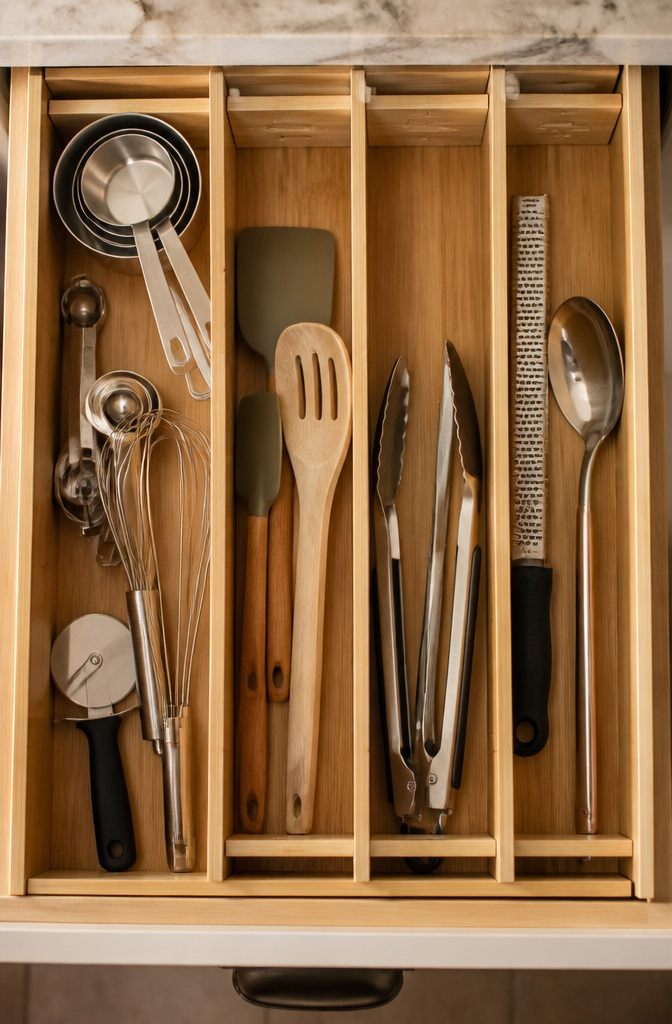
Utensil drawers collect everything that does not have a door to hide behind. Tea towels, foil, the sieve you used once for a quiche that failed. My first pass at fixing this meant sorting everything into neat rows until I found the category I had missed: the awkward-length tools. The fish spatula, the silicone basting brush, the avocado slicer nobody asked for. Those items do not fit the standard slots, so they float and topple and start the mess again.
Fixed dividers came first, the kind with molded compartments for spoons, forks, and knives. The set cost about $20, looked orderly for two weeks, then proved useless against the tool that was half an inch too long or the measuring cups that wandered from their designated square. Adjustable dividers solved this. Spring-loaded bars expand from 12 to 18 inches and lock with pressure rather than pre-sized slots. I replaced the fixed set within a month, which meant buying dividers twice.
A 3-inch height handles most flat drawers; deeper drawers want the 4-inch version with extra pieces to subdivide both ways. Check your drawer depth before ordering. An extendable tray that pulls and tucks underneath works for some kitchens, but the adjustable bars fit drawers the trays cannot, especially the narrow ones common in older rentals.
6. Over-the-Cabinet Organizers
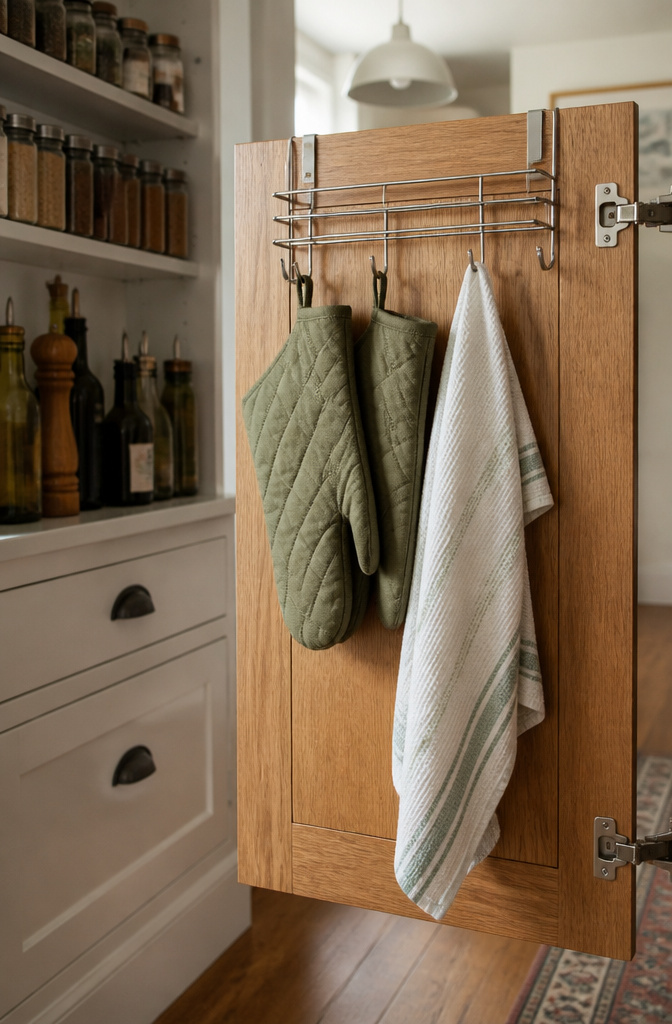
The inside of a cabinet door looks like free real estate until you try to close it. I mounted a wire rack meant for bakeware on the inside of my under-sink cabinet, loaded it with spray bottles and spare dish soap, and the door bounced open for three days before I realized the bottles were hitting the plumbing. You need at least an inch of clearance behind anything you hang, and most racks don’t advertise whether they account for it.
Over-the-cabinet hooks worked better for lighter stuff. I hung oven mitts and a dish towel on the outside of a cabinet near the stove, where the hook’s curve actually bought me space rather than costing it. The trouble started when I tried the same thing inside: a cutting board on two small hooks knocked loose every time I reached past it for a plate. Adhesive hooks rated for lightweight items held measuring cups fine, but anything with leverage needed a screw, and most rental cabinets aren’t thick enough to take one without showing through.
Door-mounted paper towel holders and towel bars do minimize counter clutter, though. The holders that hook over the top edge keep the door functional, while the ones that screw to the face turn the door itself into a wall you can’t open fully. I learned to check the swing before buying.
7. Pegboards
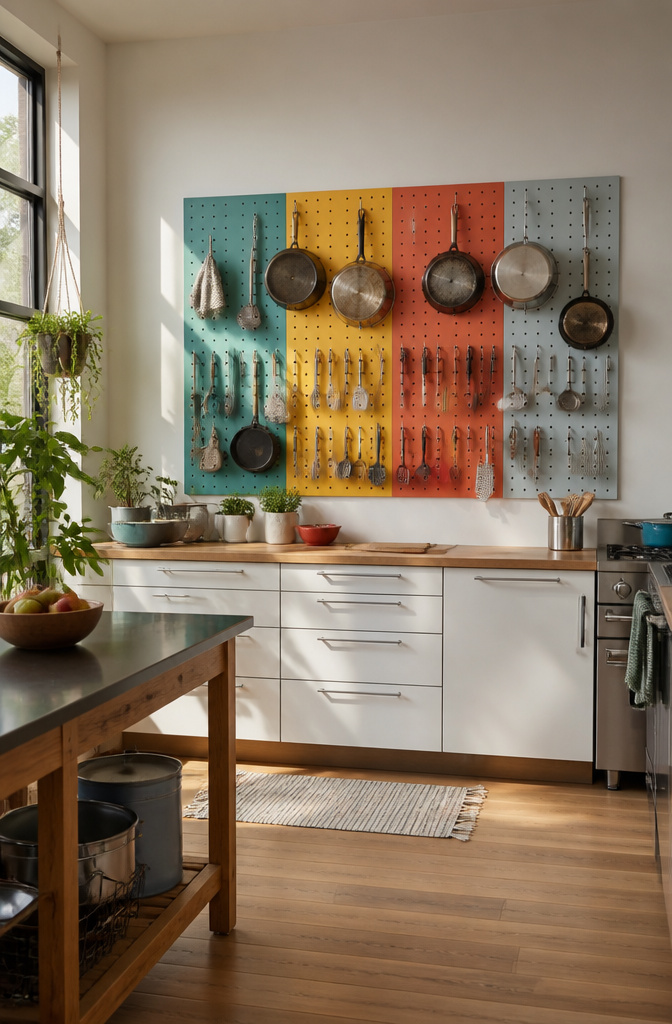
A 16-by-32-inch steel pegboard panel can hold up to 200 pounds when properly mounted, which sounds like overkill until you realize cast iron adds up fast. I gave up about four square feet of wall beside my stove, space that previously held nothing but a calendar and grease splatter. The 1⅞-inch and 2⅞-inch hooks handle most pots and utensils well, though my heaviest Dutch oven eventually pulled a hook straight after six months of daily use.
The grease film after a year was worse than I expected, coating everything in a sticky layer that required unscrewing the whole panel to clean behind it. Wall Control makes this in colors including hot pink, or you can paint it yourself, but matte finishes hide the grime longer than gloss. The 20-gauge steel panels come in vertical or horizontal orientations and never droop like old fiberboard versions, though you cannot cut them to fit awkward spaces. For tiny kitchens, that rigidity is the tradeoff: exact fit or nothing.
8. Magnetic Knife Strips
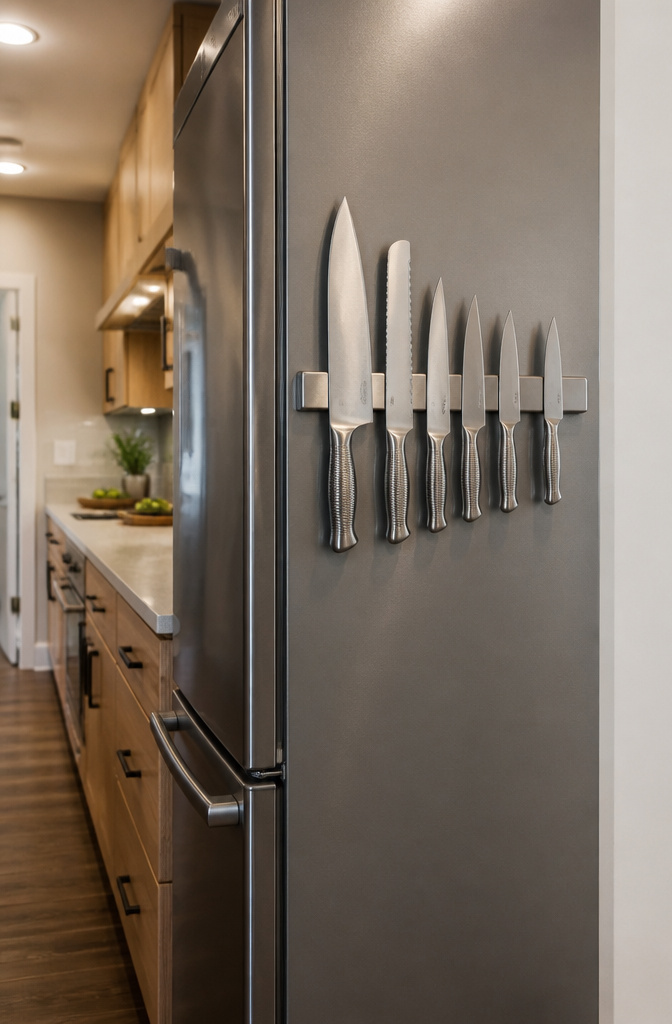
The 16-inch Modern Innovations Stainless Steel Magnetic Knife Bar runs about $23 and lives on the side of my refrigerator now, but the switch took longer than it should have. My old knife block sat on the counter for years, eating up roughly a square foot of prep space I did not have to spare. What held me back was the wall of exposed blades. I pictured a bumped elbow, a knife on the floor, a trip to urgent care. The reality turned out quieter: the magnet grips tight enough that you feel a small tug when you lift a knife free, and the blade faces the wall, not the room.
Not every knife sticks. My stamped steel paring knife holds fine, but the heavier forged santoku with its softer stainless blend wants to slide if I place it off-center. The strip also works better for shears and a metal peeler than some sources suggest, though I would not trust my good blades to it long-term if I had the choice. For the price, the tradeoff is fair: counter space back for under twenty-five dollars, with the understanding that your best knife may still belong in a drawer.
9. Stackable Containers
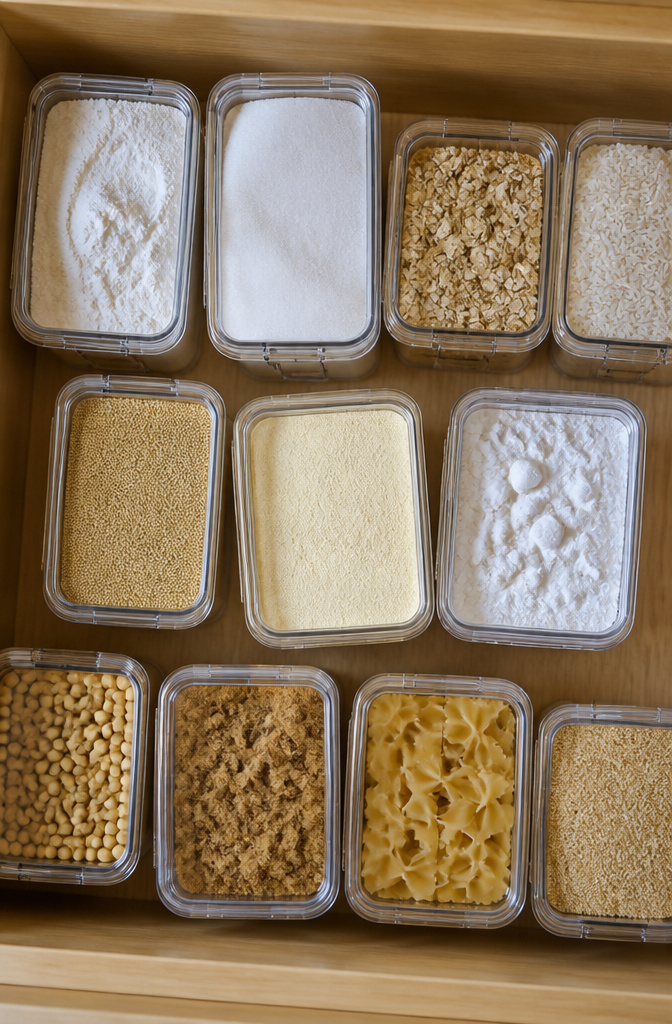
Clear containers for pantry staples look uniform on a shelf, but the real test is whether the lids actually swap between sizes. I bought a set that promised exactly that, then found the medium lid sealed fine on the medium body and leaked on the large one. Lid compatibility within a set is not guaranteed, even when the marketing says it is, so test the fit before you commit to a whole system.
Round jars like mason jars work well on lazy susans where you can spin them into reach. Straight-sided rectangles suit flat shelving better, and they waste less space in corners. I store sugar and rice in rectangles now. Flour, though, goes somewhere else entirely. The low wide shape I tried for flour developed a ridge of damp material along the bottom seam after a few months. Narrower and taller with a tighter seal solved it, though I still open that one more often than the others just to check.
Labels matter more than you’d think when every container looks the same from across the kitchen. A label maker helps, or slip-on tags if you are using woven baskets or anything the adhesive will damage over time.
10. Vertical Storage
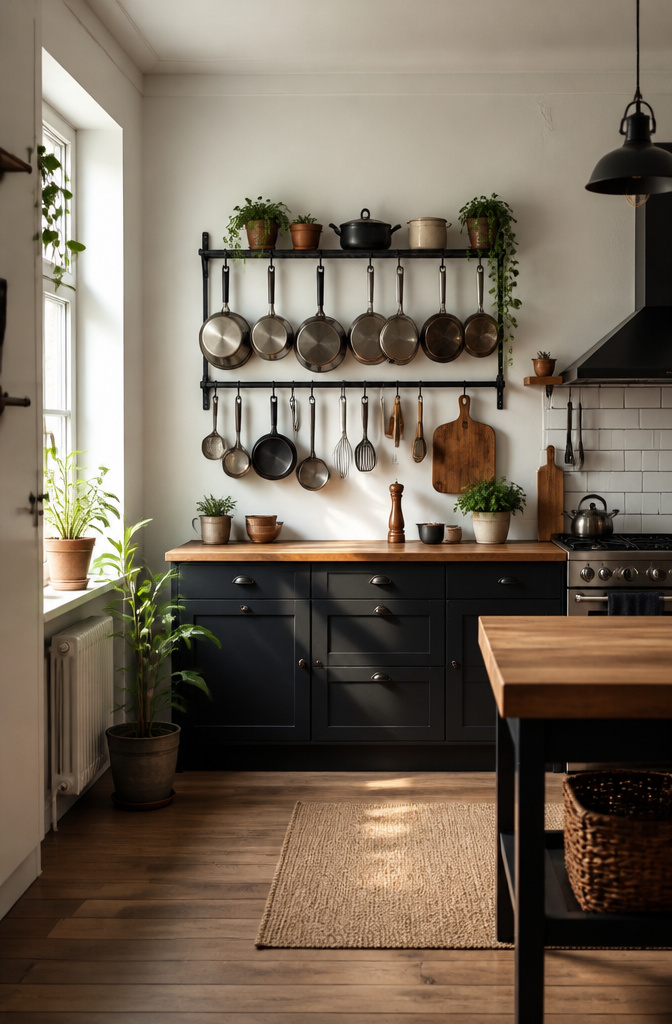
Wall-mounted racks and shelves turn the backsplash and upper walls into storage that keeps counters clear. I learned the hard way that a stud finder is not optional. The first rack I hung came down at 2 a.m., taking a ceramic plate and my confidence with it. Command hooks hold less weight but require zero drilling, which matters if your landlord charges for patched drywall. A $9 IKEA pot rail or a few adhesive hooks behind the stove can move utensils and small pans off the counter without the structural gamble. For items used daily, the rail wins. For the occasional ladle or oven mitt, the hooks suffice.
11. Under-Sink Organizers
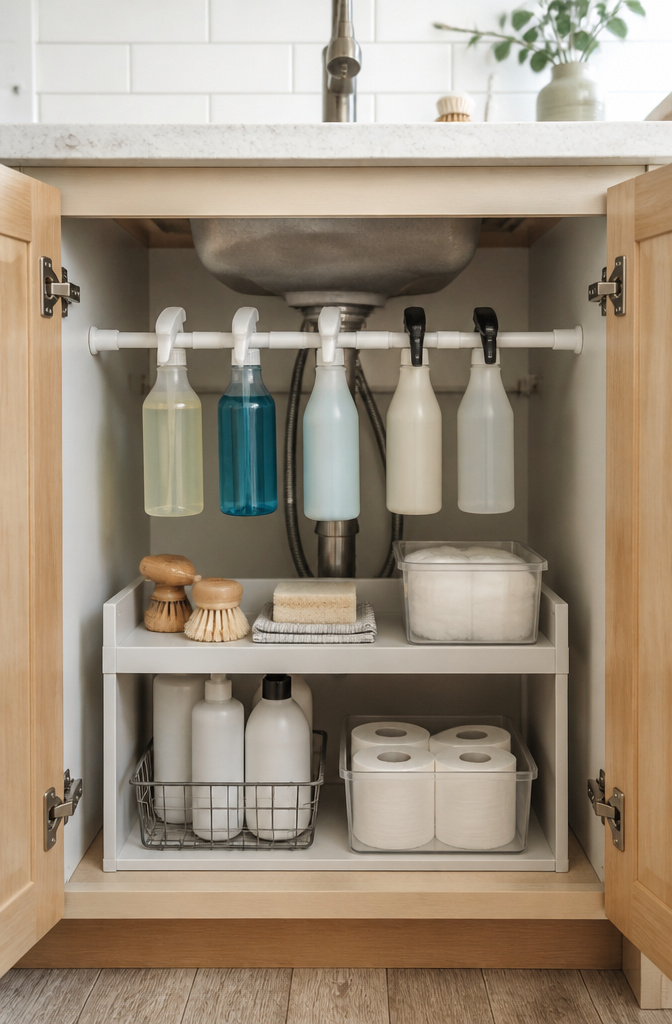
A tension rod across the upper third of the cabinet creates a hanging row for spray bottles, but the pipe running down the back wall is the measurement most people skip. I eyeballed the width and bought a rod an inch too long, then spent twenty minutes wedging it in at an angle that cleared the trap. The second rod, cut to the actual opening with a hacksaw, went in flat and held.
The two-tier shelf that slides around the plumbing works until a bottle tips. I stored a degreaser upright on the top level; the cap cracked against the P-trap when I slid the shelf back in, and the leak sat overnight on the particleboard floor. That cabinet still smells faintly of lemon solvent two years later. Now a solid plastic bin with a lid holds anything liquid, and the shelf above it carries only dry refills: sponges, scrub brushes, the box of dishwasher pods.
12. Adjustable Bakeware Racks
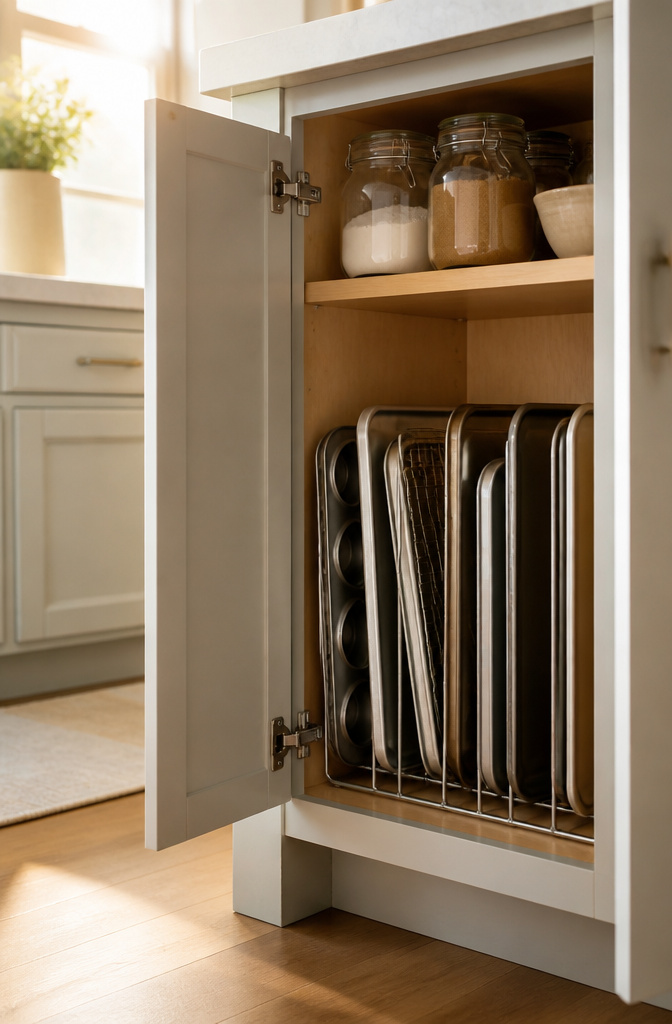
Stacking sheet pans flat used to be my default, which meant pulling the whole tower out to reach the one on the bottom. The YouCopia StoreMore Adjustable Bakeware Rack changed that. At 7¼ by 11½ inches, it fits upright inside most standard cabinets and holds pans vertical with seven dividers you can reposition as needed.
Vertical storage wins on access: each pan slides out individually without disturbing the rest. The vinyl feet keep the rack from sliding, and the frame stays put even under a heavy wood cutting board or pizza stone. One thing to watch: a warped pan will stress the dividers over time. My older, bowed half-sheet pan did exactly that, slowly widening the wire slot it sat in until I moved it to the end position where the frame itself provides more support.
Cabinet depth is the real gatekeeper here. At 11½ inches deep, the rack needs a shelf with at least that much clearance front to back. My rental kitchen’s narrower upper cabinet almost excluded it; I ended up using the deeper base cabinet beside the stove instead. The swap cost nothing but five minutes of measuring, and the pans I reach for most often ended up closer to my prep space anyway.
Maximizing Vertical Space
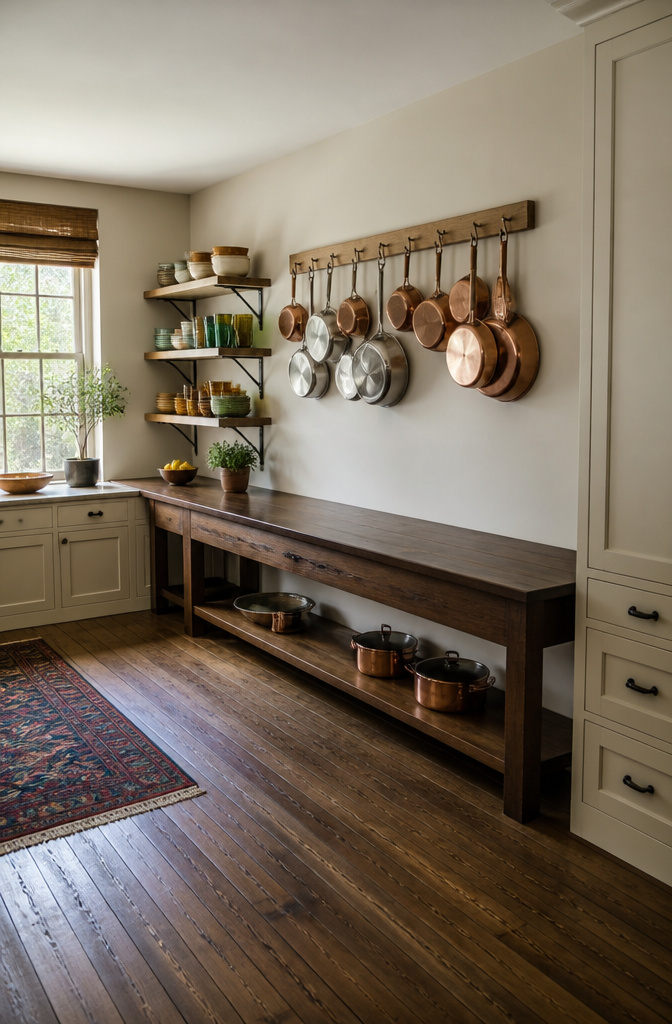
Wall-mounted racks and shelves only started making sense in my kitchen after I had already bought two countertop organizers and a rolling cart. The cart blocked a cabinet door. The organizers ate the prep space I actually needed. What finally clicked was that vertical storage works best as a system, not a single fix, and the system only matters if it keeps the counter completely clear.
A 36-inch wooden wall-mounted pot rack runs about $68 and solved the pot problem I created for myself. I had considered corner-mounted racks first, but even the compact ones swing out far enough to bump an oven door. Wall-mounted keeps everything in one plane. The same rack comes with hooks, which matters when a utensil crock takes up square footage you do not have. Bracketed shelves do the same job for glassware or dishes you use often enough to want visible, without the bulk of a cabinet box eating into the room.
Higher shelves work for the occasional stuff. Cake stands, large pots, seasonal dishes. The tradeoff is accessibility. If you are pulling something down twice a week, it belongs lower. If it is holiday bakeware, near the ceiling is fine. Magnetic hooks or strips can fill the gaps for mugs, knives, or tools you want at hand. The ceiling itself is fair game for hanging baskets if you are short on wall space.
The mistake I made early was treating each wall as its own project. One rack here, one shelf there, none of them talking. The better move is to map the whole vertical footprint first, then assign items by how often you grab them.
Drawer Organization
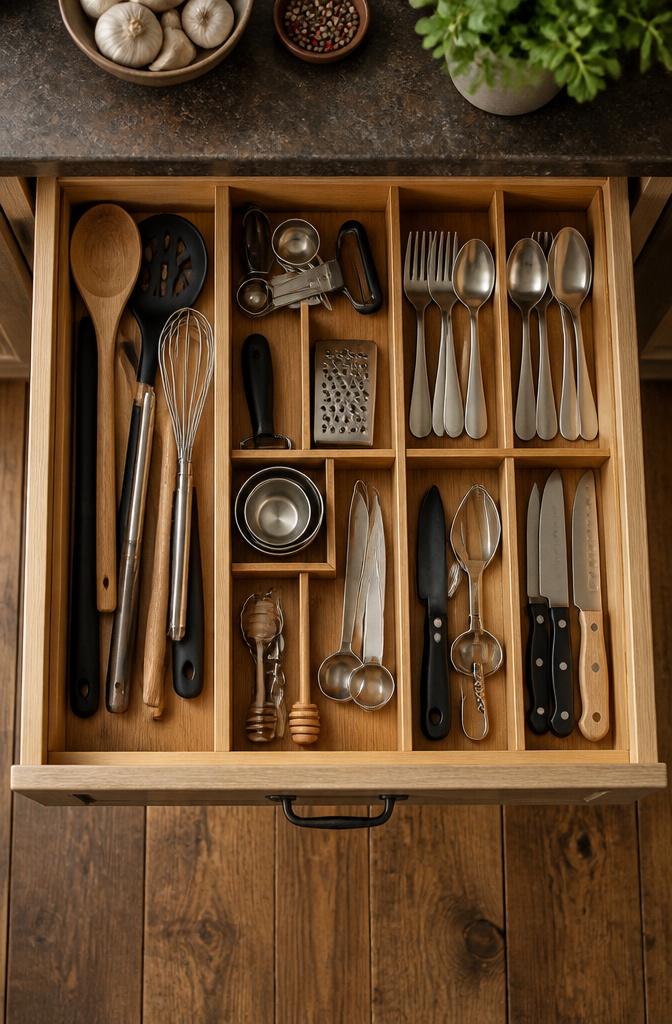
The first sorting system I tried in my kitchen drawers was the one the internet suggested: group by function. Spatulas with spatulas, measuring tools with measuring tools. Within two weeks the system collapsed because half my tools do more than one job, and the overflow items, the tea towels and the foil and the odd-sized sieve, had nowhere logical to go.
What actually stuck was sorting by reach frequency instead. The top drawer holds everything my hand goes for without thinking: the one slotted spoon I use for pasta, the pair of tongs that works for salad and roasting, the small offset spatula that started in baking and now lives there full-time. The second drawer down is for the tools I need weekly, not hourly. The third is where the single-task items wait, the cherry pitter and the bench scraper and yes, that sieve.
The utensil-adjacent stuff, the things that used to clutter the main drawer, now share space on the same principle. Tea towels sit in the second drawer because I grab one most nights; foil moved to a cabinet near the prep area because I reach for it before I reach for a spoon. An extendable organizer with movable separators, the kind with a pull-out tray that tucks underneath, keeps the first drawer from sliding back into chaos. The separators adjust, which matters more than I expected, since my drawer is an awkward width and fixed trays left an inch of wasted space on one side or the other.
Cabinet Door Storage
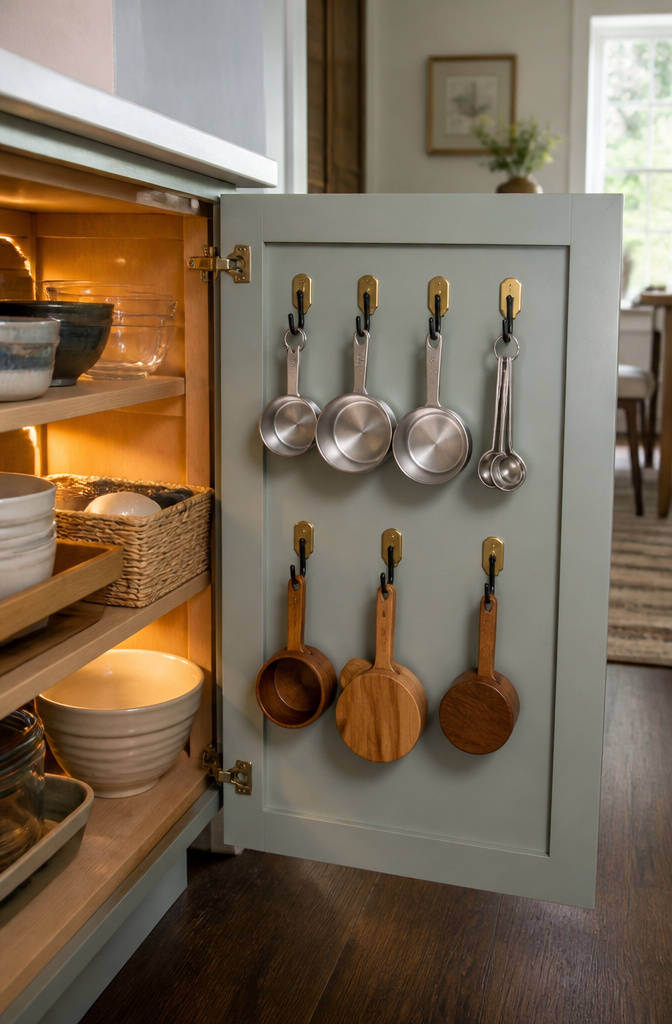
Cabinet doors sit there doing nothing while the counters drown. That empty interior is square footage you already paid for, and the gap between the door panel and the shelf behind it is usually six to eight inches of dead air. Mounting something inside that gap keeps the counter clear and puts small tools where your hand already is.
I started with a row of nails hammered through the door under my sink. Cutting boards, a sieve, a strainer, all hung flat and the door closed fine. Then I tried the same thing on an upper cabinet with heavier gear. Three pounds seems to be where the physics turn on you; the screws pulled, the door sagged, and a ceramic measuring cup hit the counter at 6 a.m. The nails went in easier than they held, and the particleboard core of a standard cabinet door is not built for leverage.
Now I keep it to lightweight stuff. Adhesive hooks hold measuring cups and spoons, the ones that used to roll around the bottom of the drawer. Oven mitts hang on the cookware cabinet door. I open that door slower than I used to, but the trade is worth it. For anything with real heft, the door is the wrong wall.
Clear Containers and Visibility
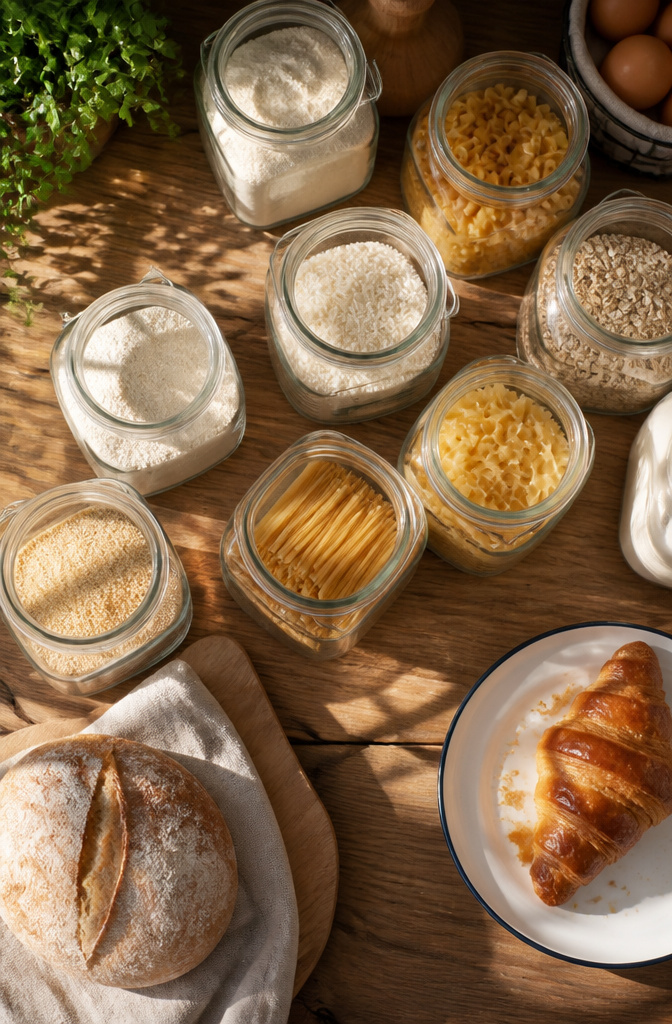
Switching to clear containers changed what I actually reach for in a morning rush. Rice, flour, sugar, pasta: these are already in tall rectangular bins on a single shelf where the light hits them. The flour and sugar stay unlabeled now because the shape tells me which is which. The one that stays labeled is my overflow red-lentil jar; same height, same lid, and the one time I grabbed it thinking it was split peas taught me that lesson.
Pasta went the other direction. I stopped labeling thin pastas like angel hair and fettuccine because the nests look nothing like penne or rigatoni. Two shapes, two containers, no confusion. The single opaque woven basket I use sits on the same shelf and holds tea bags. I kept it opaque because the thirty-odd wrappers, even tidy, still read as clutter from across the room; Out of sight lets me keep the collection without it stealing visual space from the counter-facing half of the pantry.
For anything in a clear bin, the goal is one glance. If you have to pull it out or turn it to know what’s inside, the container’s size is wrong for the quantity.
Oven Storage and Seasonal Rotation
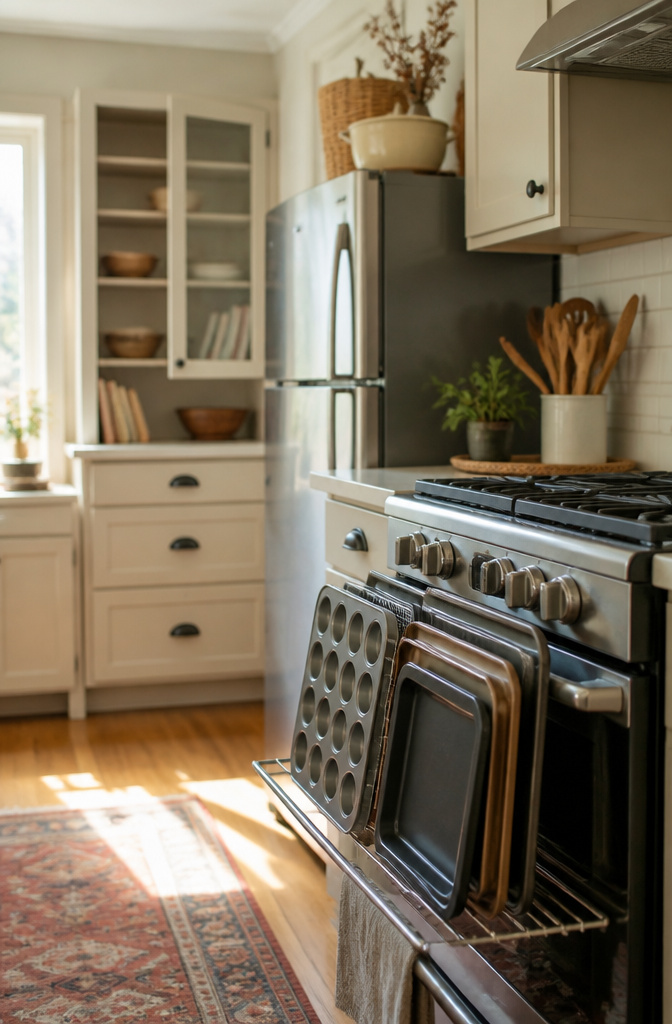
Baking sheets and muffin tins take up awkward cabinet real estate in a small kitchen, and the oven itself sits empty most of the day. I started sliding my half-sheet pans onto the rack when the oven cools, which freed an entire lower cabinet for the mixing bowls I reach for more often. You must pull them out before you preheat, a lesson I learned the hard way one Tuesday when I smelled something wrong and opened the door to find a forgotten quarter-sheet warping at 350 degrees.
Seasonal items make the same kind of sense to relocate. Holiday cookie cutters, the springform pan I use twice a year, and the ceramic pie weights all moved to the shelf above the refrigerator that requires a step stool. The trade is worth it: the everyday colander and skillet live at eye level, and I only hunt for the bundt pan when the leaves turn.
Frequently Asked Questions
How do I organize a small kitchen?
Start by purging unnecessary items, then use vertical space and drawer organizers. Wall-mounted racks, magnetic strips, and floating shelves move tools off counters while keeping them within reach. Adjustable drawer dividers handle awkward tools better than fixed trays, and the insides of cabinet doors add storage square footage you already own.
What are the best storage solutions for small kitchens?
Lazy Susans, tiered shelves, and over-the-cabinet organizers work well, but each has limits. A double-level turntable needs short items on both tiers to avoid burying the bottom ring. Tiered spice organizers require heavier, wider jars on the top step to prevent tipping. Over-the-cabinet racks need at least an inch of clearance behind them or the door will not close.
How can I maximize cabinet space?
Use the insides of cabinet doors and install pull-out or tiered shelves. Adhesive hooks on doors hold measuring cups and oven mitts if you clean the surface with rubbing alcohol first and press firmly for thirty seconds. For heavier items, lower cabinet doors carry less swing momentum than upper ones. Magnetic strips on doors can hold metal utensils, though screw-mounted options last longer if your cabinet face is thick enough.