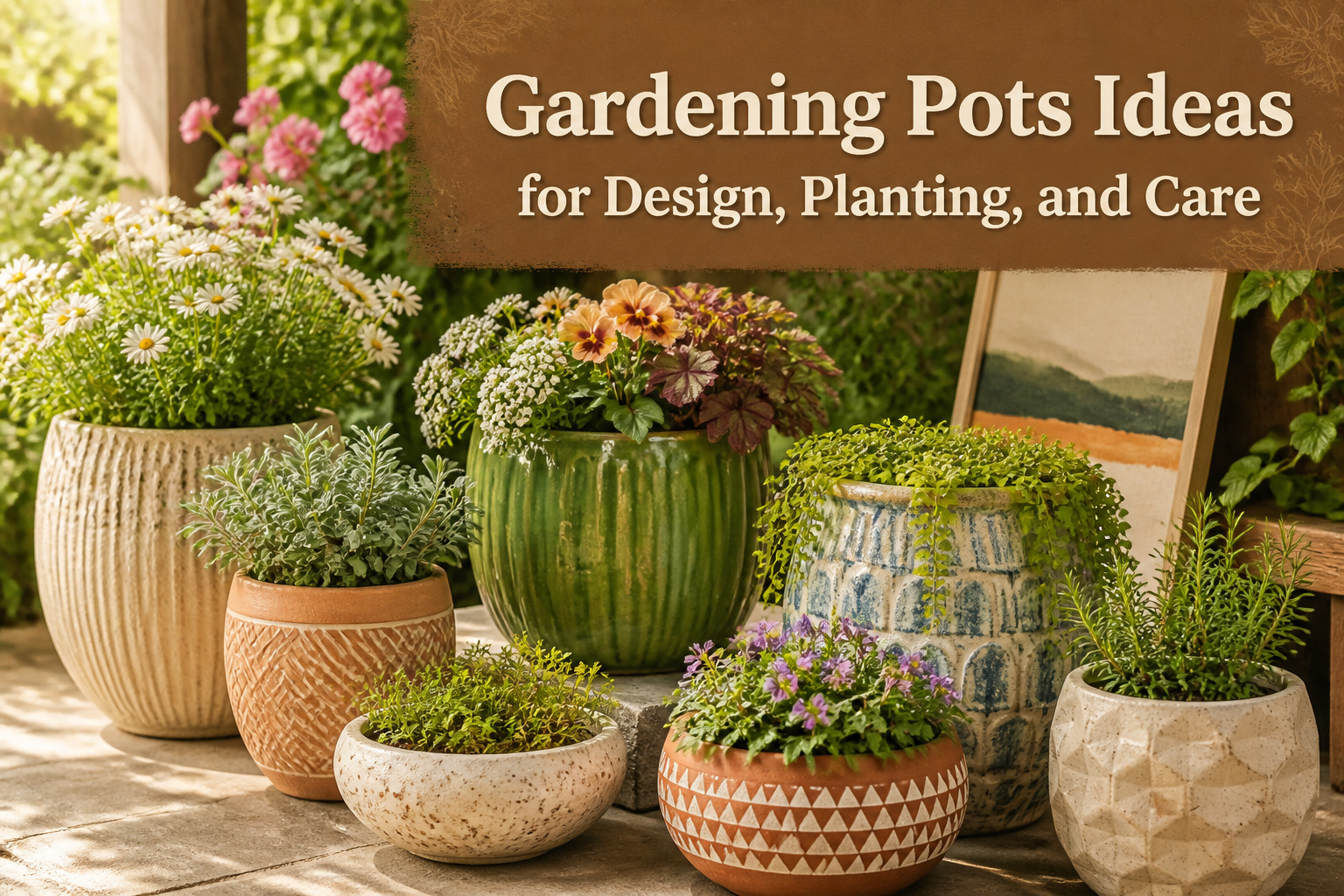
The right gardening pots ideas depend on whether you are planting for one season or trying to stretch a single container through spring, summer, and fall. That rhythm, three seasons from one pot, costs about an hour and twenty dollars in new plants versus starting over entirely. The catch is that self-watering reservoirs buy you a day or two in July heat, not a week, and the soil still dries from the top down.
1. Thriller, Filler, Spiller Method
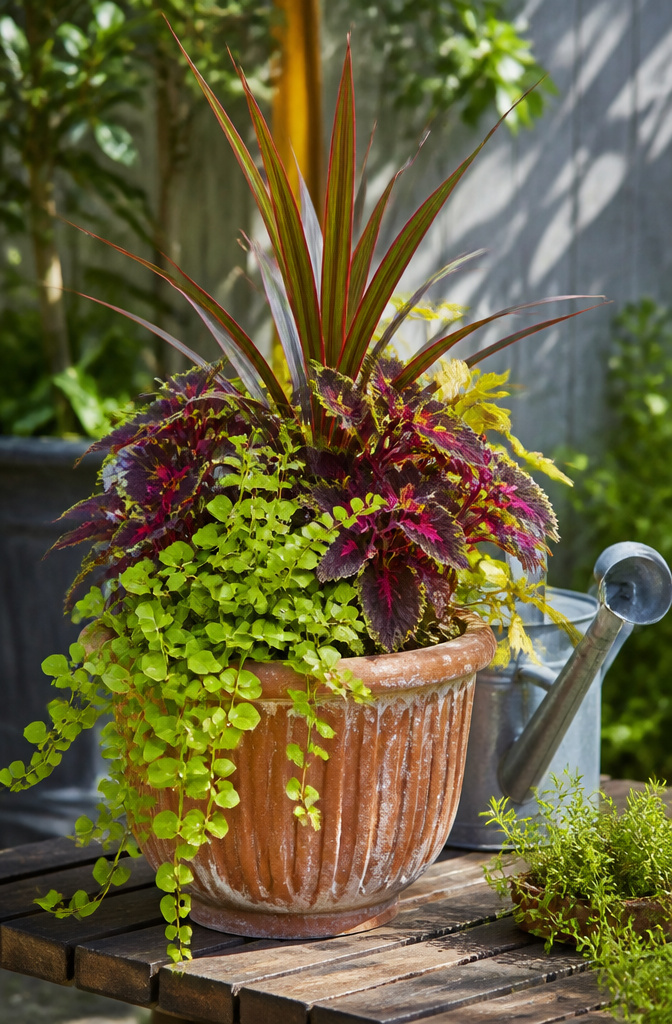
The thriller, filler, spiller method sounds like a gardening podcast catchphrase until you actually try it. My first attempt paired a dracaena spike with coleus and creeping Jenny, and the result looked like a florist arrangement for about three weeks. By August the Jenny had colonized the filler space and the spike was invisible.
Thriller plants need real height to stay relevant, not just the tallest thing at the nursery in May. Grasses hold up better than spikes in my experience, though they shift from thriller to oversized filler by late summer. For fillers, coleus delivers the color density the formula promises, but it wants more water than the drought-tolerant spillers that sources pair it with. That mismatch matters: creeping Jenny and sweet potato vine will trail obediently over a pot rim, yet they root wherever they touch soil and escape into garden beds if the container sits low.
The formula breaks down when scale shifts. Cluster enough pots together and your thriller becomes filler by proximity, or one strong spiller in a neighboring pot steals the vertical drama you paid for. Monochromatic schemes using this structure, say a spectrum of greens, read as sophisticated in magazine spreads and read as "three plants, all green" on your actual patio. I have had better luck treating thriller, filler, spiller as a starting negotiation between plants rather than a binding contract.
2. Seasonal Plant Combinations
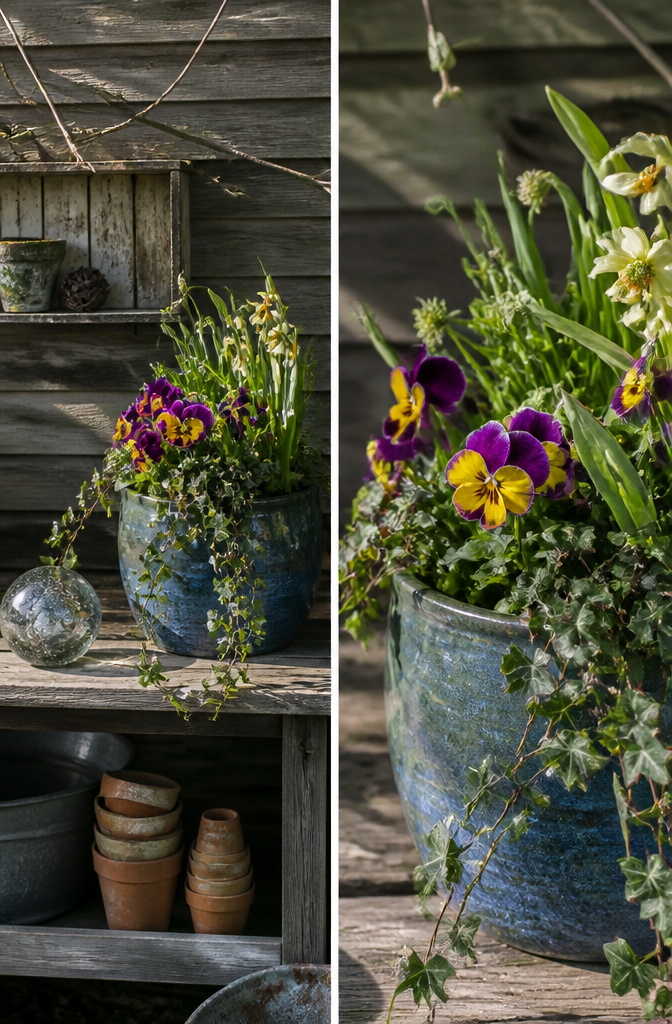
Spring bulbs in pots look like a promise for about ten days, then sit there browning and limp for a month. I learned to treat them as the first layer, not the whole show. A pot started in March with pansies and a few daffodils gets its ivy pulled forward as the bulbs die back; the evergreen foliage fills the gap while summer plants establish. English ivy stays manageable only if you keep it confined to the container, since it can overrun a garden bed the moment it touches soil.
By late May I swap the spent bulbs for scabiosa or lantana, leaving the ivy and any heuchera that held its color through spring. Heucheras in caramel or purple tones bridge the seasons better than flowers alone; foliage carries the design when blooms fade. One October I tried carrying a summer pot straight into fall without editing, and the leggy petunias looked exhausted against chrysanthemums. Now I pull the annuals in September and drop in fall perennials around the permanent structure, which gives the roots six weeks to settle before cold weather.
The transition costs maybe an hour and twenty dollars in new plants, versus emptying soil and starting over. That rhythm, three seasons from one container, is what makes pots practical on a real budget.
3. Color Schemes That Hold Up
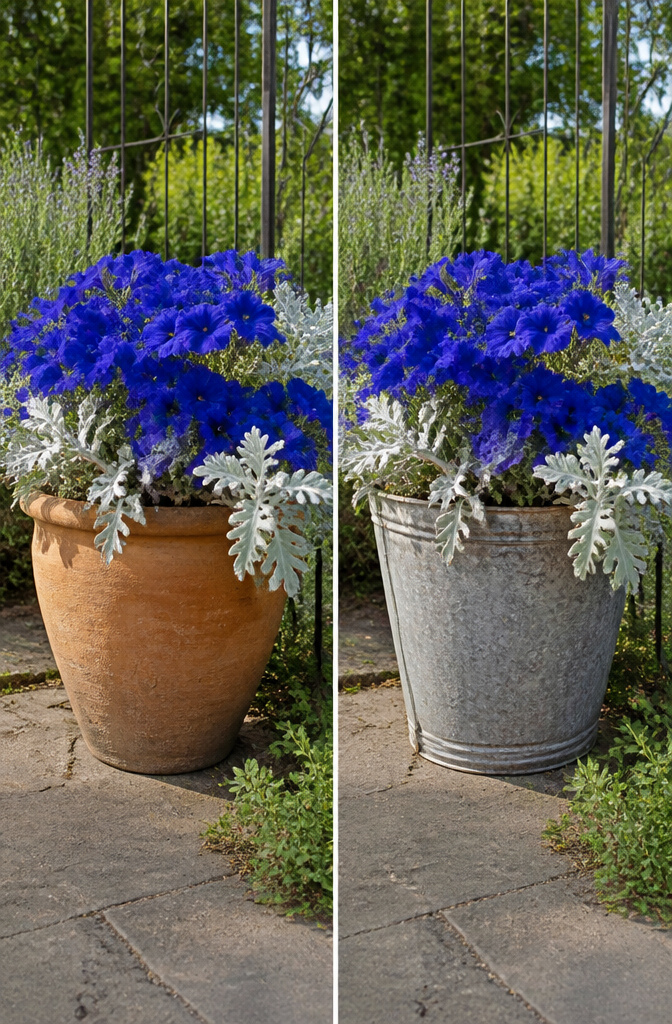
Petunia in sapphire blue against dusty miller’s silvery gray stopped me dead on a nursery run one spring, and that two-tone pairing carried straight through to the first frost. I stuck with just two or three complementary tones after learning that a third competing color turns the whole pot muddy by August, once the early flush fades and heat stress dulls everything.
Pinks, blues, and purples mingle without fighting. Reds, oranges, and yellows work if you want loud, but they need restraint or they read as noise from the driveway. My insurance palette is white, silver, pale yellow, or chartreuse dropped in as a bridge, and that filler kept an experiment alive last year when a heat wave crisped the blooms off a plum-colored dahlia. The pale leaves held the shape until the temperatures broke.
The pot itself counts as color. A terracotta container I planned as neutral went almost pink at midday and turned ginger by evening, shifting the whole design. Foliage carries longer than flowers, so building around leaf color, not bloom, keeps the scheme from collapsing when the petals drop.
4. Layering Plants by Height and Texture
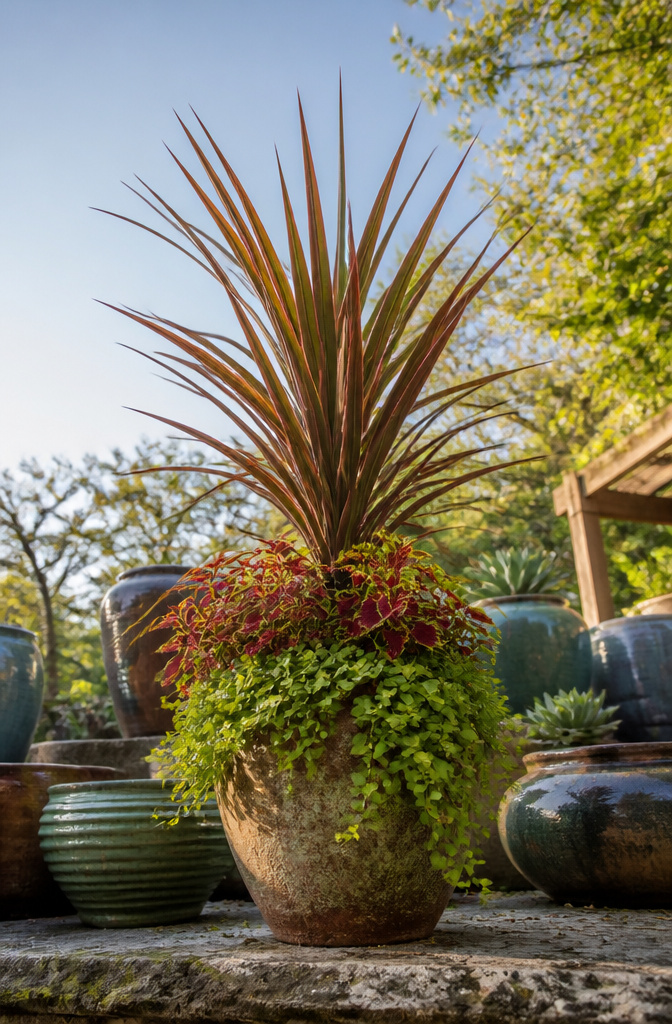
A tall spike of dracaena in the center of a pot draws the eye upward, but that only works if something actually happens below it. The first time I tried the thriller-filler-spiller formula, the dracaena dominated and the trailing sweet potato vine underneath just looked like a green puddle. The eye stopped at the height difference, not the combination. What fixed it was choosing a filler with its own structure: coleus, with its wide, ruffled leaves, holds the middle ground and forces the gaze to travel through all three layers instead of jumping from top to bottom. Creeping Jenny works as a spiller because its small, bright leaves read as texture from a distance rather than as individual stems, but it will swallow the pot if you don’t trim it back. Bricks behind the back pot raised my calibrachoa to eye level on the patio, and that single lift mattered more than the plant choice. Two ways to play height: tiered stands give each plant its own stage, or you hide the risers and fake a single dense mound. The stand wins if you move pots around; the hidden brick wins for renters who need the floor space back by fall.
5. Edible Plants in Ornamental Pots

Lemon thyme and creeping rosemary spill over the edges of decorative pots in a way that reads as intentional design, not kitchen practicality. By late August, flat-leaf parsley has bolted into something taller and less tidy than the mounding herbs around it, which is the compromise: harvest hard or let it go to seed and become the visual weak spot.
Swiss chard ‘Peppermint’ and ‘Rainbow’ carry the container through October with stems that read as color blocking from across the patio. The leaves shrink as nights cool, so the ornamental value outlasts the kitchen usefulness. Hot peppers mixed with purple pearl millet and young brassica leaves give a harvest-feast palette, though the millet is bred for that plum foliage, not grain you would actually eat. The question is whether you pick the pepper and expose the stem, or leave the fruit to shrivel as a visual accent. Most years, the stems win by September.
6. Self-Watering Containers

The reservoir-and-wick setup in self-watering pots sounded like an answer to the daily slog, especially for anyone in a full sun spot. I picked up a PVC window box with the built-in tray a few years back after the wooden one I built started looking rough. The mechanism is simple: a hollow bottom holds water, and capillary action draws it up through the soil as the roots need it. In practice, that meant skipping the hose on days when I would otherwise be out there twice.
The catch showed up in July. The reservoir in that 7-foot box ran dry faster than I expected in real heat, and the petunias wilted hard before I noticed. A self-watering reservoir is not a set-it-and-forget-it system in hot weather; it is a buffer that buys you a day, maybe two, not a week. The soil still dries from the top down, and small pots or shallow boxes empty fastest because there is less volume to begin with. I now treat the gauge, or my finger in the top inch, as the actual signal rather than trusting the water level below.
Where these containers earn their keep is in cutting the frequency, not eliminating it. A standard pot in full sun needs daily attention. The self-watering version stretched that to every two or three days, which matters when you are away for a weekend or just tired of the routine. The failure mode is complacency: the plant looks fine until it suddenly does not, because the reservoir is empty and the wick has nothing left to pull.
7. Grouping Containers for Cohesion

Three pots on my back step never quite looked right until I matched them in terra-cotta and lined identical agaves down the walk. From the street the repetition read as architecture, a low wall of spines drawing the eye toward the door. Up close it felt almost too perfect, so I broke the rhythm at the end with a blue-glazed pot half a size smaller. That gap saved it.
Varying height matters more than matching it. I have stacked an extra pot upside-down to lift a smaller one, and the lift tricks the eye from twenty feet away. Close up you notice the seam where the two meet, so I tuck that junction behind foliage and let lobelia or another cool-season favorite spill over the edge.
A five-pot grouping I tried on the driveway held up from a distance but collapsed into clutter when you stood beside it. Three is the number that works on a step or a corner of deck: two at ground level, one raised, spaced about a hand’s width apart so they read as one mass without touching.
Try to vary heights of pots. You can place larger pots next to smaller ones, or raise a pot by stacking it on top of an extra upside-down pot.
The point is practical, not decorative. A raised pot catches light differently and casts a shadow pool that reads as depth from afar, while a flat line of same-height pots photographs like a fence.
8. Containers as Focal Points
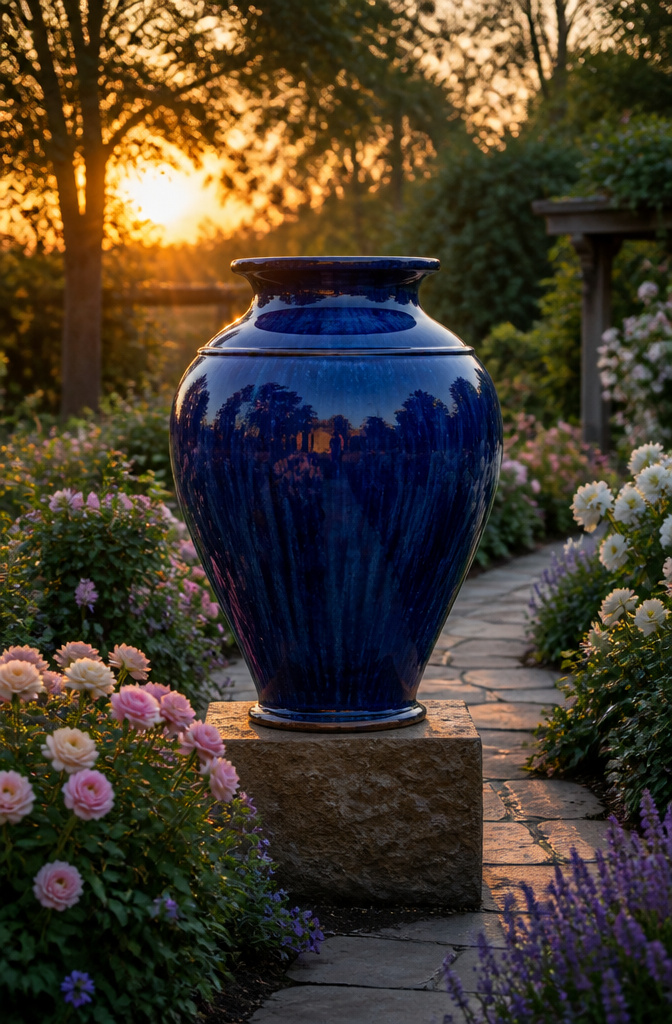
A 24-inch urn shoved against a wall reads as clutter. The same urn placed where a path turns, or at the low end of a sloped bed, pulls the eye through the garden instead of stopping it cold. I learned this after parking a heavy zinc planter by my front steps for two years, where its size felt impressive at first and then simply obstructed the walkway. The passage to the door narrowed, guests edged around it, and the rosemary I planted inside grew woody and lopsided from brushing against coats.
Proportion matters more than size alone. A tall, narrow container like the Del Meson style can slip between granite boulders or into a bed too root-bound for in-ground planting, adding height without swallowing space. An oversized urn works best when the garden around it goes bare; winter reveals the shape and color rather than leaving it to compete with summer growth. Some pieces deserve to stay empty. A striking blue glaze or a weathering zinc patina carries enough interest without a plant fighting for attention, and an unplanted urn avoids the seasonal collapse of annuals that turns a focal point into an eyesore from October through March.
The trick is placement that guides movement, not blocks it. Line a path to direct foot traffic, or set the pot where it draws the eye toward seating or an entrance. If the container sits in a garden bed, raise it slightly so it reads as deliberate elevation rather than a pot that fell off the patio.
9. Unexpected Containers
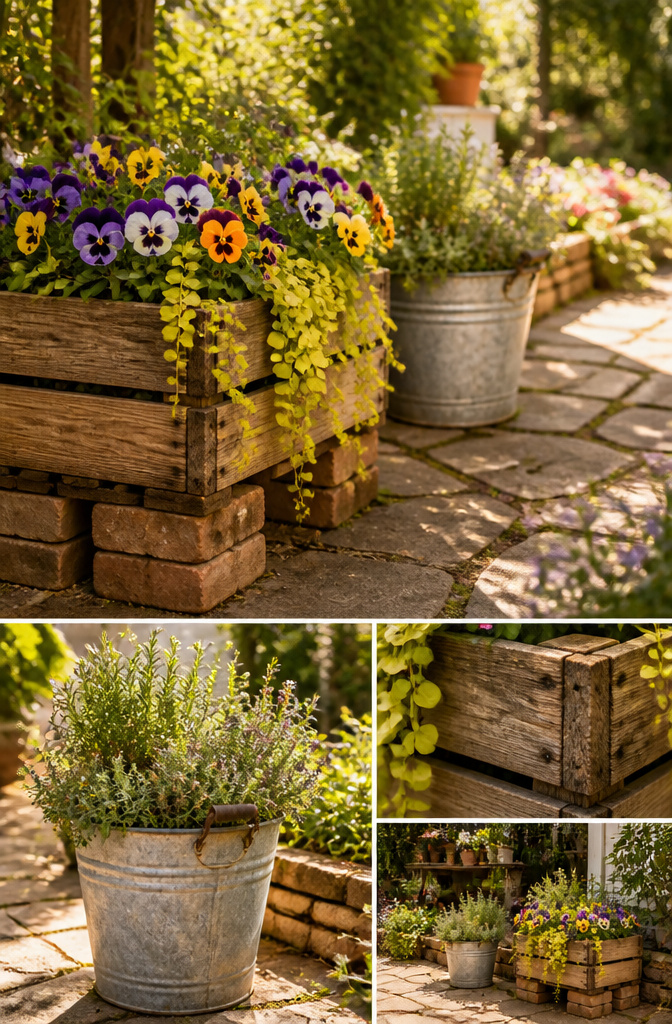
Galvanized buckets hold up longer than you’d expect, but the bottom seam is where they fail first. Water pools there, and in my experience the zinc coating flakes off around the drain holes within two seasons, leaving bare steel that rusts through by year three. Drill holes in the bottom, not the sides, or the bucket warps outward from the weight of wet soil pressing against thin metal.
Wooden crates look romantic for about eight months. I lined one with landscape fabric to keep the dirt in, and the fabric held; the slats didn’t. The soil stays damp against the wood, and even cedar softens at the corners where water collects. A crate raised on bricks so air circulates underneath buys you another season, maybe two, before the bottom rots out.
An old wheelbarrow is the one repurposed container that earns its spot permanently, as long as the basin isn’t galvanized steel. The wheel keeps it mobile, which matters more than you’d think when you need to chase sun or dodge a hard freeze. Rust in the basin is cosmetic; holes are the problem. Patch them with roofing tar or accept that it’s a short-term planter, not a permanent fixture.
The real limit with any of these is drainage. Containers without holes waterlog roots fast. Drill them, or nest a plastic nursery pot inside the decorative shell and empty the runoff yourself.
10. Repurposed Household Items
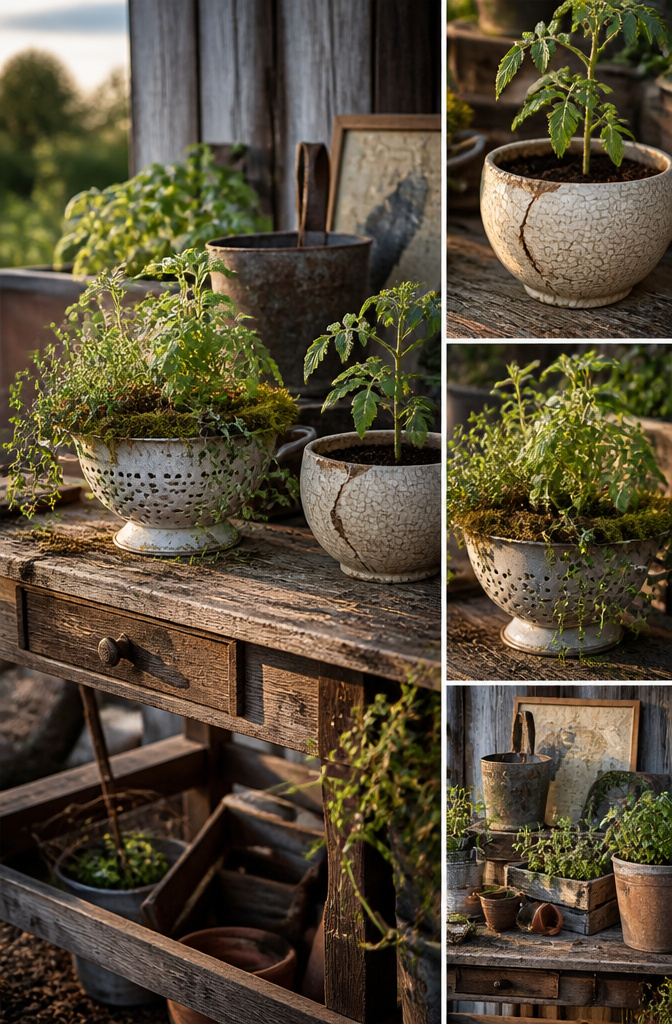
Some household cast-offs become planters that look deliberate, and some just look like garbage with soil in it. The difference usually comes down to drainage and proportion. An old colander already perforates, so a layer of gravel and a saucer underneath turns it into a herb pot that reads as intentional. A galvanized metal bucket or washtub works the same way: drill holes, or sit a liner pot inside so water escapes. The proportions of the object against the plant matter more than the object itself. A cracked antique crock with a trailing succulent looks curated; that same crock stuffed with a tomato seedling looks like you ran out of real pots.
Logs hollowed from a removed tree read as rustic planters if the cavity is deep enough for root run and you angle-drill the base so water drains. Old crates need the most editing. Left as-is, they wick moisture into the wood and rot by fall. Line them with perforated plastic, raise them on bricks, and they last a few seasons. The planted chair I keep seeing in photos works because the seat is stripped to the springs, so soil volume stays small and succulents stay shallow. Fill a whole upholstered seat with dirt and the thing collapses into soggy nonsense in one rain.
The objects that fail are usually the ones where drainage was treated as optional. Unglazed terracotta, metal buckets, plastic bins: without an exit for water, roots drown regardless of how clever the container looked on the porch.
11. Container Care That Actually Works
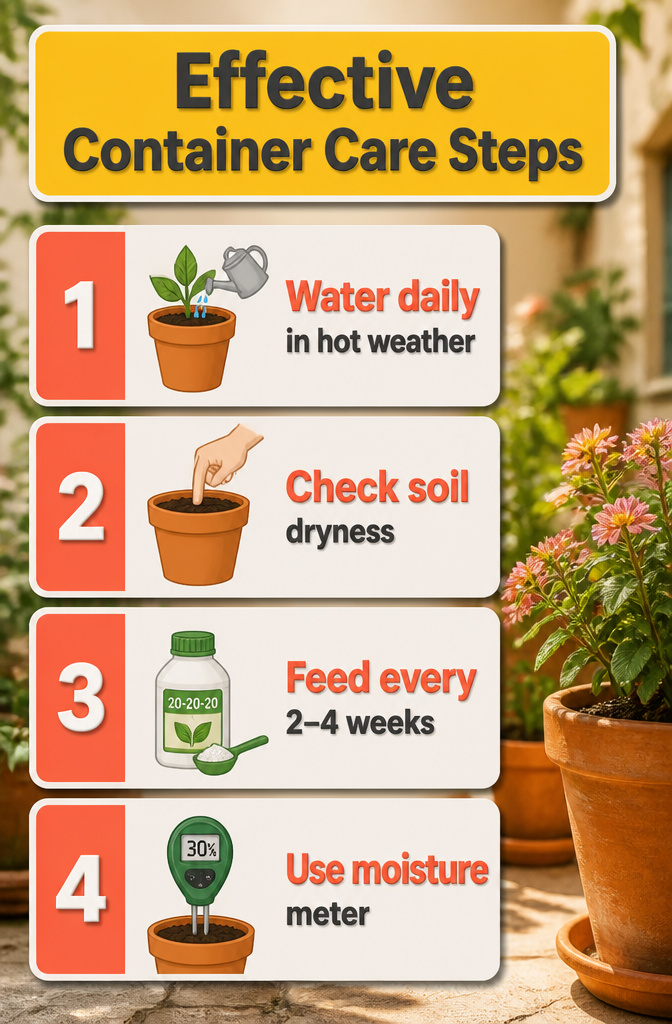
Terracotta dries fast enough that daily watering in hot weather is the baseline for most containers, especially smaller ones. The top inch of soil should feel dry before you add more; a finger check works, or a cheap moisture meter if you want to stop guessing.
Frequent watering leaches nutrients, so container plants need regular feeding. A balanced water-soluble fertilizer every 2–4 weeks keeps growth steady. Skip it and the leaves yellow, the blooms shrink, and you wonder what went wrong while the plant starves in a pot it cannot escape. Skip daily watering in July and the wilting happens by afternoon, often too late to undo.
Glazed pots hold moisture longer, stretching that interval to every two or three days, but the same feeding schedule applies. Granulated slow-release fertilizer buys a few months of laziness if you prefer, though I find the water-soluble routine easier to remember, since I am already standing there with the hose.
Container Materials and What They Do

Terracotta breathes, and that breath costs you water. Unglazed clay pulls moisture straight out of the soil; in July heat, daily watering is the norm, not the exception. The payoff is root health and a warm, weathered look that plastic never quite matches. Terracotta is not frostproof, though. Left outside through a freeze-thaw cycle, it cracks along the rim or splits at the base, something I learned to account for by moving mine under cover each November.
Glazed ceramic does the opposite. The fired glass surface seals the wall, so water stays put and you stretch intervals to every two or three days. That retention suits thirsty plants and forgetful waterers alike, but the glaze adds weight and cost, and a chip exposes porous clay underneath.
Plastic is the renter’s friend: light enough to haul up stairs, cheap enough to replace, and it holds moisture longer than either clay option. The downside is heat. Dark plastic in full sun can cook roots, and after two or three winters it goes brittle and fades.
| Terracotta | Glazed ceramic | Plastic | |
|---|---|---|---|
| Watering frequency | Daily in summer | Every 2–3 days | Longest intervals |
| Winter survival | Cracks in freeze | Generally survives | Brittles over time |
| Weight | Heavy | Heaviest | Light |
If you are filling an oversized pot, nursery starter pots flipped upside down in the bottom cut soil volume and weight without hurting drainage. The soil line sits about 18 inches deep either way, which is plenty for most roots.
Plant Selection for Shared Conditions
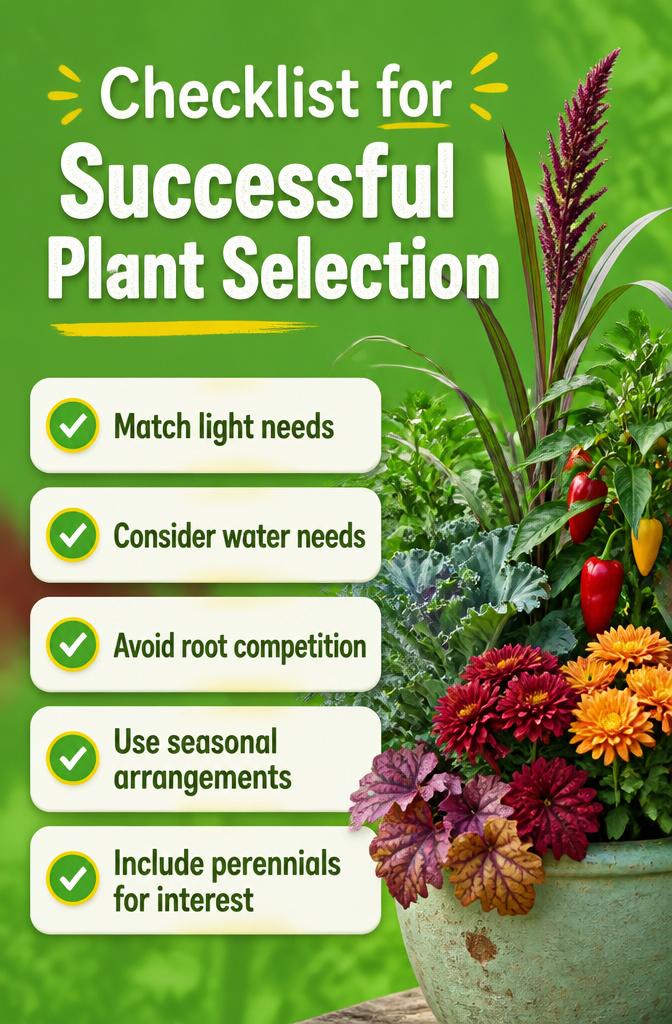
Matching plants by light and water needs saves more pots from failure than any design trick. A sun-hungry pepper and a shade-craving heuchera in the same container means one of them loses, and the root competition makes it worse.
I learned this the hard way with a mixed edible-ornamental pot that looked great in May. The purple pearl millet wanted full sun and moderate water. The kale tucked underneath it needed consistent moisture and started flagging by July while the millet stayed thirsty. Both survived, but neither thrived. Group plants by shared conditions first, then worry about color.
The combinations that worked followed that rule. A hot pepper with brassicas and ornamental millet, all sun lovers with similar water appetites, carried through to frost. Chrysanthemums in matching burgundy and rusty yellow joined late without upsetting the balance. Annuals, perennials, and edibles can share space fine when their care requirements align.
Heucheras are the exception I make for perennials in pots. Their caramel and purple foliage earns a spot even if the arrangement shifts seasonally. I either leave them in for fall interest or transplant them out when the annuals need refreshing. The trick is treating the pot as temporary housing for something that will eventually move to a garden bed, not as a permanent home.
Design Principles for Real Spaces

Balance on a stoop or small patio works differently than in a magazine spread. Two matching pots flanking a door feel formal and deliberate, and that symmetry helps when the architecture itself is plain. I tried this on a rental with a slab concrete step and zero trim, and the paired containers gave the entrance the only visual structure it had. But carry that same mirroring around a corner or down a narrow balcony, and it starts to look staged, like furniture shoved to the edges of a room.
Visual height matters more than symmetry once you step away from the door. A single tall container at the back of a grouping, or a plant on a cheap concrete block you already own, pulls the eye up and makes the space feel larger than it is. I learned that the hard way after lining pots in a neat low row along a fence and wondering why the whole thing read as a parking strip. A six-inch lift under one pot changes the sight line enough that the rest stop competing with each other.
Where strict symmetry actually hurt was a corner setup with two identical pots and two identical plants. The match looked stiff because nothing else in the scene matched; the brick was uneven, the railing was crooked, and the plants grew at different rates anyway. Asymmetry let me stagger heights and repeat one color instead of one form, which read as intentional without reading as rigid. The rule I use now: symmetry for the entry, asymmetry for the seating area, and never both in the same sight line if the space is under twelve feet across.
Frequently Asked Questions
What are the best plants for container gardening?
Choose plants that match your light conditions and won’t outgrow their pot. Annuals, herbs, dwarf shrubs, succulents, and ornamental grasses all work well. The most important rule is grouping plants with similar water and sun needs so nothing struggles while its neighbor thrives.
How often should I water container plants?
Most containers need daily watering in hot weather, especially small terracotta pots that dry fast. Glazed ceramic and plastic stretch that to every two or three days. Check the top inch of soil with your finger; if it’s dry, water thoroughly near the roots rather than over the foliage.
Do containers need drainage holes?
Yes, drainage holes are essential to prevent waterlogged roots. If a pot lacks them, drill holes in the bottom or nest a plastic nursery pot inside the decorative shell. Without an exit for water, roots drown regardless of how clever the container looks.