
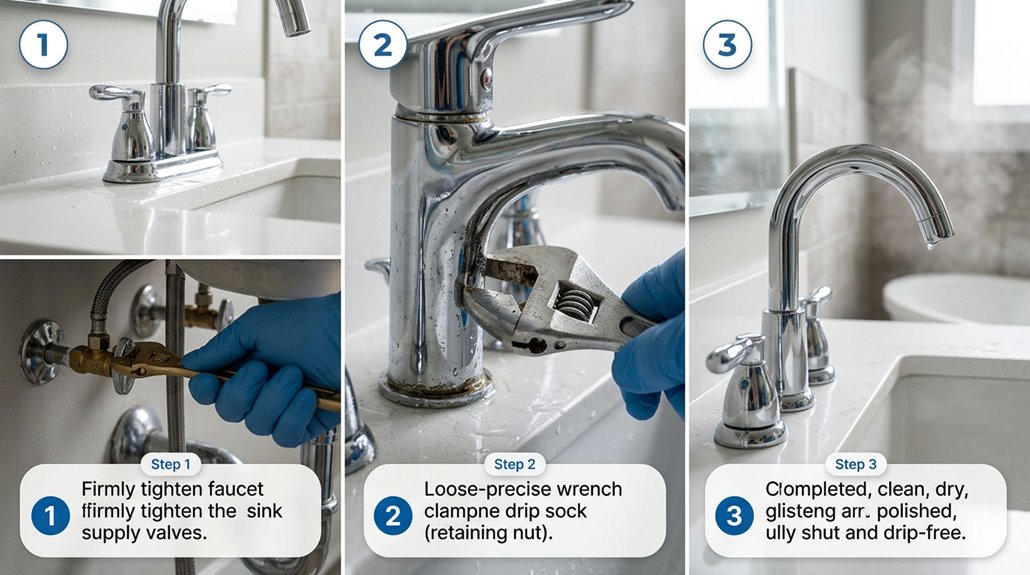
I’ll fix your leaking bathtub faucet in three steps. First, shut off the water supply by turning the valves clockwise beneath your tub, or flip the main switch if needed.
Next, disassemble the faucet handle and remove the packing nut to identify exactly where the leak is occurring.
Finally, replace the worn washer, cartridge, or O-ring with the exact matching part, apply plumber’s tape and silicone grease, then reassemble everything and slowly turn the water back on. Follow each step carefully to resolve the leak.
Turn Off the Water Supply
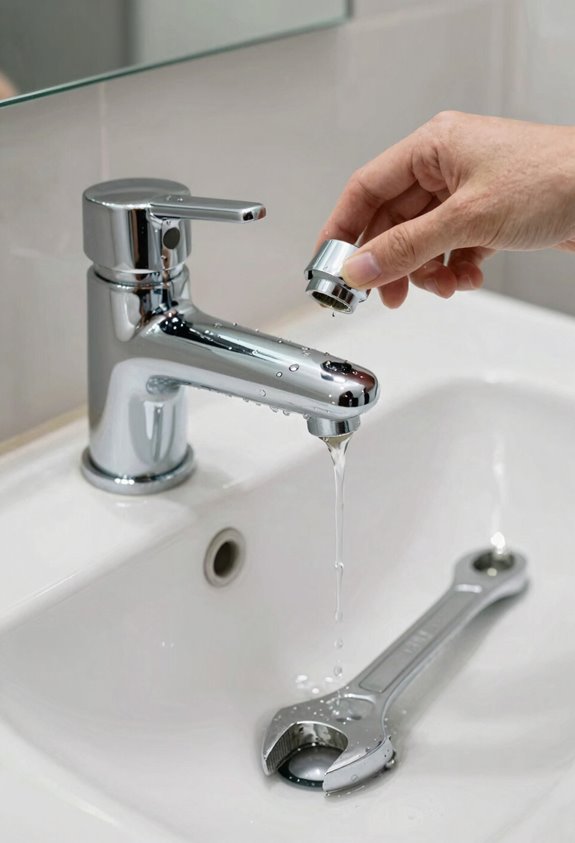
Before you plunge into fixing that leak, you need to shut off the water supply. This is the most important step you’ll take. First, locate the shutoff valves beneath your bathtub, then turn them clockwise until they’re completely closed. This stops water flow immediately and helps prevent leaks from getting worse. If you can’t find dedicated tub valves, shut off the main water supply instead and open the faucet to release pressure. Next, verify there’s zero flow by trying to run water. If nothing comes out, proceed with the repair. Keep towels nearby to catch any remaining water in the lines. Finally, label those valves so you remember exactly which ones to reopen later.

Universal Design: the tub spout diverter repair kit is designed for repairing most standard tub spouts, and features straight edges; Nice tub spout repair replacement parts for faucet bathtub spouts

Universal Design: This bathtub faucet repair kit (stem: 6cm/2.36in tall, cap: 1.7cm/0.66in wide) fits most standard tub spouts. Please verify dimensions (rubber seals: 1cm/0.62in ID, 0.5cm/0.19in thick; plastic parts: 3cm/1.18in wide)

Universal Design: the tub spout diverter repair kit is designed for repairing most standard tub spouts, and features straight edges; Nice tub spout repair replacement parts for bathtub spouts
Disassemble and Diagnose the Leak Source
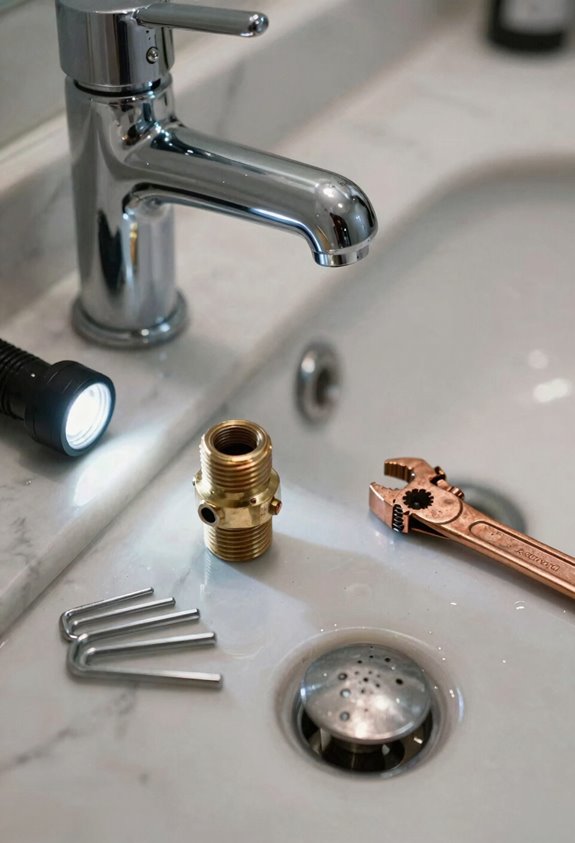
Disassemble your faucet to pinpoint the leak source—handle, cartridge, or threaded connections each reveal different problems requiring specific fixes.
Carefully disassemble your faucet handle and packing nut to expose the cartridge or stem underneath. You’ll immediately spot where water’s escaping. Is it leaking at the handle itself, around the cartridge, or behind the wall at those threaded connections? Each location indicates a different problem.
Check the valve seat for mineral buildup or damage. Look closely at washers and O-rings. These worn-out components cause most leaks in two-piece assemblies. If you’ve got a diverter valve, inspect it too, especially when leaks happen during showers.
Match replacement parts exactly to your faucet model and stem size.
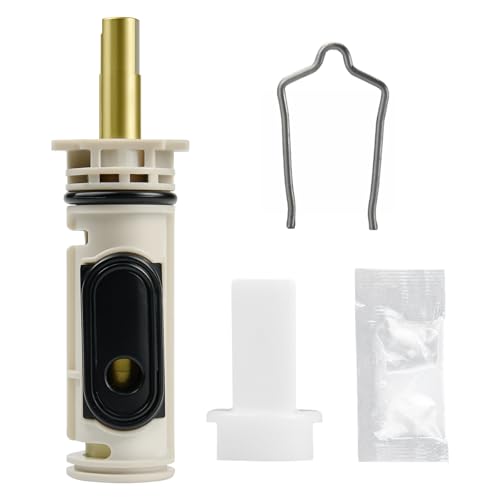
Premium Durability: High-density brass core components + engineering plastics, anti-rust and anti-corrosion design, high-pressure and high-temperature resistance, to extend service life

Compatibility –Our RP46074 cartridge assembly replacement for Monitor rough-in valves (R10000, R1100, R1800, R2200, etc.) and most single-handle 13/14 series tub/shower faucets Kit. (Excludes 1300/1400 series)

🚰 【Perfect Fit for American Standard 994053-0070a / 0070a/H】 This 2-pack faucet cartridge is precisely engineered to replace model 994053-0070a and 994053-0070a/H. Works seamlessly in bathroom sinks, kitchen faucets, and bathtub fixtures. No more guessing compatibility.
Replace the Damaged Component and Verify the Fix
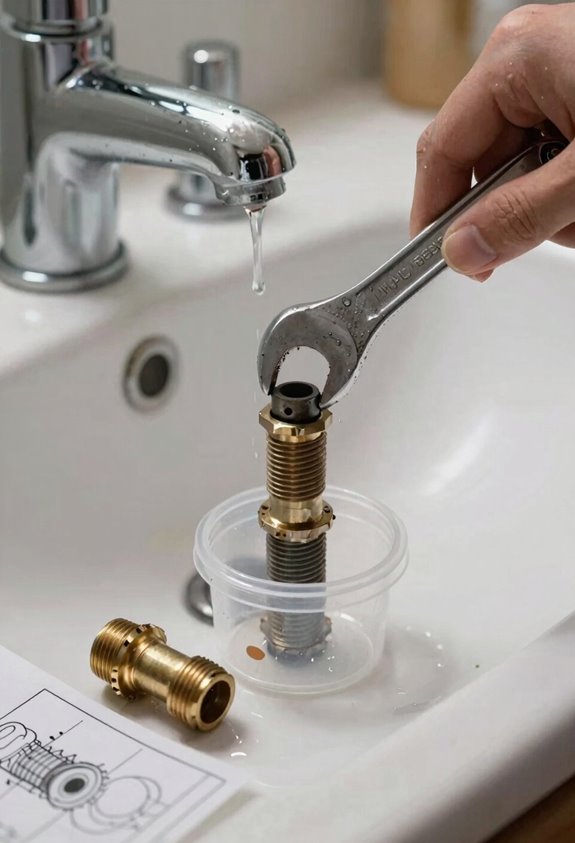
Once you’ve identified the problem, whether it’s a worn washer, damaged O-ring, or faulty cartridge, you’re ready to install a replacement part.
Here’s what you need to do:
- Get the right replacement – Match your part to your specific faucet model; compatibility is essential.
- Apply protective sealants – Wrap plumber’s tape around threaded connections and add silicone grease for a watertight seal.
- Test before reassembling – Verify the new component fits perfectly before putting everything back together.
Reassemble in reverse order: reinstall the cartridge, retaining nut, escutcheon, trim, and handle. Turn your water back on slowly and check carefully for any drips. The leaking faucet will be resolved with these steps completed.

Multiple sizes: 106 Pcs faucet washer kit with assorted different flat beveled common sizes: 3/8, 1/4L, 1/4, 1/4M 0, 1/4S 00. also comes with 6 non-corrosive brass screws to meet your various size repair replacement needs

Premium Material: These assorted o rings are made of outstanding rubber material with good air tightness and high temperature resistance, which are oil resistant, heat resistant, wear resistant and durable for long time use.

Seats, Springs & Quad Rings (2)